Herpetic Eye Disease Is Not a Single Event
-
By
-
Deborah Fisher
-
June 17, 2026
-
3 min
By
Deborah Fisher
June 17, 2026
Clinic expands cataract and medical retina expertise with appointment of consultant ophthalmic surgeon
July 13, 2026

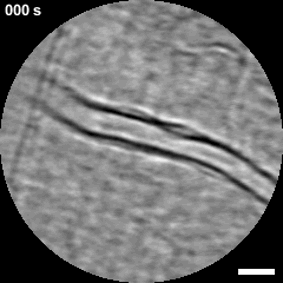
The movement of immune cells through the retinal vasculature has long been inferred from laboratory models. Now, advances in imaging are allowing clinicians to observe these processes directly. At the 2026 meeting of the Association for Research in Vision and Ophthalmology (ARVO) in Denver, Richard B. Rosen, MD, ScD(hon), FACS, FASRS, FARVO, described early clinical work using adaptive optics scanning laser ophthalmoscopy (AOSLO) to visualize leukocyte trafficking in vivo.
May 1, 2026