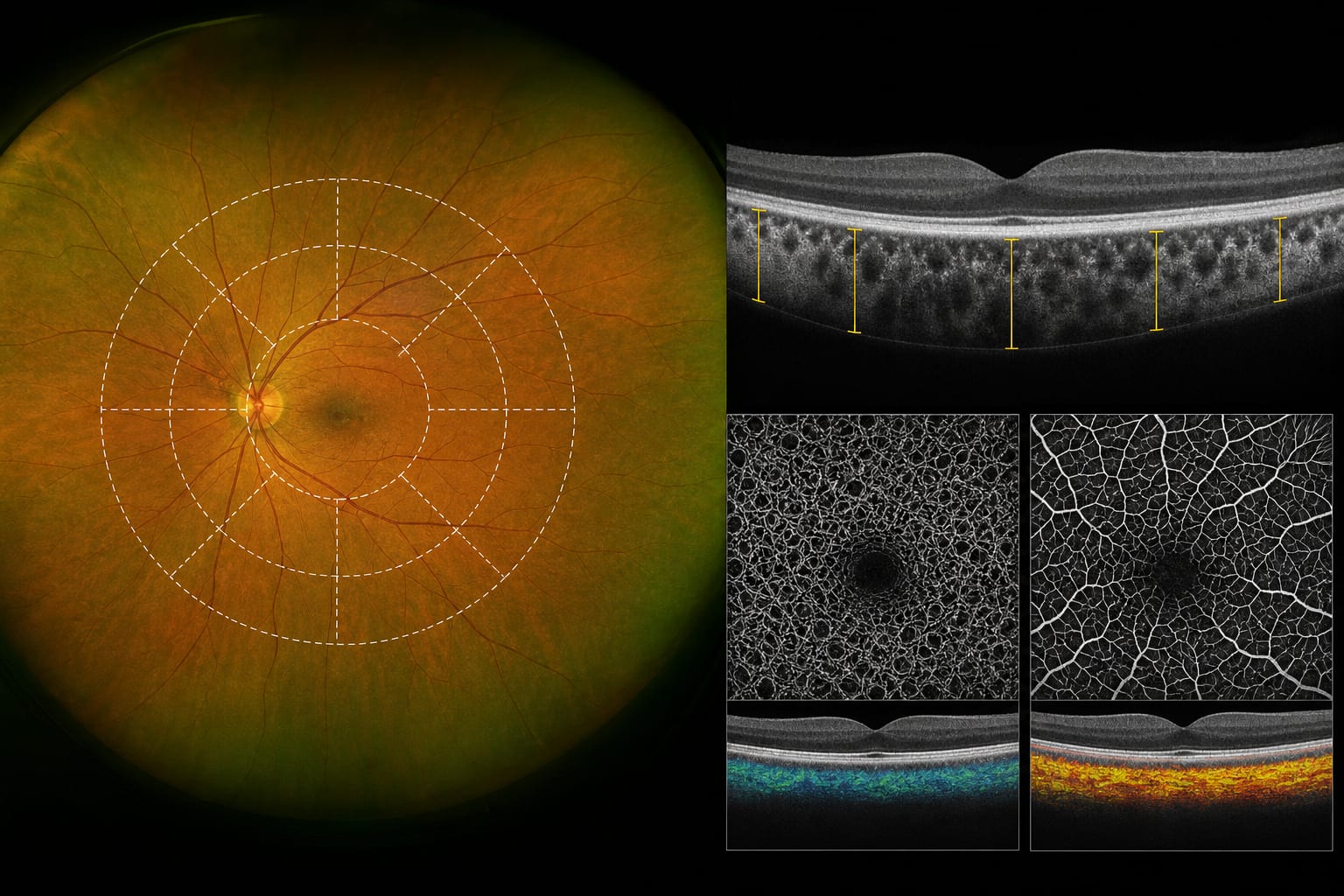
To characterize region-specific choroidal alterations in Chinese young adults with varying refractive errors using ultra-widefield SS-OCTA.
Approach:
Study Design: Cross-sectional study involving 218 eyes from 109 participants stratified by spherical equivalent into low, moderate, and high myopia.
Imaging Technique: Utilized ultra-widefield swept-source OCT angiography (UWF SS-OCTA) to assess choroidal thickness and vessel density.
Data Analysis: Quantified choroidal thickness (CT), choriocapillaris vessel density (CCVD), and Sattler-Haller layer vessel density (SHVD) across nine subfields.
Key Findings:
High myopia (HM) eyes showed significant reductions in choroidal thickness (CT) across all subfields and SHVD in six subfields.
CT was thickest centrally and thinnest inferonasally; CCVD was lowest centrally; SHVD peaked superotemporally.
CT correlated negatively with axial length (AL) in eight subfields and positively with spherical equivalent (SE) in seven.
SHVD correlated negatively with AL in seven subfields and positively with SE in six.
Interpretation:
Region-specific reductions in CT and SHVD occurred with increasing axial length, with preserved topographic patterns across myopia severities.
Limitations:
Study limited to a specific demographic (Chinese young adults), which may affect generalizability.
Cross-sectional design limits causal inferences.
Conclusion:
Both CT and SHVD showed significant negative correlations with axial length, indicating structural changes associated with myopia severity.