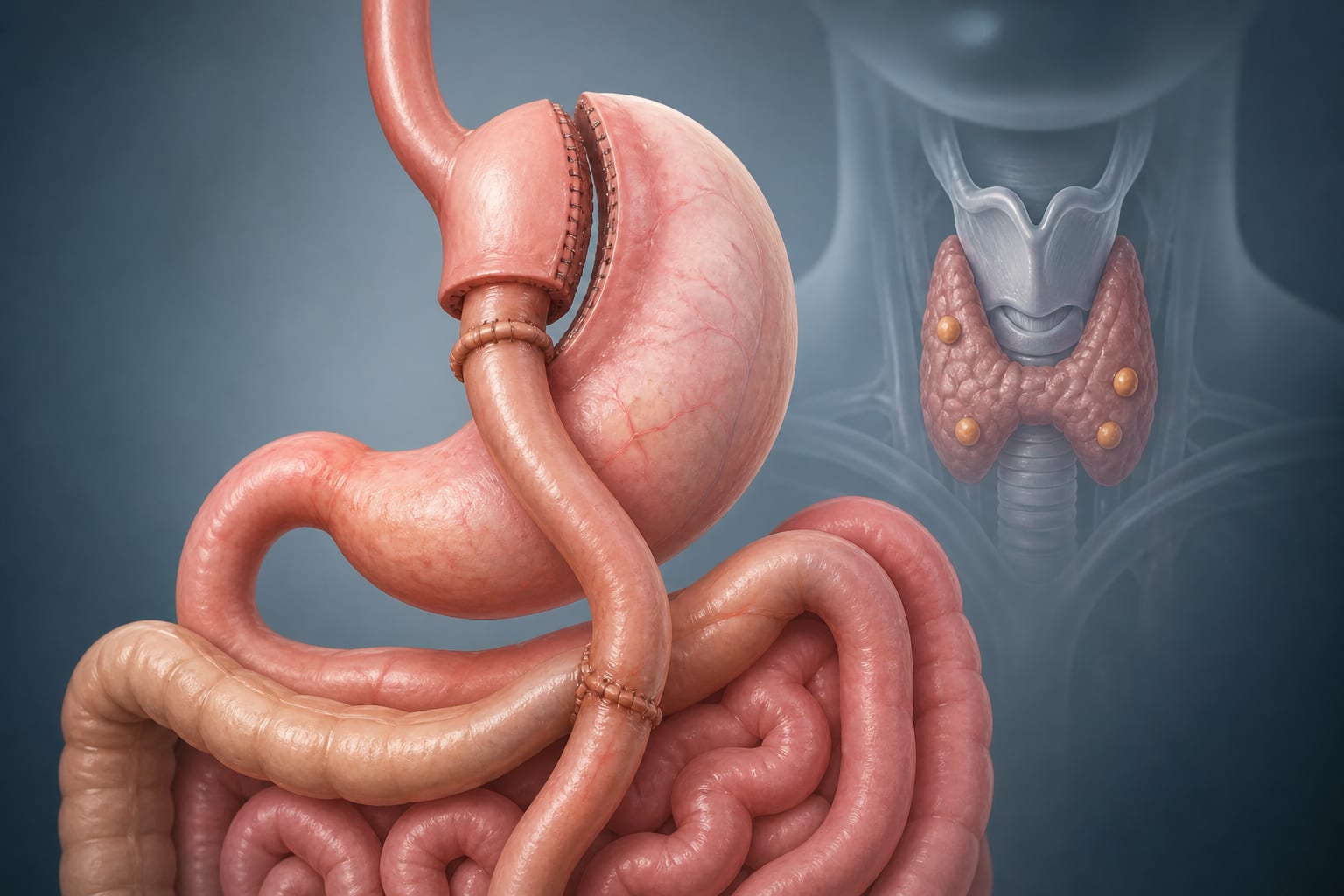
To review evidence on postoperative calcium dysregulation after total thyroidectomy in patients with prior Roux-en-Y gastric bypass (RYGB), and to present an RYGB-specific clinical framework.
Approach:
Search: The authors searched PubMed and Embase for studies of thyroidectomy in patients with RYGB, with no publication-date restriction.
Eligibility and synthesis: English-language reports of total, completion, or subtotal thyroidectomy were included; lobectomy and sleeve gastrectomy cases were excluded. Case reports, case series, and retrospective cohorts were summarized, with evidence levels assigned using Oxford CEBM …
Key Findings:
RYGB bypasses the duodenum and jejunum, principal sites of calcium absorption, and is associated with malabsorption of calcium and vitamin D.
The review describes a potential combined risk from RYGB-related malabsorption and transient hypoparathyroidism, a common complication after total thyroidectomy.
Available reports are sparse and largely focus on severe or refractory hypocalcemia; definitions of hypocalcemia varied across studies.
Patients in the included reports were predominantly female, and preoperative laboratory abnormalities consistent with reduced calcium and vitamin D absorption were frequently reported, sometimes without symptoms.
The largest individual study cited included 35 patients and found higher permanent, but not transient, hypocalcemia rates compared with controls.
Interpretation:
The authors report that evidence specific to RYGB is limited and that no established, standardized screening or management guidance addresses hypocalcemia around thyroidectomy in this population. They note that the 2026 American Thyroid Association Multidisciplinary Consensus Statement on Ambulatory Thyroid Surgery identifies this population as high risk.
Limitations:
The evidence base consists mainly of case reports and small case series, with some retrospective cohorts.
Studies used differing definitions of hypocalcemia, and no universal cutoff was prespecified.
Reports often emphasize severe or refractory cases and provide limited direction for routine postoperative care.
The supplied article context ends during the preoperative considerations section, so later review findings are not available here.
Harold Burstein, MD, PhD, and Laura S. Dominici, MD, FACS, discuss highlights from the SENOMAC trial which sheds light on whether some patients with early breast cancer and limited lymph node involvement can safely avoid additional axillary surgery.
Roxana Moayer, MD, is a plastic and reconstructive surgeon with Keck Medicine of USC who specializes in facial surgery and treatment of facial nerve disorders.