Common and rare variants in complement genes as biomarkers of COVID-19 infection and severity. A lesson to learn for emerging pathogens - Summary - MDSpire

Common and rare variants in complement genes as biomarkers of COVID-19 infection and severity. A lesson to learn for emerging pathogens

  • By

  • María Eugenia De La Morena-Barrio

  • Ana Van Den Rym

  • Olga Escorial Sanz

  • Fernando Corvillo

  • Rosario García-Sánchez

  • Laura González-Sánchez

  • Adrián Muñoz-Barrera

  • Rafaela González-Montelongo

  • José Miguel Lorenzo-Salazar

  • Carlos Flores

  • Ana de Andrés-Martín

  • Carlos Rodríguez-Gallego

  • Luis Allende

  • Laia Alsina

  • Silvia Sánchez-Ramón

  • Eduardo López-Collazo

  • Margarita López-Trascasa

  • Pilar Sánchez-Corral

  • Rebeca Pérez de Diego

  • Javier Corral de la Calle

  • Alberto López-Lera

  • June 11, 2026

  • 0 min

Share

Objective:

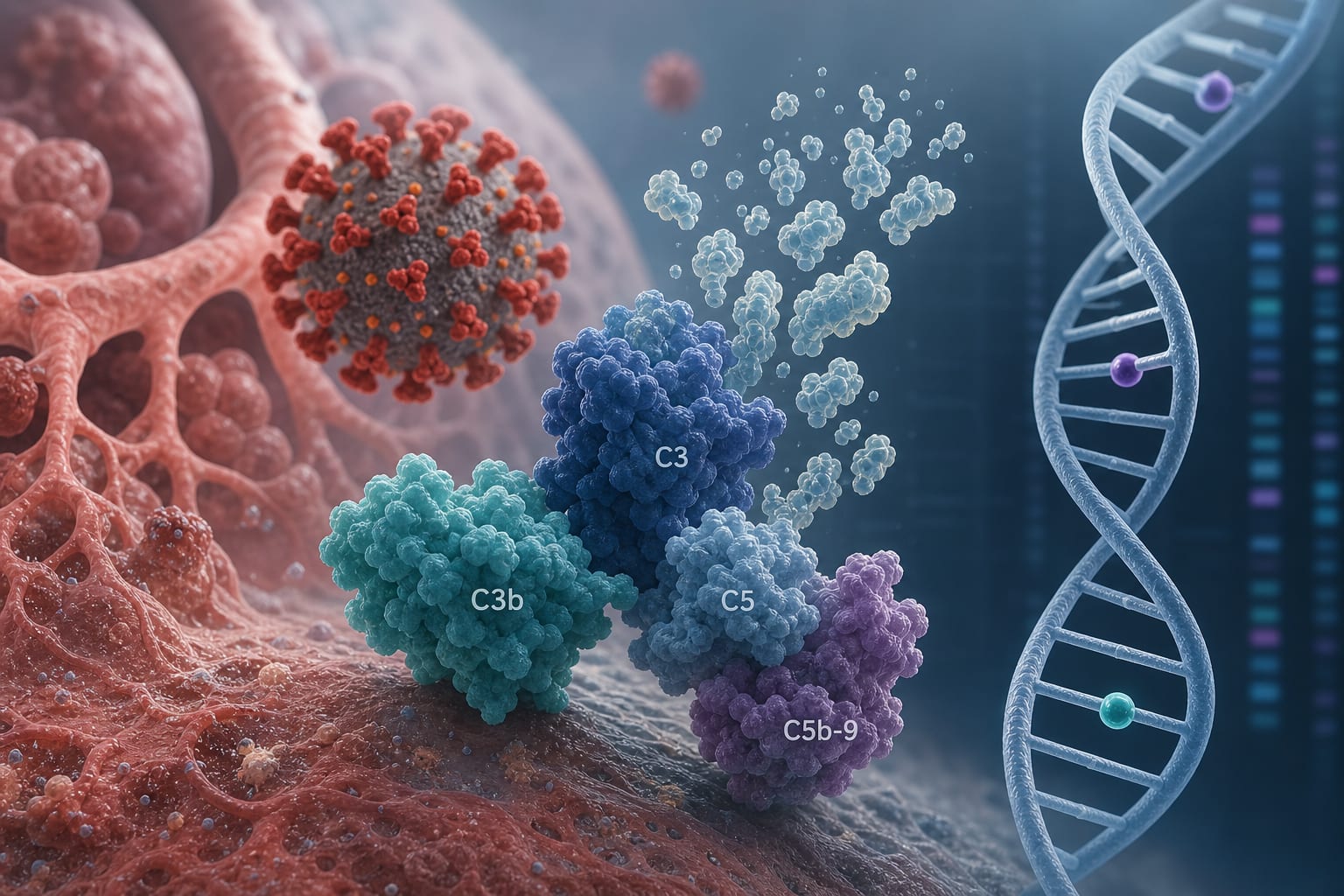
To analyze the association of genetic variants in complement pathway genes with susceptibility to severe COVID-19 and its clinical complications, including ARDS and other related conditions.

Approach:
    Key Findings:
    • CFHR4 rs7417769 and CFH rs1061170 polymorphisms are associated with protection against ARDS, suggesting potential therapeutic targets.
    • C3 rs2230199 and MASP2 rs7255087 polymorphisms correlate with low and high C3 levels, respectively, indicating their role in disease severity.
    • Over-representation of C1R rs117402032 and C8A rs143523574 polymorphisms suggests a link between defective complement activation and increased SARS-CoV-2 infection rates, highlighting the need for further research.
    Interpretation:

    Common variants in complement genes modulate susceptibility to severe COVID-19 and its complications, indicating potential genetic biomarkers for future infectious threats.

    Limitations:
    • Study focused on a specific cohort from Spain, which may limit generalizability to other populations and ethnicities.
    • Analysis based on whole-exome sequencing may not capture all relevant genetic variations, potentially overlooking other significant factors.
    Conclusion:

    The study identifies genetic variants that could serve as biomarkers for susceptibility to severe COVID-19 and highlights the critical role of the complement system in the disease's pathogenesis, suggesting avenues for future research and therapeutic strategies.

Original Source(s)

Related Content