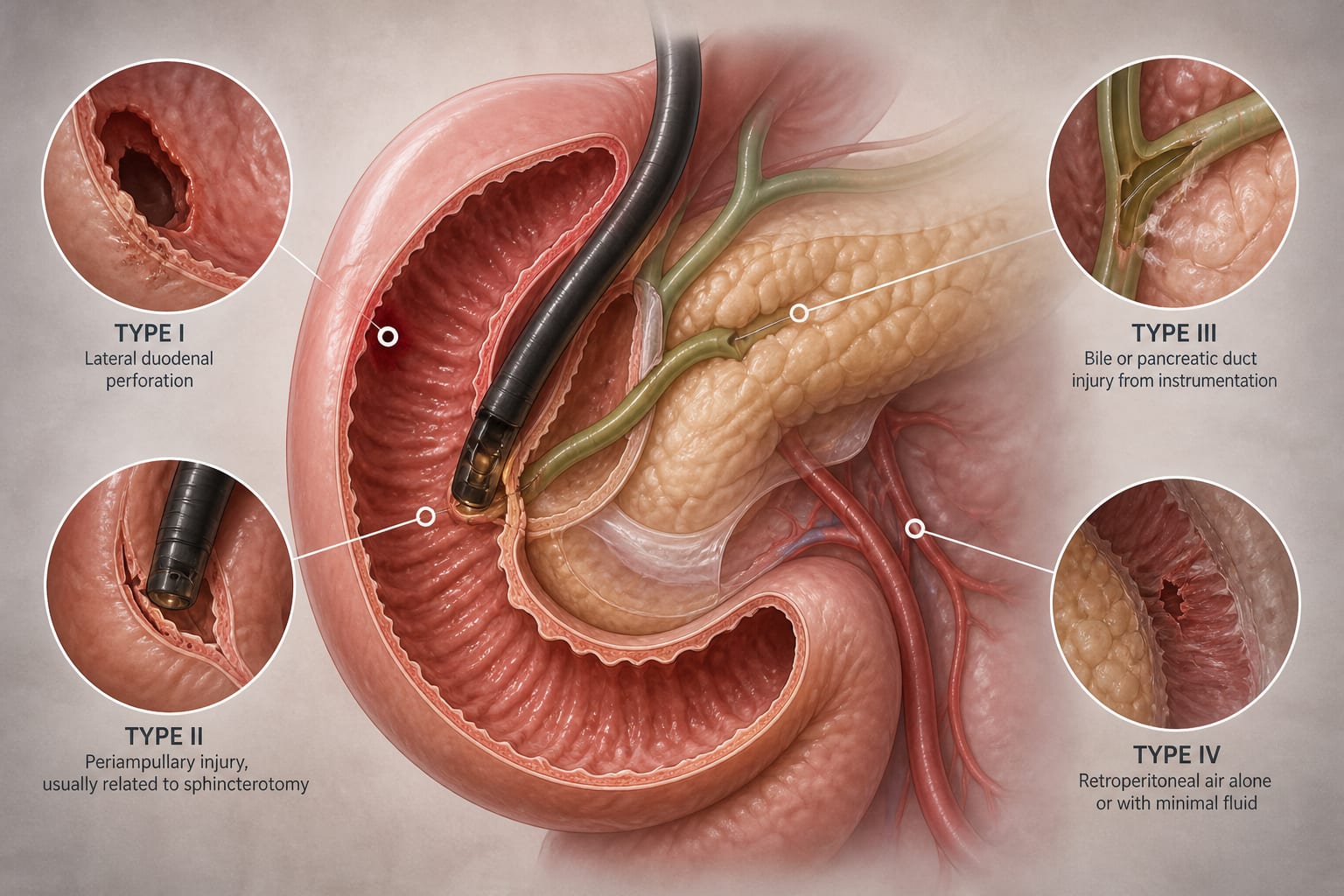
Initial non-surgical versus upfront surgical management of ERCP-related perforations by Stapfer type: a systematic review and meta-analysis - Summary - MDSpire
To compare outcomes by initial management strategy for ERCP-related perforations, stratified by Stapfer type, and to describe contemporary non-surgical interventions, rescue surgery, and factors associated with failure.
Approach:
Design: Systematic review and meta-analysis conducted according to PRISMA 2020 and prospectively registered in PROSPERO (CRD420251152632).
Search and eligibility: MEDLINE, EMBASE, Scopus, and Web of Science were searched from inception through June 30, 2026. Eligible adult studies included at least six ERCP-related perforations and reported management and outcomes.
Strategy classification: Patients were classified by the first definitive strategy after perforation identification. Patients initially managed non-surgically who later required surgery remained in that group and were counted as initial-strategy failures.
Outcomes: The primary outcome was success of initial management, defined as discharge alive without rescue surgery after initial non-surgical care, or discharge alive after upfront surgery. Mortality and hospital length of stay were secondary outcomes.
Key Findings:
The supplied context describes the review rationale and methods but provides no pooled results or quantitative findings.
For Stapfer Types III–IV, surgical comparator data were too sparse for meaningful estimates of relative effects; outcomes were reported descriptively.
Interpretation:
The review was designed to compare initial treatment strategies while accounting for Stapfer subtype and treating later rescue surgery as failure of the initial non-surgical strategy.
Limitations:
The available context does not include study counts, pooled estimates, or detailed results.
The evidence base was described as predominantly small retrospective series, with clinical heterogeneity and limited representation of contemporary endoscopic techniques.