Machine learning integration of routine inflammatory biomarkers for predicting remote punctate ischemic lesions following intracerebral hemorrhage: a single-center retrospective study - Summary - MDSpire
Advertisement
Machine learning integration of routine inflammatory biomarkers for predicting remote punctate ischemic lesions following intracerebral hemorrhage: a single-center retrospective study
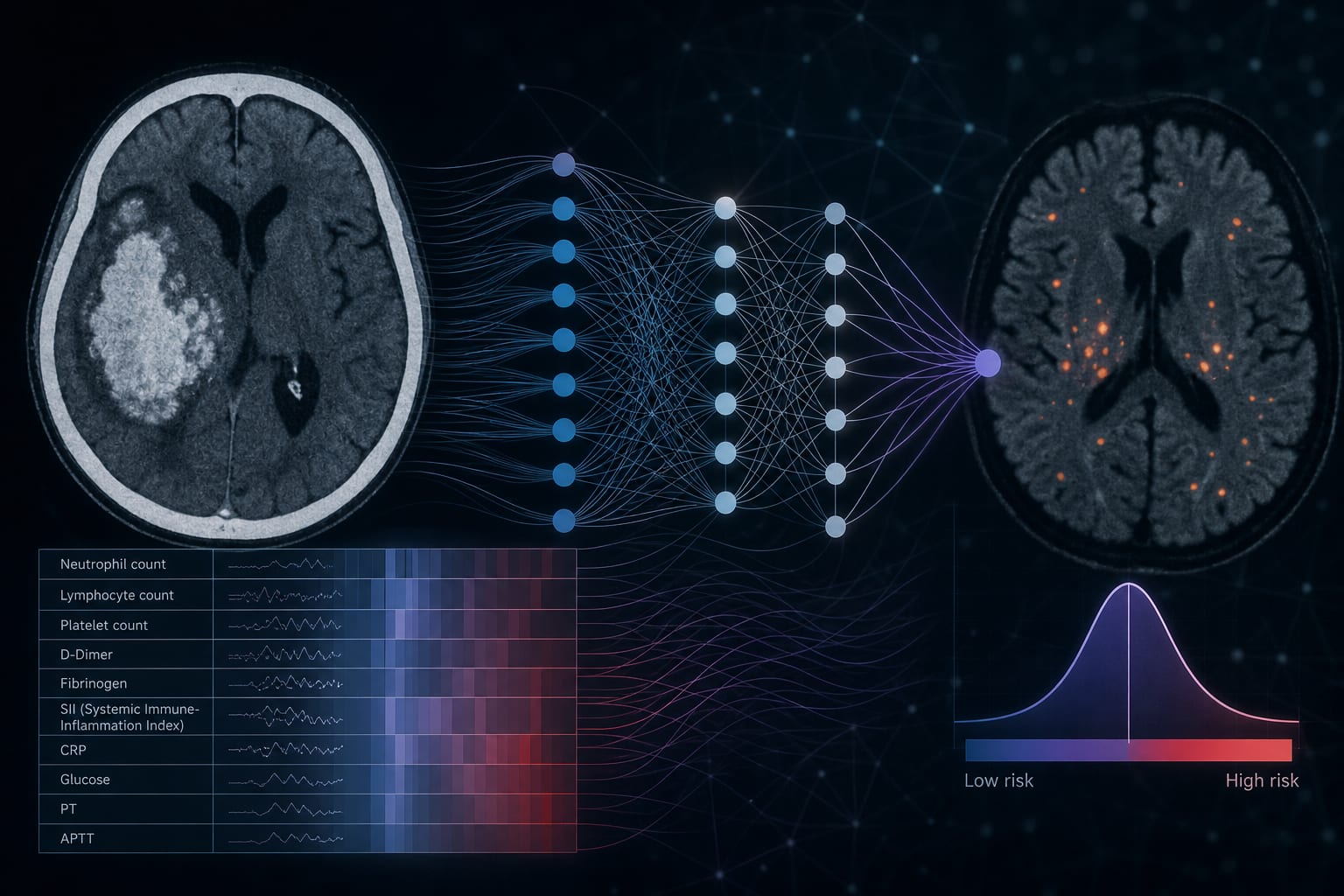
To investigate the predictive value of routine laboratory biomarkers, including the Systemic Immune-Inflammation Index (SII), for post-ICH Remote Punctate Ischemic Lesions (RPIL) and to benchmark various machine learning algorithms for optimal predictive modeling.
Approach:
Study Design: Retrospective cohort study analyzing data from 12,327 patients with ICH, with 6,134 included after exclusions. The dataset was randomly split into training (n = 4,294) and validation (n = 1,840) sets.
Feature Selection: LASSO regression identified six key predictors: Age, History of Diabetes, SII, D-Dimer, Glucose, and Fibrinogen.
Machine Learning Benchmarking: Fifteen ML algorithms were benchmarked, with XGBoost achieving the highest discrimination (AUC = 0.799), outperforming Neural Network (AUC = 0.798) and Logistic Regression (AUC = 0.770).
Model Interpretability: Feature importance analysis and a clinical nomogram were developed for risk stratification, demonstrating excellent calibration (Mean Absolute Error = 0.034) and clinical net benefit.
Key Findings:
XGBoost model outperformed other algorithms in predicting RPIL, achieving an AUC of 0.799.
Key predictors included systemic inflammation and hypercoagulability markers.
The derived nomogram showed excellent calibration and clinical net benefit in Decision Curve Analysis.
Interpretation:
The study presents findings on the predictive value of systemic inflammation and hypercoagulability markers for post-ICH ischemia, with the XGBoost model providing a precise predictive tool.
Limitations:
The study is based on single-center data, which may limit the generalizability of the findings.
The retrospective nature of the study may introduce biases in data collection and outcome assessment.
Conclusion:
Future multicenter external validation is necessary to confirm the generalizability and clinical applicability of the predictive models developed.