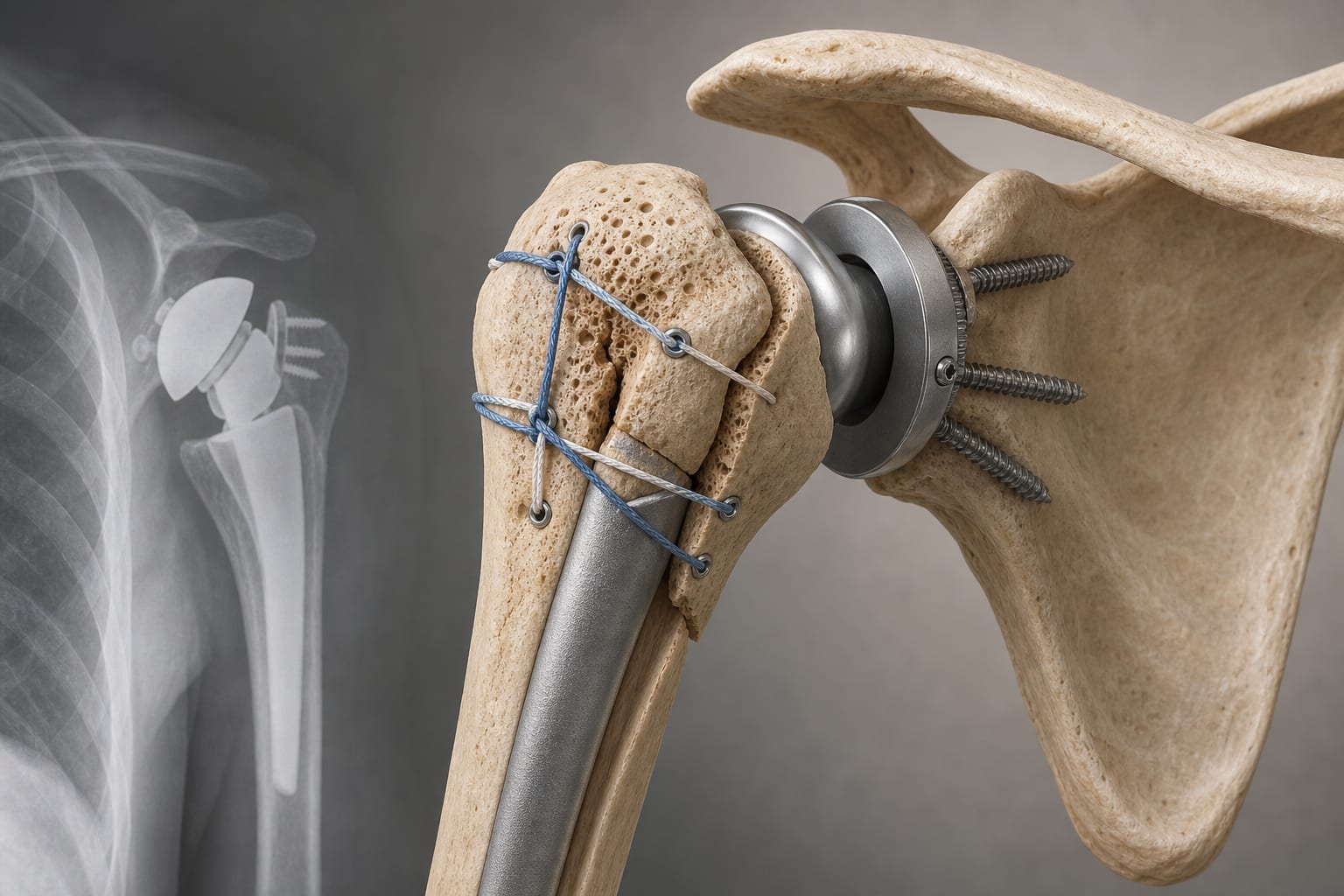
To evaluate clinical and patient-reported outcomes and radiologic greater tuberosity healing following a simplified refixation technique in reverse shoulder arthroplasty for proximal humerus fractures.
Approach:
Study Design: A two-year prospective cohort study conducted at two Swiss hospitals, including patients treated with reverse shoulder arthroplasty using the Global Unite Fracture Reverse System.
Inclusion Criteria: Patients with acute displaced or dislocated two-, three-, and four-part fractures, and those with failed conservative treatment.
Exclusion Criteria: Fractures older than six weeks, prior unsuccessful ORIF, failed hemiarthroplasty, and use of prosthetic systems other than the specified one.
Operative Technique: Standardized procedure using a two-suture construct for greater tuberosity refixation, preserving rotator cuff tissue when possible.
Key Findings:
Greater tuberosity healing is crucial for optimal outcomes in reverse shoulder arthroplasty.
The simplified two-suture technique may facilitate better biological conditions for tuberosity ingrowth.
Anatomical refixation is associated with improved range of motion and lower complication rates.
Interpretation:
The study suggests that a simplified refixation technique may be effective in promoting greater tuberosity healing and improving clinical outcomes in reverse shoulder arthroplasty.
Limitations:
The study was limited to a specific cohort and may not be generalizable to all patients with proximal humerus fractures.
Potential confounding factors related to humeral stem fixation were considered but not fully controlled.
Conclusion:
The study evaluated a simplified refixation technique using the Global Unite Fracture Reverse System for proximal humerus fractures.
As osteoporosis treatment continues to evolve, clinicians are moving beyond bone mineral density scores alone and placing greater emphasis on fracture risk when making therapeutic decisions