To explore the role of N-Myc and STAT interactor (NMI) as a regulatory node in innate antiviral immunity and its context-dependent effects.
Approach:
Contextual Analysis: The review analyzes NMI's interactions and effects across different viral infections, highlighting its dual role in suppressing or enhancing antiviral responses.
Key Findings:
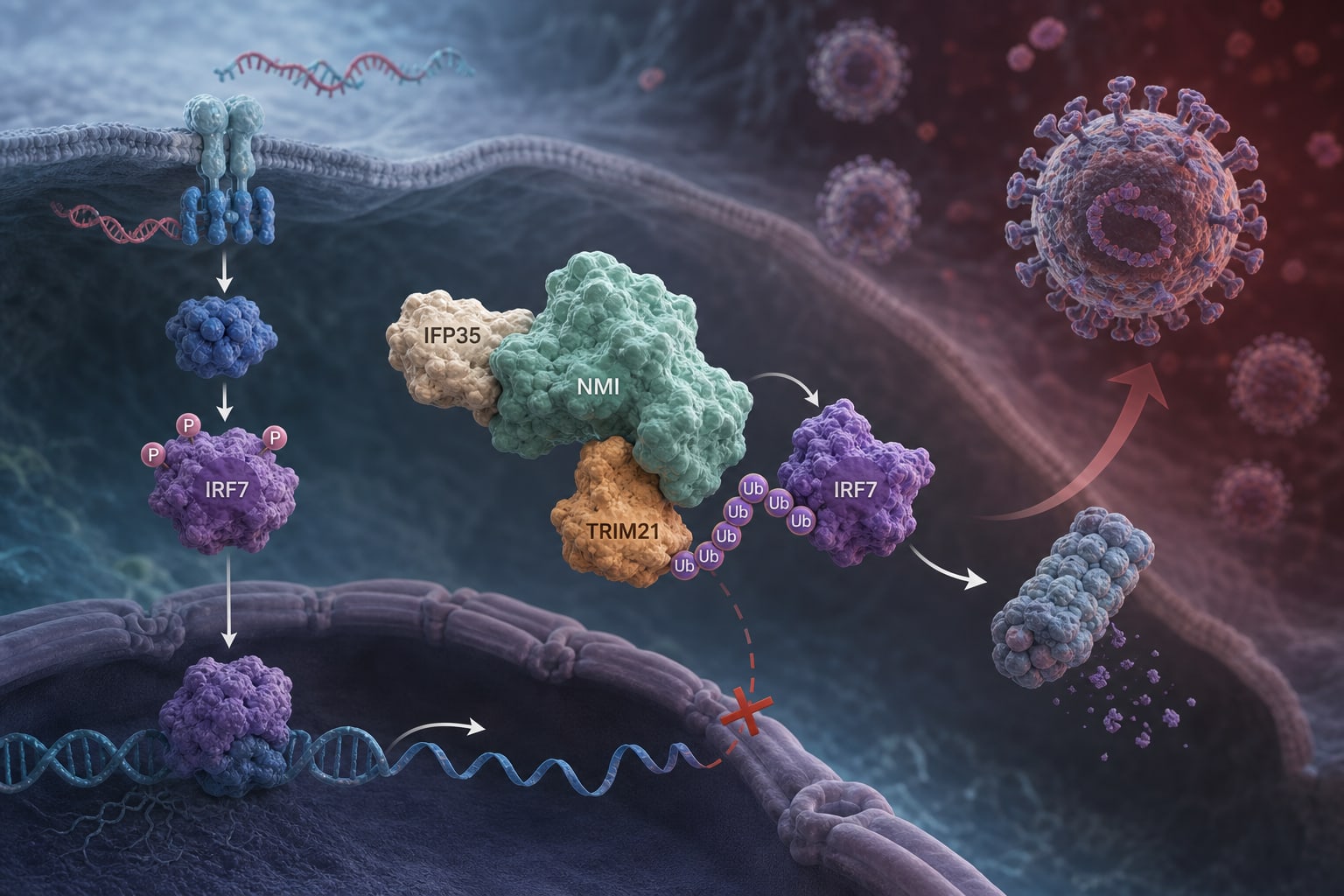
NMI does not exert a fixed antiviral or proviral effect; its function is context-dependent.
In acute RNA virus models, NMI suppresses IRF7-dependent type I interferon signaling, facilitating viral replication through an NMI–IFP35 complex that promotes IRF7 degradation.
In foamy virus infection, NMI acts as a host restriction factor by suppressing viral transcription through direct binding to the viral transactivator Tas.
During HCMV infection, NMI is targeted by the viral protein UL23, which dampens antiviral gene expression by interfering with the NMI–STAT1/IFN-γ axis.
Extracellular NMI and IFP35 can amplify inflammation as damage-associated molecular patterns, activating TLR4-NF-κB signaling.
Interpretation:
NMI functions as a context-dependent molecular switch in antiviral immunity, influenced by its interactions, signaling pathways, and localization.
Limitations:
The review is based exclusively on published studies, which may not encompass all aspects of NMI's functionality.
The exact mechanisms of NMI's functional switching and its interaction with various partners remain unresolved.
Conclusion:
NMI's role in antiviral immunity is complex and varies significantly depending on the viral context and cellular environment.