A hybrid ViT-L/32–MaxViT-L architecture with adaptive gated fusion for multiclass gastrointestinal disease detection and multi-method post-hoc explainability - Summary - MDSpire
Advertisement
A hybrid ViT-L/32–MaxViT-L architecture with adaptive gated fusion for multiclass gastrointestinal disease detection and multi-method post-hoc explainability
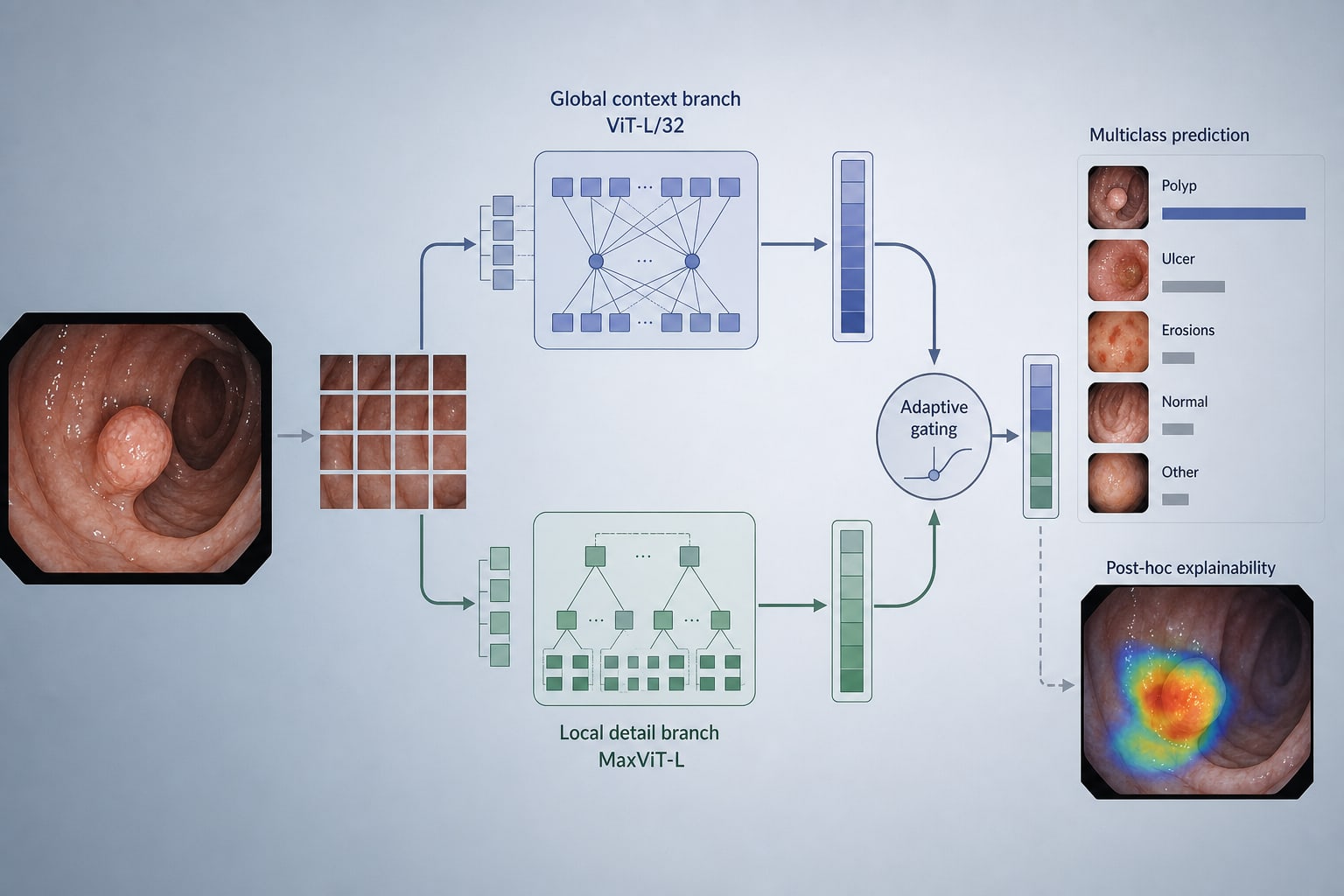
To design a dual-stream transformer architecture integrating ViT-L/32 and MaxViT-L for capturing long-range contextual dependencies and fine-grained mucosal structures, and to develop an adaptive gated fusion mechanism for balancing global and local feature representations.
Approach:
Model Framework: A dual-branch hybrid transformer framework integrating global token-level reasoning from ViT-L/32 with hierarchical spatial modeling from MaxViT-L.
Adaptive Gated Fusion: An adaptive gated fusion mechanism regulates the contribution of local and global representations on a per-sample basis.
Evaluation: The model was evaluated on a multi-class gastrointestinal endoscopic dataset using quantitative metrics, class-wise analysis, ablation studies, confidence interval estimation, and statistical validation.
Explainability: Post-hoc explainability was investigated using multiple complementary XAI techniques.
Key Findings:
The proposed framework achieved high accuracy, sensitivity, specificity, and area under the ROC curve across eight gastrointestinal disease categories.
It outperformed several state-of-the-art transformer and hybrid architectures.