Associations of CMR-based pulse wave velocity and aortic distensibility with infrarenal ultrasound-based aortic parameters in the Hamburg City Health Study - Summary - MDSpire
Coming Soon: Introducing MDSpire News. Learn more
Conexiant’s news site is now MDSpire News. Learn more

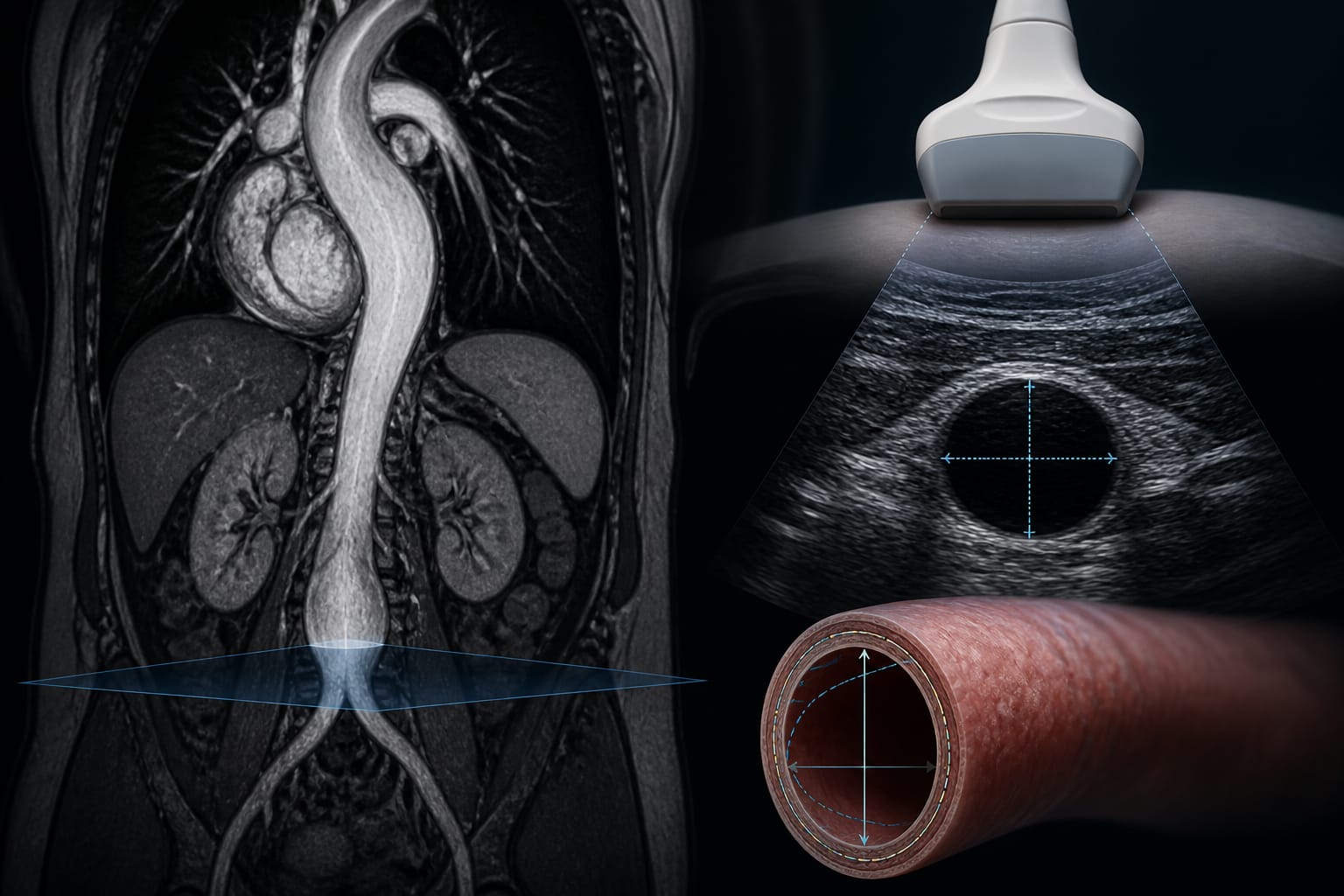
Relationships Between CMR-Derived Pulse Wave Velocity and Aortic Distensibility with Infrarenal Ultrasound Measurements of Aortic Parameters in the Hamburg City Health Study

  • By

  • Katharina Alina Riedl

  • Eleonora Di Carluccio

  • Gunnar Lund

  • Markus Huellebrand

  • Anja Hennemuth

  • Rickmer Braren

  • Paulus Kirchhof

  • Stefan Blankenberg

  • Lisa Tilemann

  • Andreas Ziegler

  • Christian- Alexander Behrendt

  • Kai Muellerleile

  • Tilo Kölbel

  • September 21, 2026

Share

Objective:

To identify associations between CMR-derived aortic stiffness parameters and infrarenal aortic measurements.

Approach:
  • Study Design: A subgroup analysis of the Hamburg City Health Study (HCHS) involving 2,093 participants who underwent both CMR-based aortic stiffness assessment and ultrasound examination.
  • CMR Protocols: CMR examinations were conducted using a 3 T MRI system to quantify pulse wave velocity (PWV) and aortic distensibility (AD).
  • Ultrasound Assessment: Ultrasound was used to measure maximum infrarenal aortic diameter and peak flow velocity.
Key Findings:
  • CMR-derived PWV and AD were assessed in relation to maximum infrarenal aortic diameter and peak flow velocity.
Limitations:
  • The study is limited to a single-center population and may not be generalizable.
  • The analysis is based on cross-sectional data, limiting causal inferences.
Sources:

Original Source(s)

Related Content