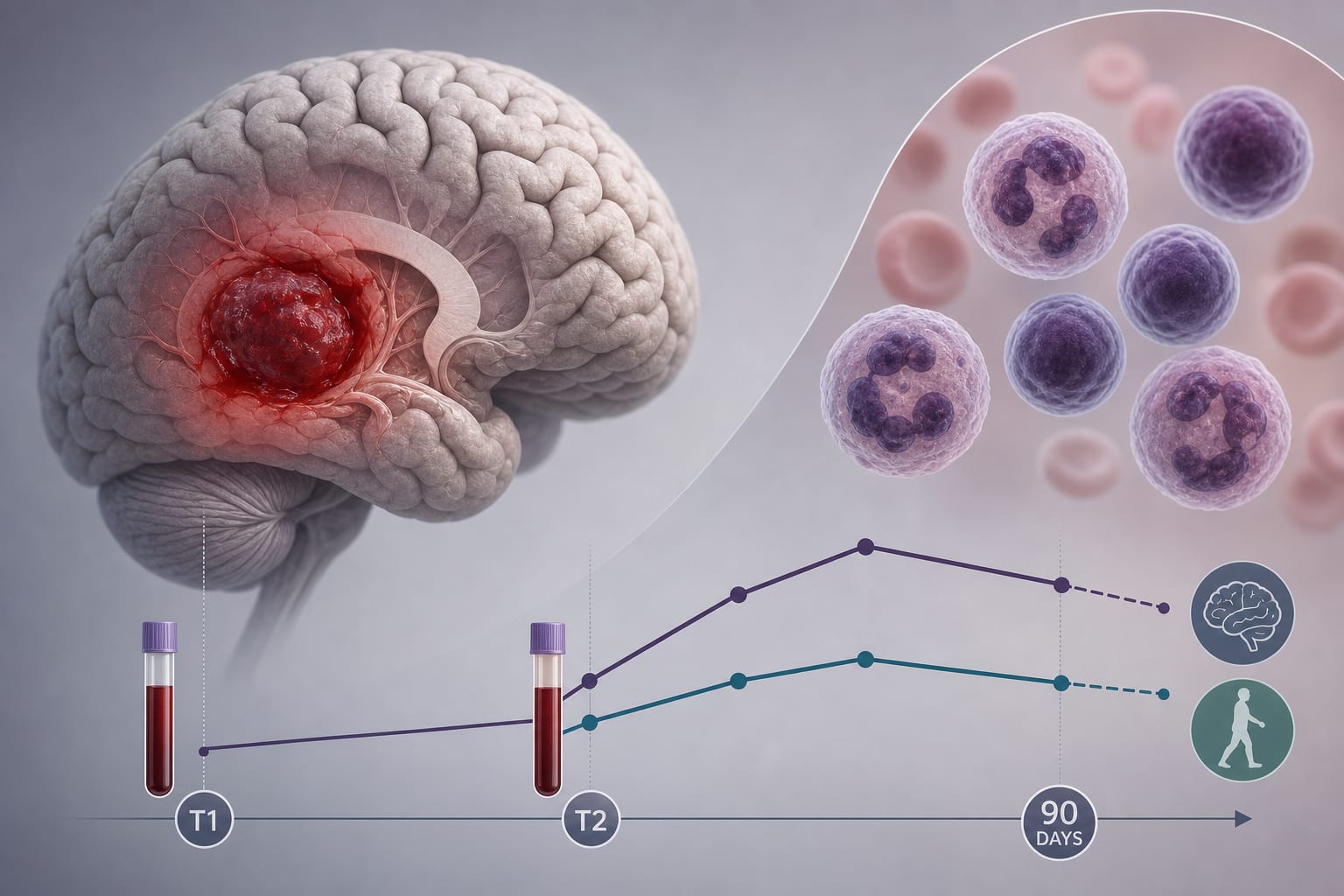
To investigate the time-dependent characteristics of composite inflammatory biomarkers in patients with spontaneous intracerebral hemorrhage (ICH) and evaluate their associations with 90-day functional outcomes and mortality, highlighting the potential impact on clinical management.
Key Findings:
Levels of NLR, SII, SIRI, and IPI at T2 were higher in patients with unfavorable outcomes and non-survivors, indicating a potential target for intervention.
Dynamic changes from T1 to T2 were more pronounced in patients with unfavorable outcomes and non-survivors, suggesting the need for ongoing monitoring.
T2 levels and dynamic change indicators were significantly associated with 90-day unfavorable functional outcomes, emphasizing their prognostic value.
T2 indices showed more consistent independent associations with mortality than T1 indices, reinforcing the importance of timely assessment.
Interpretation:
Composite inflammatory biomarkers in patients with spontaneous ICH exhibit a time-dependent pattern in prognostic evaluation, with day-7 levels and their dynamic changes showing stable associations with 90-day outcomes, which may guide clinical decision-making.
Limitations:
Single-center study may limit generalizability; future multi-center studies are needed.
Retrospective design may introduce bias; prospective studies could validate these findings.
Conclusion:
Day-7 inflammatory levels and their dynamic changes provide useful complementary information for clinical risk stratification in ICH patients, warranting further investigation into their role in treatment strategies.