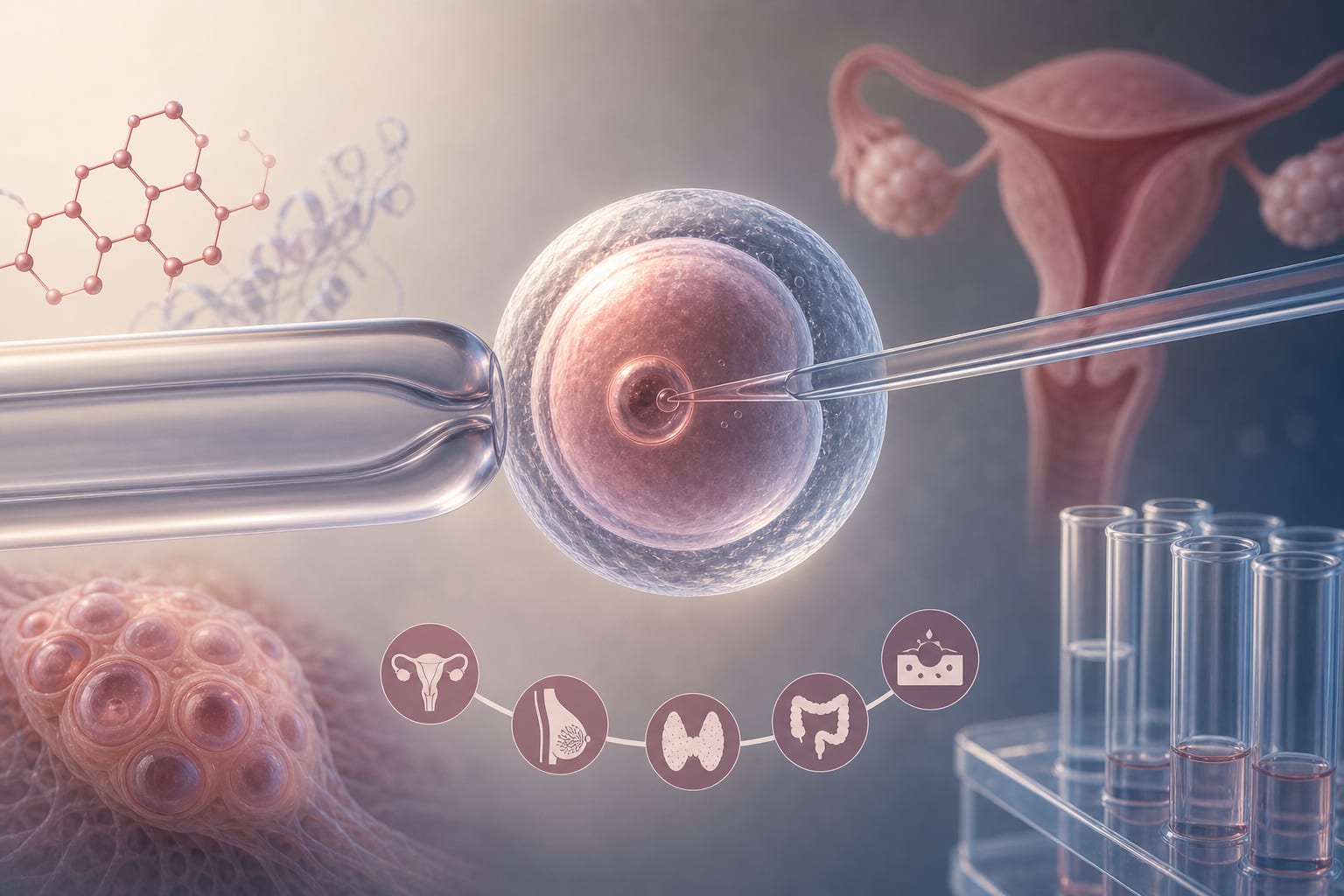
To analyze the association between medically assisted reproduction (MAR) treatments and hormone-related cancers using an emulated target trial framework.
Approach:
Study Design: A retrospective emulated target trial design was used, linking Australian state and national data to identify women who received MAR between January 1, 1991 and December 31, 2018.
Data Collection: Women were identified through records of MAR treatment reimbursement from the Medicare Benefits Scheme and matched with non-exposed individuals based on various factors.
Bias Assessment: The study included bias assessment through E-values, negative controls, and evaluation of time-varying treatment effects.
Key Findings:
Recent meta-analyses suggest few to no associations of ART with hormone-related cancer risk in female patients.
Substantial variability in study designs and confounder adjustments contributes to heterogeneous results.
Specific studies reported associations between ART and increased risks for certain cancers, including breast, ovarian, and uterine cancers, with notable findings from Vassard et al. on invasive breast cancer and Lundberg et al. on ovarian cancer risk.
Interpretation:
Strong evidence linking MAR treatments to hormone-related cancers is limited, and findings vary significantly across studies.
Limitations:
The rarity of some cancers and long latency periods complicate the assessment of cancer risk.
Heterogeneity in study designs and confounding variables affects the reliability of results.
An error in data extraction led to an imbalance in the number of nulliparous women in the study groups.
Conclusion:
The study concludes that while there are some associations reported between MAR treatments and hormone-related cancers, the overall evidence remains inconclusive. The variability in study designs and the presence of confounding factors necessitate cautious interpretation of the findings, highlighting the need for further research to clarify the relationship between MAR and cancer risk. Understanding these risks is critical for patients and healthcare practitioners.
by Adrian Raymond Walker, Christos Venetis, Signe Opdahl, Antoinette C. Anazodo, Neville F. Hacker, Michael Chapman, Louisa Jorm, Robert J. Norman, Catharyn Stern, Ursula M. Sansom-Daly, Georgina Mary Chambers, Claire Melissa Vajdic