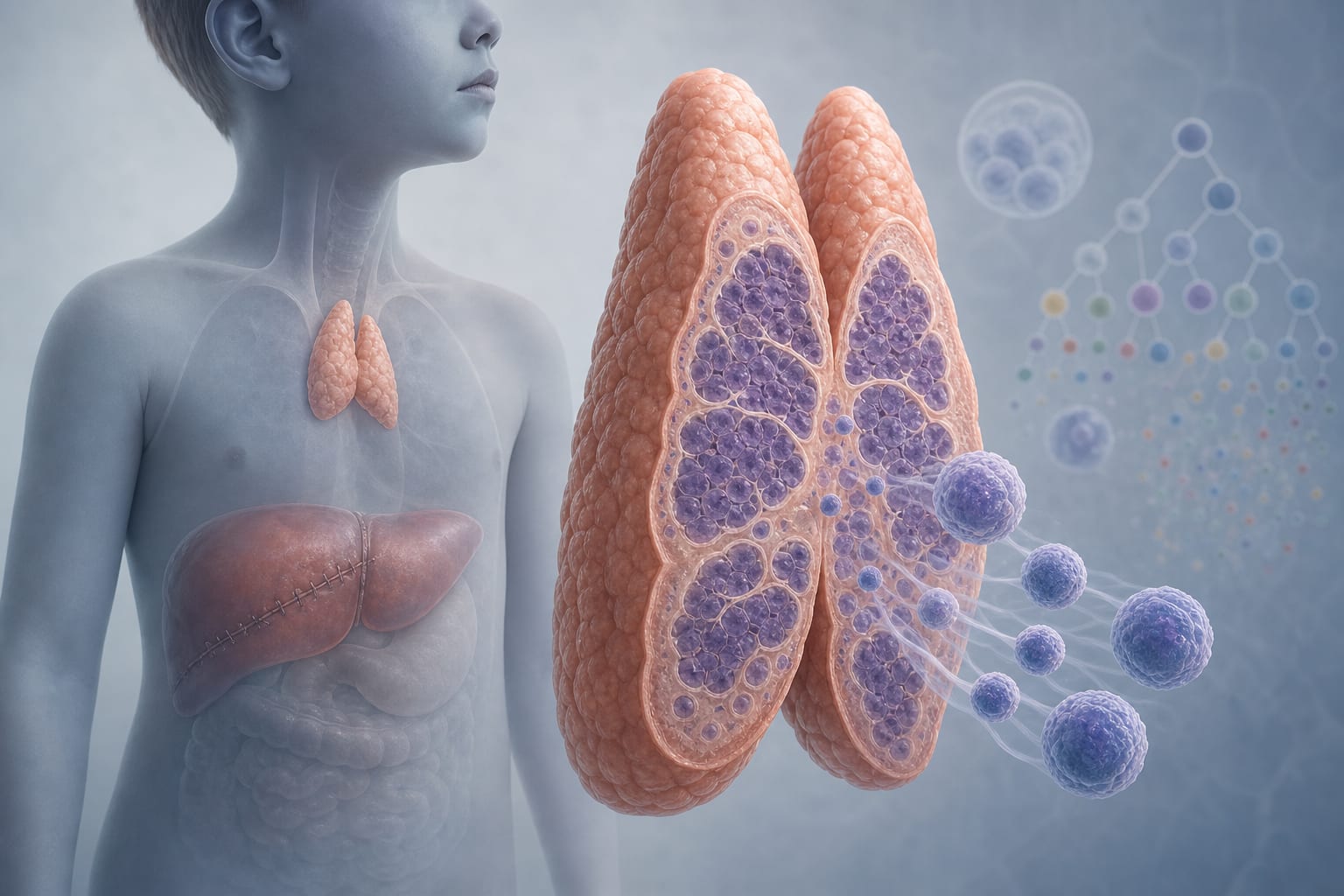
Immunosuppression after pediatric liver transplantation may lead to early and prolonged acute thymic involution: findings from a pilot longitudinal study - Summary - MDSpire
Advertisement
Immunosuppression after pediatric liver transplantation may lead to early and prolonged acute thymic involution: findings from a pilot longitudinal study
To assess the impact of immunosuppressive therapy on thymic function and morphology in pediatric first-time liver transplant recipients over a one-year follow-up period.
Approach:
Study Design: A prospective study involving twelve pediatric liver transplant recipients, assessing thymic output, intrathymic proliferation, recent thymic emigrants, and thymic morphology at multiple time points (baseline, 1, 3, 6, and 12 months post-transplant).
Key Findings:
Thymic output measured by sjTRECs declined significantly over the 12-month follow-up (β=-732.1, p<0.01).
The sj/βTREC ratio showed a significant reduction after 3 months post-transplant.
The frequency of recent thymic emigrants (RTEs) showed a decreasing trend but did not reach statistical significance.
Thymic size assessed by ultrasound decreased significantly at 3 months, with partial recovery thereafter.
Interpretation:
Preliminary evidence of early and persistent changes in markers of thymic function following immunosuppression after pediatric liver transplantation was observed.
Limitations:
Small sample size.
Exploratory design of the pilot study.
Conclusion:
Statistically significant changes in the primary endpoint warrant further controlled studies to characterize the impact of immunosuppressive therapy on thymic recovery and long-term immune reconstitution in pediatric transplant recipients.
by Guillermo Costaguta, Brenda Dinatale, Itauá Leston Araujo, Wilson Savino, Fernando Alvarez, Oscar Bottasso, Ana Rosa Perez, Florencia Belén González, Alejandro Costaguta