Differentiated associations of inflammatory indices with laboratory-defined organ injury/involvement and hospitalization length in pediatric respiratory tract infections - Summary - MDSpire
Conexiant’s news site is now MDSpire News. Learn more
Advertisement
Distinct Relationships Between Inflammatory Markers and Laboratory-Confirmed Organ Damage and Hospital Stay Duration in Children with Respiratory Tract Infections
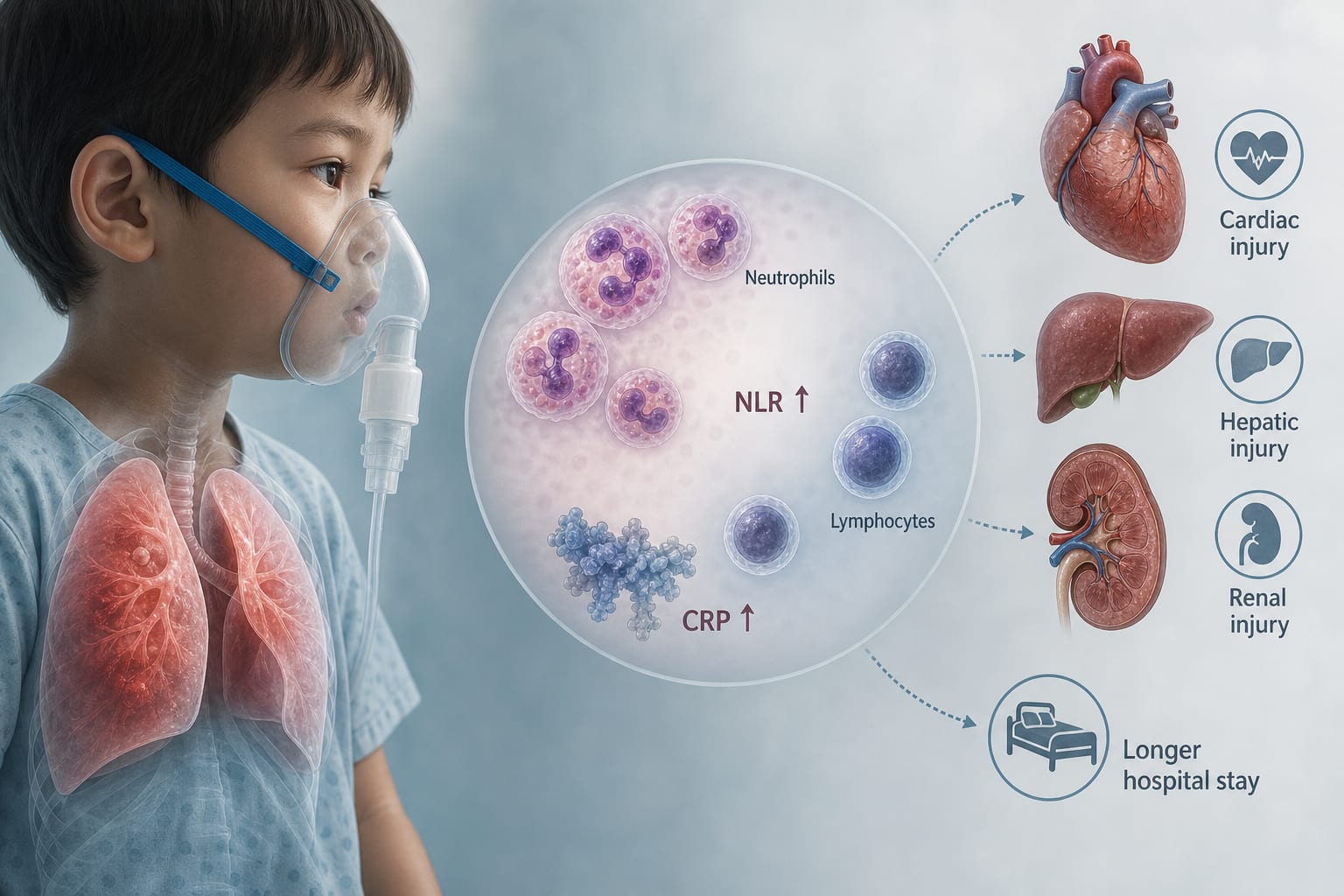
To analyze the associations of inflammatory indices with laboratory-defined organ injury/involvement and hospitalization length in pediatric respiratory tract infections (RTIs).
Approach:
Logistic Regression Analysis: Examined associations between inflammatory index levels and laboratory-defined cardiac injury, liver injury, and kidney involvement.
ROC Curve Analysis: Evaluated the discriminative ability of inflammatory indices for laboratory-defined organ injury/involvement.
Linear Regression Analysis: Assessed associations between inflammatory index levels and hospitalization length.
Key Findings:
Lower levels of neutrophils, CRP, SII, NLR, NPR, and CLR were associated with the presence of laboratory-defined cardiac injury.
Higher lymphocyte levels and lower levels of neutrophils, platelets, CRP, SII, NLR, PLR, NPR, and CLR were associated with the presence of laboratory-defined liver injury.
Higher levels of WBCs, neutrophils, CRP, SII, NLR, PLR, and CLR, along with lower lymphocyte levels, were associated with the presence of laboratory-defined kidney involvement.
NLR, SII, and CLR had high discriminative ability for laboratory-defined cardiac injury; SII, NLR, and PLR for laboratory-defined liver injury; NLR, CLR, and NPR for laboratory-defined kidney involvement.
Higher levels of WBCs, lymphocytes, CRP, NPR, and CLR, along with lower levels of platelets and Hb, were associated with longer hospitalization.
Interpretation:
Inflammatory indices, particularly composite indices, were associated with laboratory-defined organ injury/involvement and longer hospitalization in children with RTIs.
Limitations:
Study conducted in a single hospital, which may limit generalizability.
Potential confounding factors not accounted for in the analysis.
Conclusion:
Inflammatory indices derived from routine blood tests may serve as non-invasive exploratory markers for organ injury and hospitalization length in pediatric RTIs.