Association of baloxavir treatment timing with serial interval and household transmission of influenza through a likelihood-based analysis - Summary - MDSpire
To estimate how the timing of baloxavir treatment is associated with the serial interval between influenza cases and with household secondary transmission in a model linking the two measures.
Approach:
Odds Ratio Analysis: Compared household transmission by baloxavir treatment status and timing.
Serial Interval Estimation: Compared the time between symptom onset in an index case and the earliest secondary case in households with a definable serial interval.
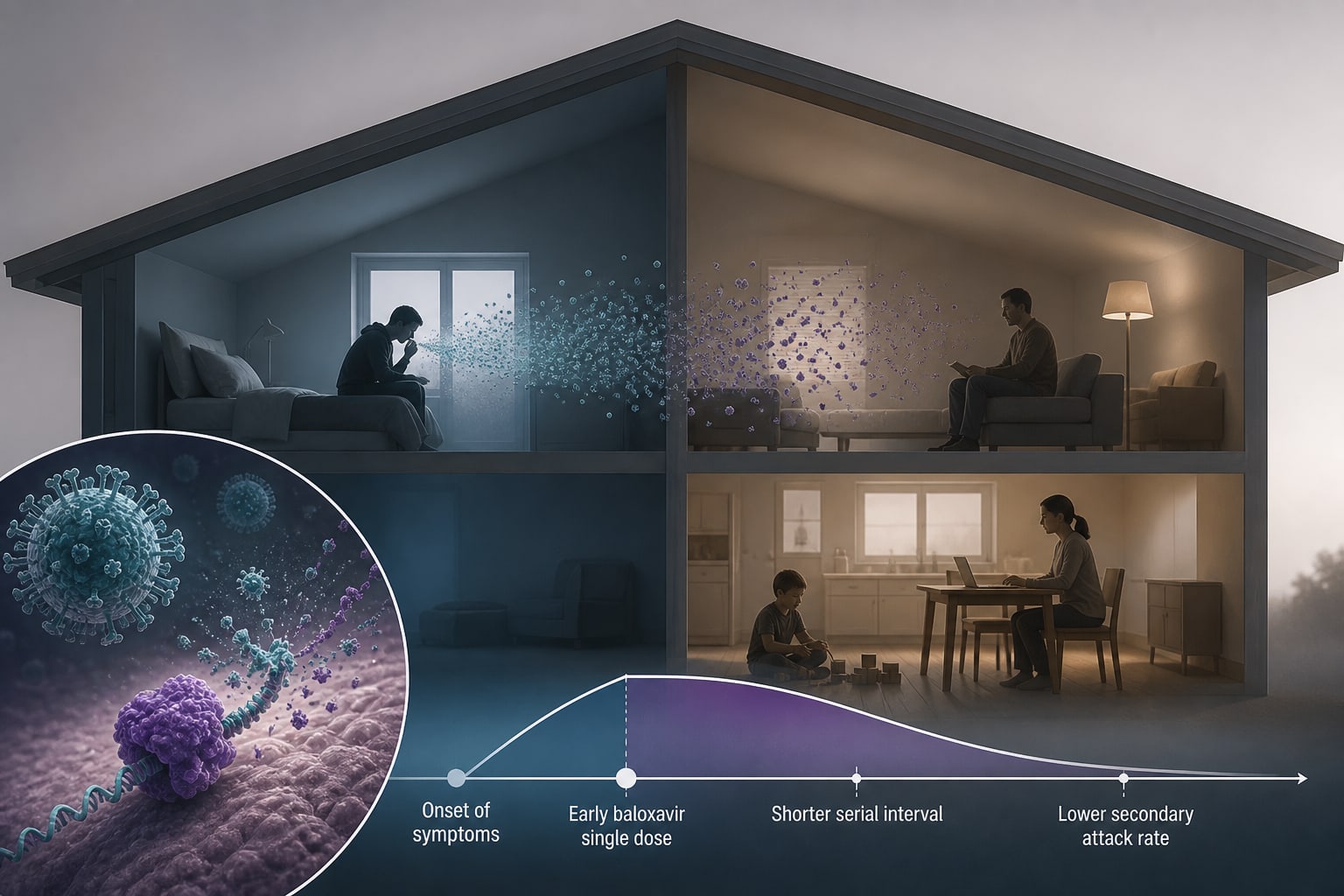
Model Development: Used a likelihood-based model that assumed the treatment-associated reduction in the area under the serial interval distribution corresponded to a proportional reduction in the household secondary attack rate (SAR).
Data Collection: An internet-based household survey in Japan, conducted from October 2018 through February 2019, classified influenza cases as confirmed or suspected. The serial interval analysis included 95 index cases.
Key Findings:
The observed SAR was lower for baloxavir-treated than untreated index cases (0.23 vs 0.29), but the difference was not statistically significant.
The model estimated a 31.54% reduction in serial interval density after baloxavir treatment. Treatment within 24 hours of symptom onset was associated with a 25.34% reduction in the area under the modeled distribution; reductions were smaller with later treatment.
Earlier treatment was associated with lower estimated household transmission risk. These are model-based associations, not proof that baloxavir prevented secondary infections in the surveyed households.
Interpretation:
Earlier baloxavir treatment was associated with a shorter modeled serial interval distribution and lower estimated household transmission risk. The serial interval measures time between symptom onsets; it is not a direct measurement of how long an index case remained infectious.
Limitations:
The survey relied on reported illnesses and lacked information on treatment or isolation practices among household contacts and on transmission chains beyond the index case.
Households without a definable serial interval were excluded from the serial interval analysis, though they remained eligible for SAR and odds ratio analyses. Few index cases received treatment at least 72 hours after symptom onset.
Conclusion:
The findings suggest that earlier baloxavir treatment may be associated with greater reductions in modeled influenza transmission risk within households. The observed SAR comparison was not statistically significant, and the model’s assumptions limit causal conclusions.