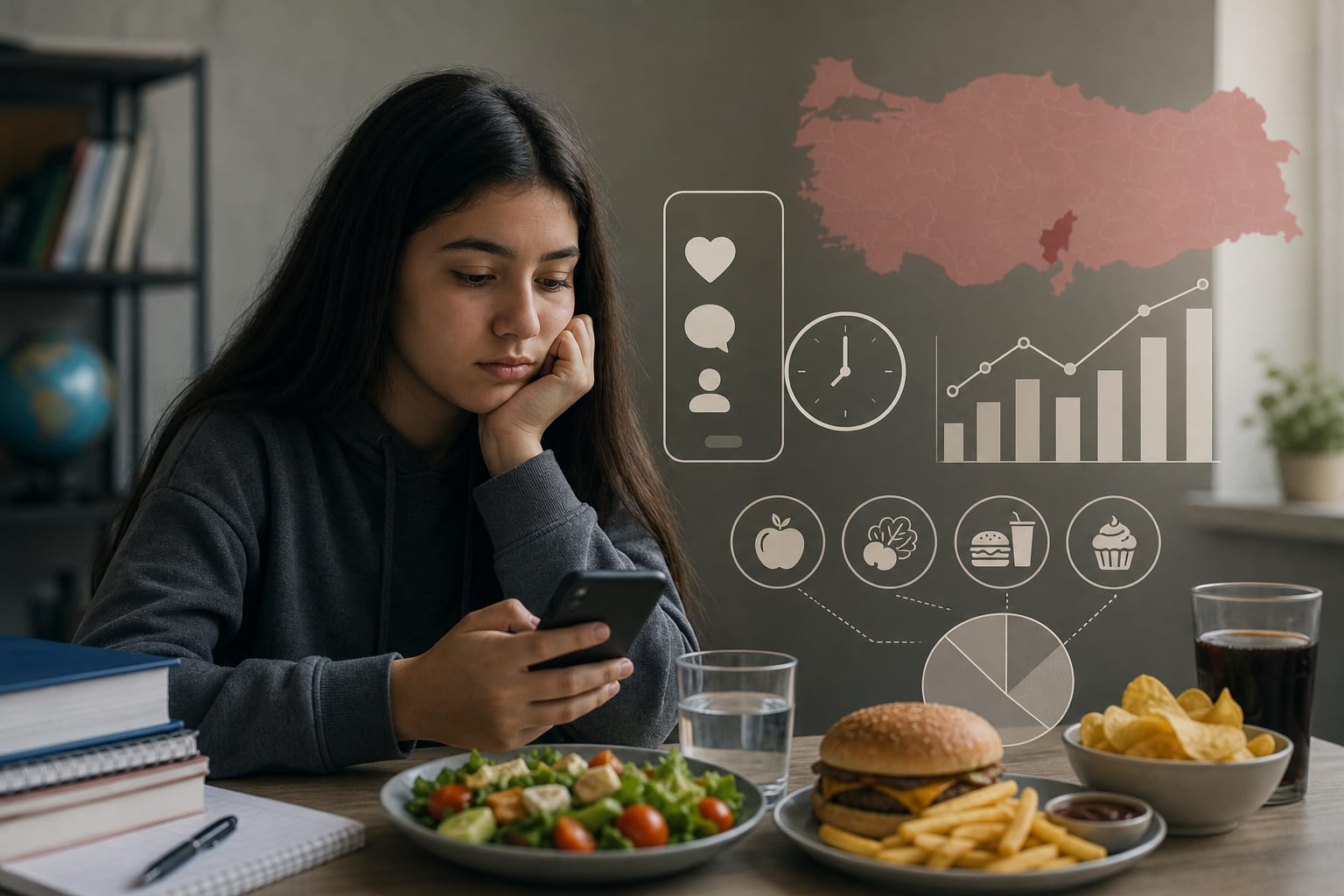
To investigate the association between social media use and dietary intake among adolescents in Turkiye.
Approach:
Study Design: A cross-sectional study was conducted with convenience sampling among adolescents aged 13-18 in private schools in Şanlıurfa and Karaman.
Sample Size: The final sample consisted of 251 adolescents, with 49% being male.
Data Collection: Dietary data were collected using a validated food frequency questionnaire, and multiple regression analysis was used to assess relationships.
Key Findings:
47.4% of participants reported using social media for over three hours daily.
Prolonged social media use (>3 h) was associated with higher energy (β = 356.21 ± 111.91 kcal), carbohydrate (β = 41.19 ± 14.82 g), sucrose (β = 10.75 ± 3.24 g), fat (β = 16.51 ± 5.83 g), calcium (β = 146.44 ± 54.72 mg), and zinc (β = 2.16 ± 0.75 mg) intake.
After Benjamini–Hochberg correction, no significant relationship was found between dairy, meat, and pastry consumption with social media duration.
Interpretation:
Limitations:
The study's sample consisted solely of adolescents from private schools, limiting generalizability.
Cross-sectional design does not establish causality.
Conclusion:
Longitudinal studies are needed to determine a causal relationship between social media use and dietary intake.
Federal prosecutors allege that a Florida physician and research staff fabricated clinical trial records that were submitted into database systems used to evaluate investigational drugs.