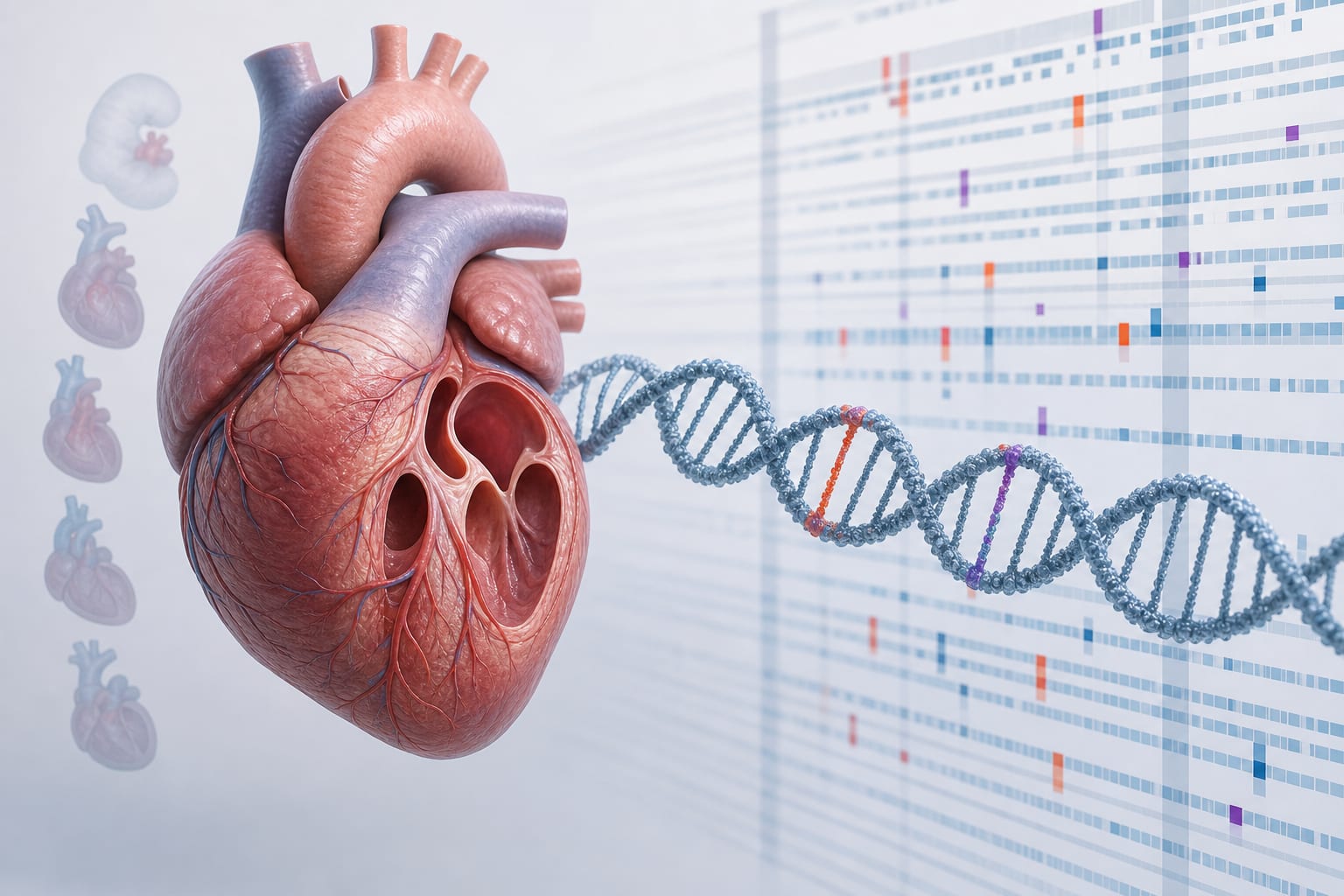
To investigate the genetic architecture underlying congenital heart defects (CHD) through whole-genome sequencing in a cohort of patients.
Approach:
Whole-Genome Sequencing: Performed on a cohort of 50 patients with echocardiographically confirmed CHD, followed by systematic variant identification and functional annotation.
Variant Prioritization: Integrated clinical classifications, genomic data, and tissue-specific expression profiles to identify novel variants and regulatory signals associated with CHD.
Key Findings:
Current genomic annotation databases have limited discriminatory capacity for CHD.
Stratification of genetic risk assessments by specific CHD subtypes is necessary.
Identified novel coding and non-coding variants linked to specific CHD subtypes.
CHD subtype-specific genetic associations include JARID2 with PDA, GOSR2/TBX18 with VSD, PCDHA9 with ASD, and a multi-gene signature with atrioventricular septal defects.
COL11A2 and PCOLCE2 were identified as plausible candidates for CHD pathogenesis among non-CHD-associated genes.
Interpretation:
The study emphasizes the polygenic architecture of CHD and the importance of context-aware interpretation of genetic variants.
Limitations:
Small sample size of 50 patients limits the generalizability of findings.
Current genomic annotation databases may not adequately capture the complexity of CHD genetics.
Conclusion:
The study expands the understanding of the genetic landscape underlying congenital heart anomalies and highlights the need for larger, deeply phenotyped cohorts.
by Anna V. Korobeinikova, Ekaterina S. Petriaikina, Dmitry I. Tychinin, Vladimir S. Yudin, Naida I. Bulaeva, Sayaly M. Gyulmamedova, Georgy A. Khugaev, Tatiana V. Sukhacheva, Ekaterina A. Snigir, Sergey I. Mitrofanov, Antonina M. Rumyantseva, Dmitry V. Svetlichnyy, Sergey M. Yudin, Elena Z. Golukhova, Veronika I. Skvortsova