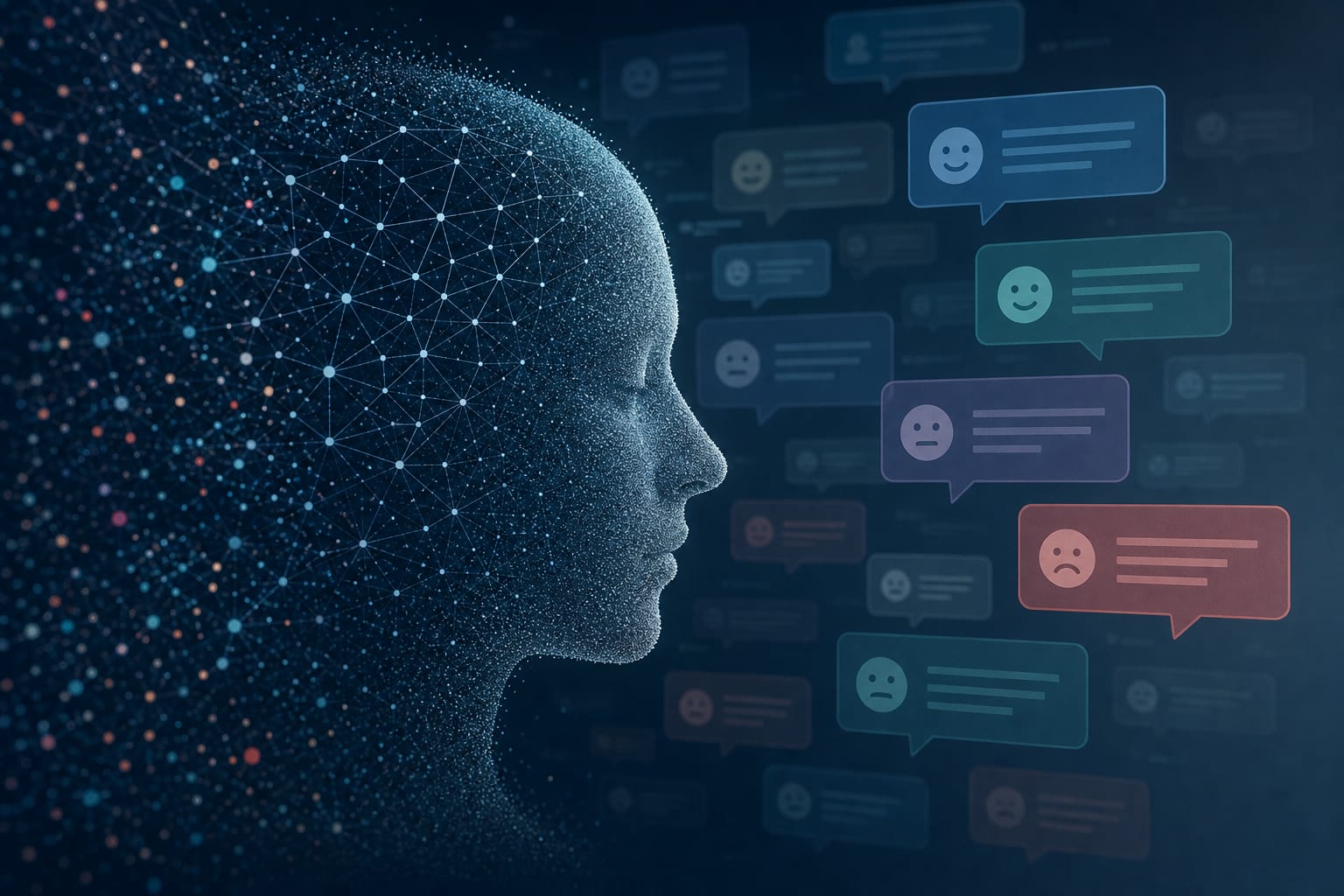
To investigate the relationship between multidimensional AI perception, emotional expression, trust-related discourse, and purchase-related discourse in naturalistic online environments.
Approach:
Dataset: Analyzed a dataset of 2,326,781 cleaned YouTube comments from 8,947 videos and 5,176 channels.
AI Perception Categories: Operationalized AI perception through six categories: automation perception, robotic communication style, scriptedness, lack of authenticity, perceived artificiality, and uncanny valley perception.
Analytical Methods: Employed LLM-assisted weak supervision, transformer-based classification, manual validation, sentiment analysis, and statistical association tests.
Key Findings:
AI perception was prevalent and strongly associated with negative emotional expression.
Comments with AI perception cues exhibited higher levels of negative sentiment.
Emotional expression varied across AI perception categories, with robotic communication style, lack of authenticity, automation perception, and uncanny valley perception showing the highest levels of negative expression.
Trust-related and purchase-related discourse were rare and showed limited differentiation across AI perception conditions.
Interpretation:
The findings indicate a pattern of expressive decoupling, where perceived AI presence is reflected in emotional expression.
Limitations:
The study relies on user-generated content, which may not fully capture actual behavioral outcomes.
The analysis is limited to YouTube comments and may not generalize to other digital platforms.
Conclusion:
The study contributes to understanding emotional expression associated with perceived AI presence in digital environments.