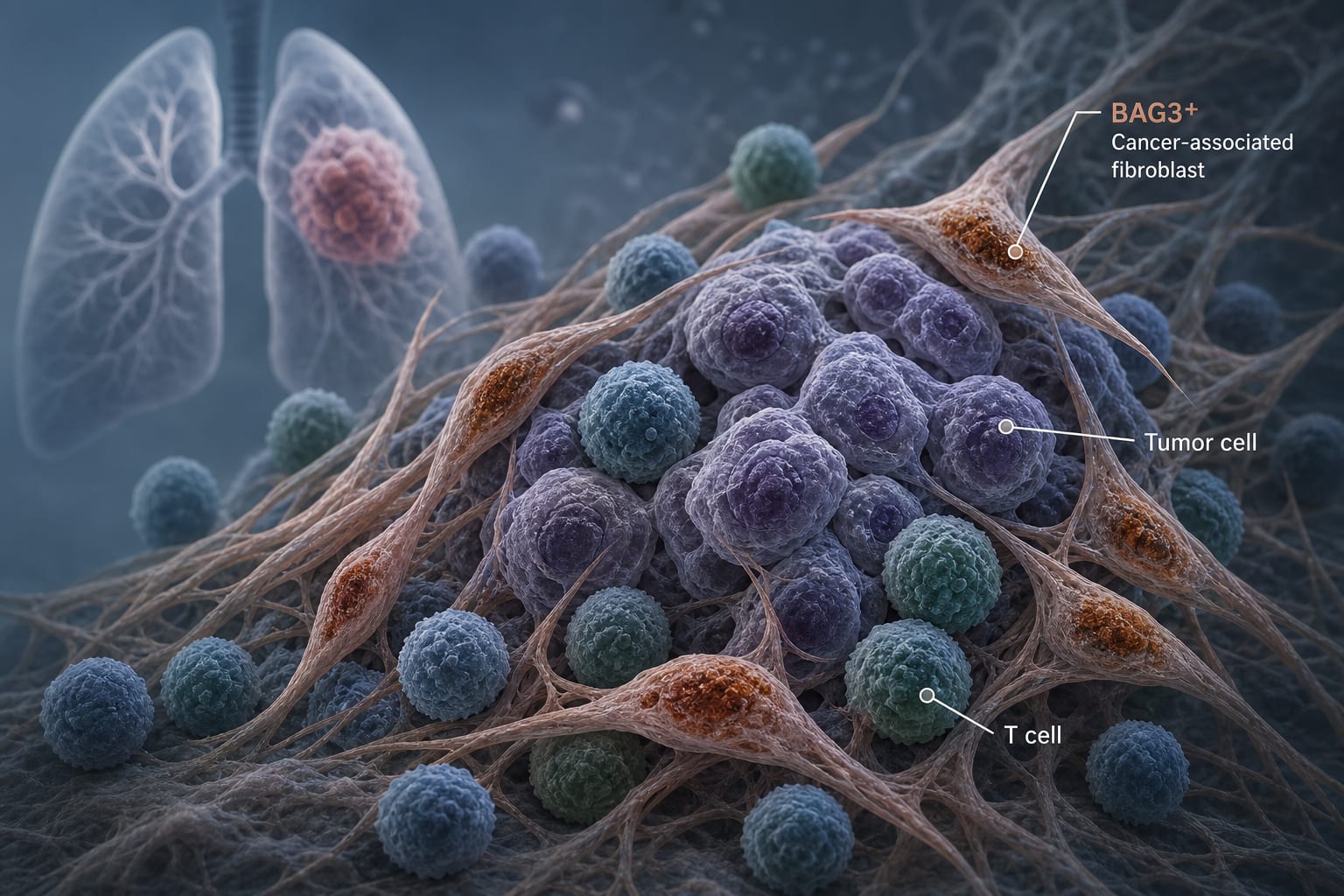
To identify a predictive biomarker for non-response to neoadjuvant chemoimmunotherapy (NCIT) in non-small cell lung cancer (NSCLC).
Approach:
Study Design: Single-cell RNA sequencing (scRNA-seq) was performed on pre-treatment NSCLC tissue samples, integrating data from public databases to identify signaling pathways linked to poor treatment response.
Validation: Key findings were validated using multiplex immunofluorescence (mIF), assessing the predictive value of identified molecules in the study cohort and GEO datasets.
Key Findings:
Among the 83 patients, 23/57 (40.35%) of radiological responders failed to achieve major pathological response (MPR).
BAG3+IFITM2+ CAFs and BAG3+CD8+ T cells were significantly more abundant in non-MPR patients.
The BAG3+ CAF-T Cell Neighborhood was significantly more abundant in the non-MPR group compared to the MPR group (p<0.05).
AUC values for BAG3+IFITM2+ CAFs, BAG3+CD8+ T cells, and the BAG3+ CAF-T Cell Neighborhood were 0.84, 0.72, and 0.87, respectively.
Overall survival (OS) and disease-free survival (DFS) were significantly decreased in the high BAG3+ CAF-T Cell Neighborhood group compared to the low group (p<0.05).
Interpretation:
The BAG3+ CAF-T Cell Neighborhood may serve as a biomarker for predicting non-response to NCIT in NSCLC.
Limitations:
The study's findings need further validation in larger, independent cohorts.
Potential confounding factors in patient selection and treatment response assessment.
Conclusion:
The BAG3+ CAF-T Cell Neighborhood has significant potential to inform clinical decision-making regarding NCIT in NSCLC.