Machine learning-based prediction of difficult laryngoscopy in infants with Pierre Robin sequence using quantitative 3D computed tomography parameters - Summary - MDSpire
Advertisement
Machine learning-based prediction of difficult laryngoscopy in infants with Pierre Robin sequence using quantitative 3D computed tomography parameters
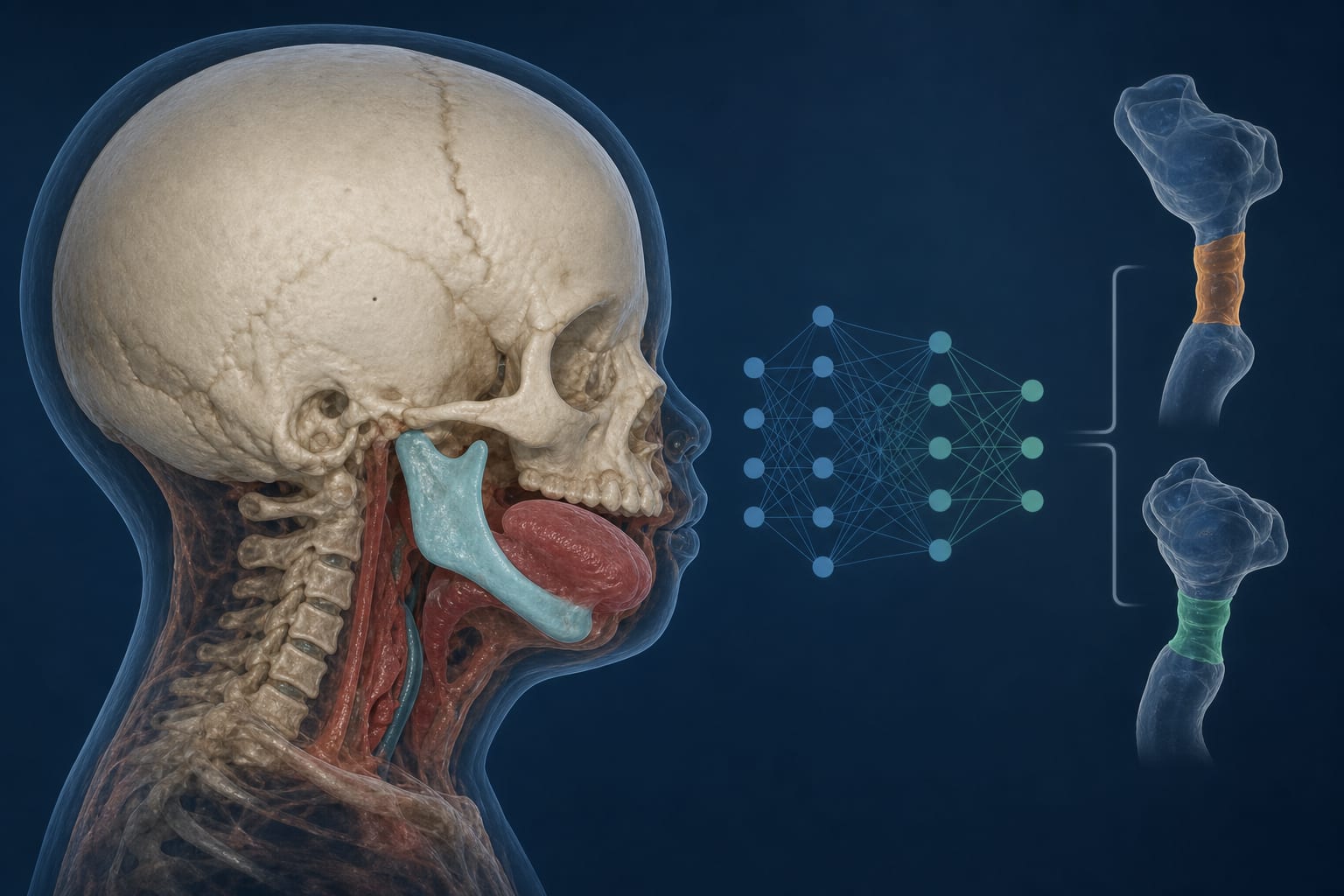
To identify key 3D-CT parameters associated with difficult laryngoscopic exposure in infants with Pierre Robin sequence (PRS) and to develop and externally validate machine learning–based predictive models.
Approach:
Study Design: Retrospective analysis of 214 infants with PRS who underwent mandibular distraction osteogenesis between 2023 and 2024.
Key Findings:
Four independent predictors identified: tongue length (D1) (odds ratio [OR] = 1.058, p = 0.005), tongue base–posterior pharyngeal wall distance (D4) (OR = 0.718, p < 0.001), sagittal oropharyngeal cross-sectional area (S2) (OR = 0.271, p = 0.001), and tongue base–epiglottic angle (A2) (OR = 0.952, p = 0.028).
XGBoost achieved the highest discrimination in the training cohort (AUC = 0.961).
The Extra Trees model showed superior generalizability in the temporal validation cohort (AUC = 0.876), with an accuracy of 0.812 and an F1-score of 0.805.
Calibration analysis indicated excellent agreement for the Extra Trees model (p > 0.999).
Decision curve analysis showed substantial net clinical benefit across threshold probabilities.
Interpretation:
Quantitative 3D-CT parameters reflecting tongue morphology and oropharyngeal airway dimensions are clinically relevant predictors of difficult laryngoscopic exposure in infants with PRS.
Limitations:
Study limited to a single institution, which may affect generalizability.
Potential limitations of 3D-CT imaging include radiation exposure, cost, and accessibility.
Conclusion:
The Extra Trees model demonstrated promising performance in temporal validation within a single-center cohort.