Clinical efficacy and safety of different video-assisted thoracoscopic surgery approaches for bullous lung resection: a systematic review and meta-analysis - Summary - MDSpire
Advertisement
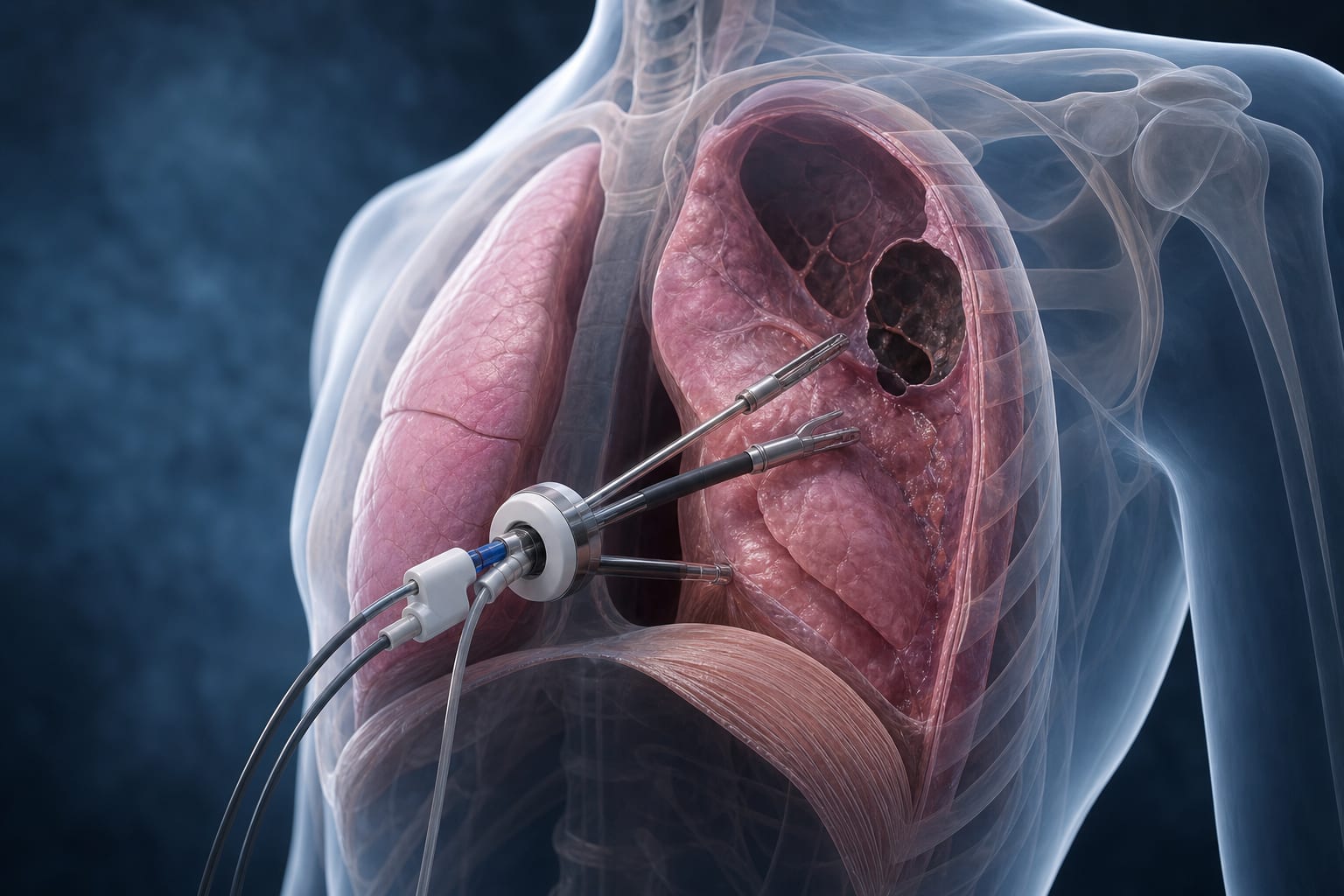
Comparative Analysis of Safety and Effectiveness of Single-Port versus Multi-Port Video-Assisted Thoracoscopic Surgery for Bullous Lung Resection: A Systematic Review and Meta-Analysis
To evaluate the perioperative safety and comparative efficacy of single-port (conventional or modified) versus multi-port video-assisted thoracoscopic surgery (VATS) for bullous lung resection in patients with primary spontaneous pneumothorax.
Key Findings:
Thirteen cohort studies (1,151 patients) were included. Single-port VATS resulted in a significantly reduced hospital stay (MD = 0.246 days; 95% CI, 0.075–0.416).
Postoperative pain was significantly lower in single-port VATS (MD = 1.100; 95% CI, 0.528–1.671).
Incidence of chest wall paresthesia was lower in single-port VATS (risk ratio = 0.580; 95% CI, 0.432–0.779).
No significant differences were found in operative time, chest tube duration, stapler use, complications, or recurrence rates.
Interpretation:
Single-port VATS is associated with accelerated recovery, reduced postoperative pain, and lower neurological sequelae compared to multi-port VATS, without increasing operative time or complication rates. Further randomized trials are needed to establish superiority.
Limitations:
Majority of studies were small-scale, single-center retrospective cohorts, limiting statistical power.
Variability in modified single-port protocols and pleurodesis techniques.
Many studies lacked critical intraoperative data, such as stapler utilization.
Conclusion:
Single-port VATS represents a safe and feasible alternative for bullous lung resection, although further randomized trials are needed to establish superiority.