A CT-based multi-scale fusion model with SHAP interpretation for preoperative differentiation between lung adenocarcinoma in situ/minimally invasive adenocarcinoma and invasive adenocarcinoma: a multicenter study - Summary - MDSpire

A CT-based multi-scale fusion model with SHAP interpretation for preoperative differentiation between lung adenocarcinoma in situ/minimally invasive adenocarcinoma and invasive adenocarcinoma: a multicenter study

  • By

  • Ning Dong

  • Shihang Sun

  • Zhongwei Li

  • Zhenjie Cong

  • Yi Lin

  • Jingxian Chen

  • Hu Zhang

  • Yuxin Liu

  • Shuxia Li

  • Jing Xu

  • Demin Kong

  • Qingfeng Yin

  • May 12, 2026

  • 0 min

Share

Objective:

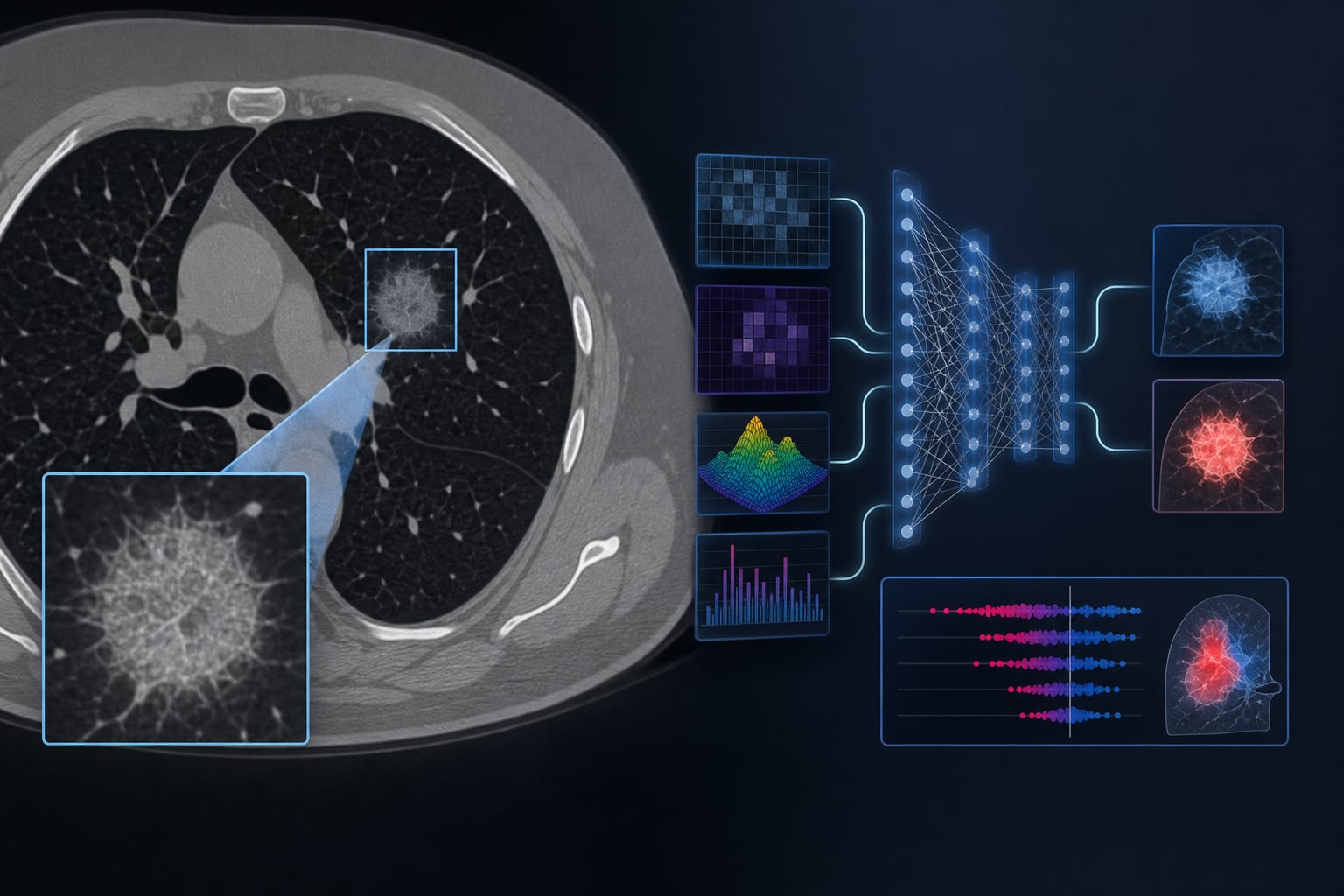
To develop a multi-scale model integrating radiomics, habitat, deep learning, and clinical information for preoperative precise differentiation between lung adenocarcinoma in situ/minimally invasive adenocarcinoma and invasive adenocarcinoma in ground-glass nodules (GGNs), ultimately improving patient outcomes.

Key Findings:
  • The early fusion model achieved AUCs of 0.988, 0.903, and 0.872 in training, internal validation, and external testing cohorts, respectively, indicating high diagnostic accuracy.
  • The 2.5D ResNet50 architecture provided the best performance among deep learning models.
Interpretation:

The multi-scale early fusion model significantly enhances preoperative diagnosis accuracy compared to existing methods, aiding in individualized treatment decisions for GGNs.

Limitations:
  • The study is retrospective and may have selection bias, potentially affecting the generalizability of the findings.
  • The model's performance may vary in different clinical settings.
Conclusion:

The developed model offers a robust framework for the preoperative differentiation of GGNs, potentially improving patient outcomes.

Original Source(s)

Related Content