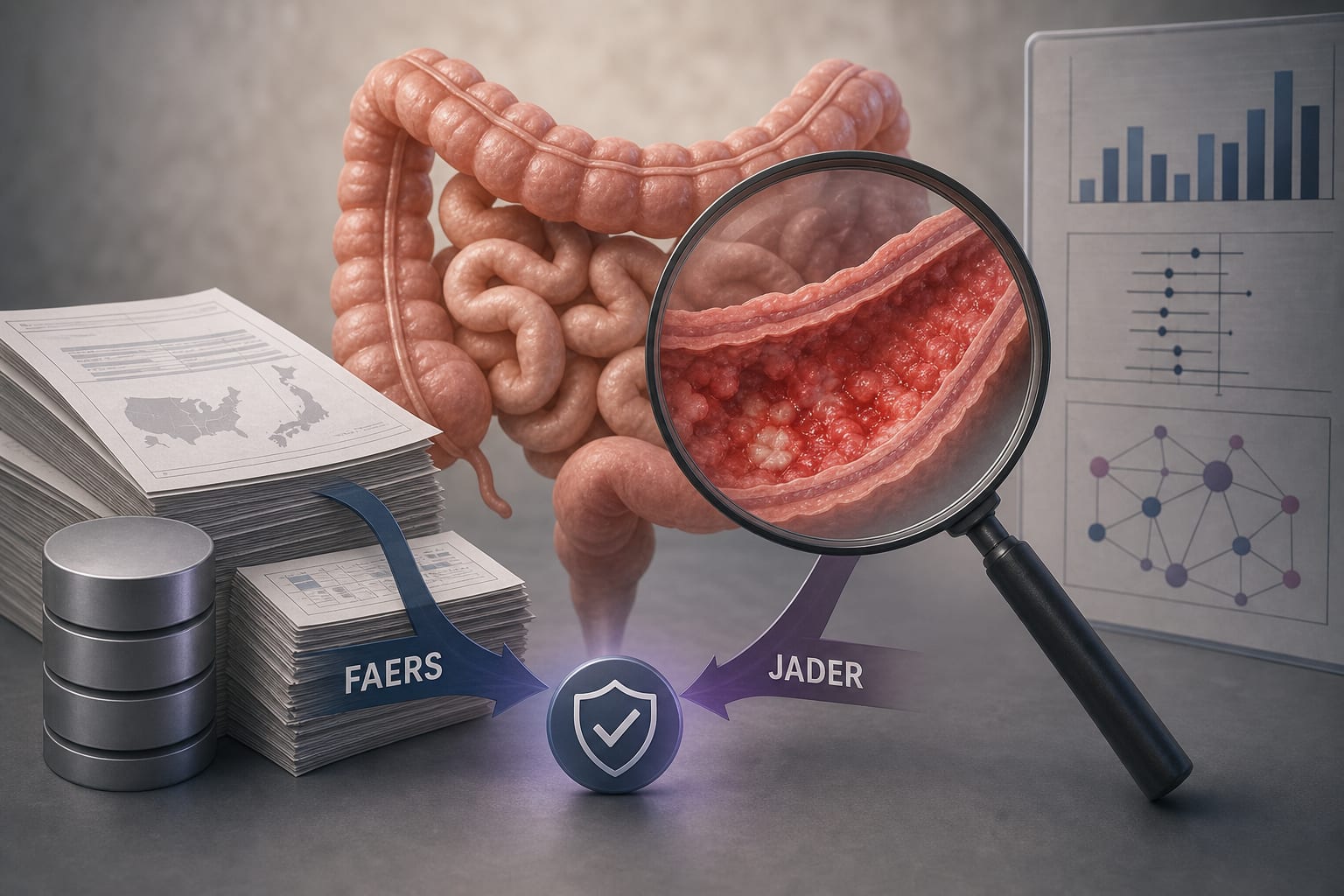
Investigating Drug-Related Inflammatory Bowel Disease: A Comprehensive Analysis of FAERS and JADER Data
-
By
-
Yuou Ying
-
Mengyuan Shen
-
Jinhan Chen
-
Tongfei Feng
-
Zejiong Li
-
Zhekai Ying
-
Dongdong Yang
-
Ruyi Ju
-
Jiannong Wu
-
July 7, 2026
Objective:
To identify medications most frequently reported in connection with inflammatory bowel disease (IBD) by analyzing data from FAERS and JADER.
Approach:
- Data Extraction: Reports of drug-associated IBD adverse events were extracted from FAERS and validated using JADER.
- Disproportionality Analyses: Four methods were used: Reporting Odds Ratio (ROR), Proportional Reporting Ratio (PRR), Bayesian Confidence Propagation Neural Network (BCPNN), and Multi-Item Gamma Poisson Shrinker (MGPS).
- Additional Analyses: Included time-to-onset assessment, Weibull distribution modeling, and subgroup analyses by age, sex, and IBD subtype.
Key Findings:
- TheFAERSdatabaseyielded52,395reportsofdrug-associatedIBD,correspondingto50,426patients.Femalesaccountedforahigherproportionofreportsthanmales,withthemajorityofcasesoccurringinindividualsaged18–64years.Theannualnumberofreportsshowedanoverallupwardtrend.Amongdrugsreportedatleast50times,17metallfouralgorithmicthresholdcriteriaandwereclassifiedaspositivesignals.Anti–tumornecrosisfactor-alpha(anti-TNF-α)inhibitorsrankedhighestbyreportingfrequency,whereasisotretinoindemonstratedthestrongestsignalintensity.ExternalvalidationusingJADERconfirmedconsistentsignalsforcertainanti-TNF-αinhibitors,anti–interleukinbiologicagents,conventionalimmunosuppressants,andantibiotics.Time-to-onsetanalysisrevealedthatthemedianonsetofIBDoccurredwithinoneyearformostdrug-associatedcases.
Interpretation:
The study provides a comprehensive overview of medications associated with IBD, highlighting the need for monitoring drug-related risks.
Limitations:
- Thestudyreliesonspontaneousreportingsystems,whichmayhaveunderreportingorbias.Confirmationinlargeprospectivecohortstudiesisnecessary.
Conclusion:
The findings deliver real-world evidence to support the identification and monitoring of drug-associated IBD.