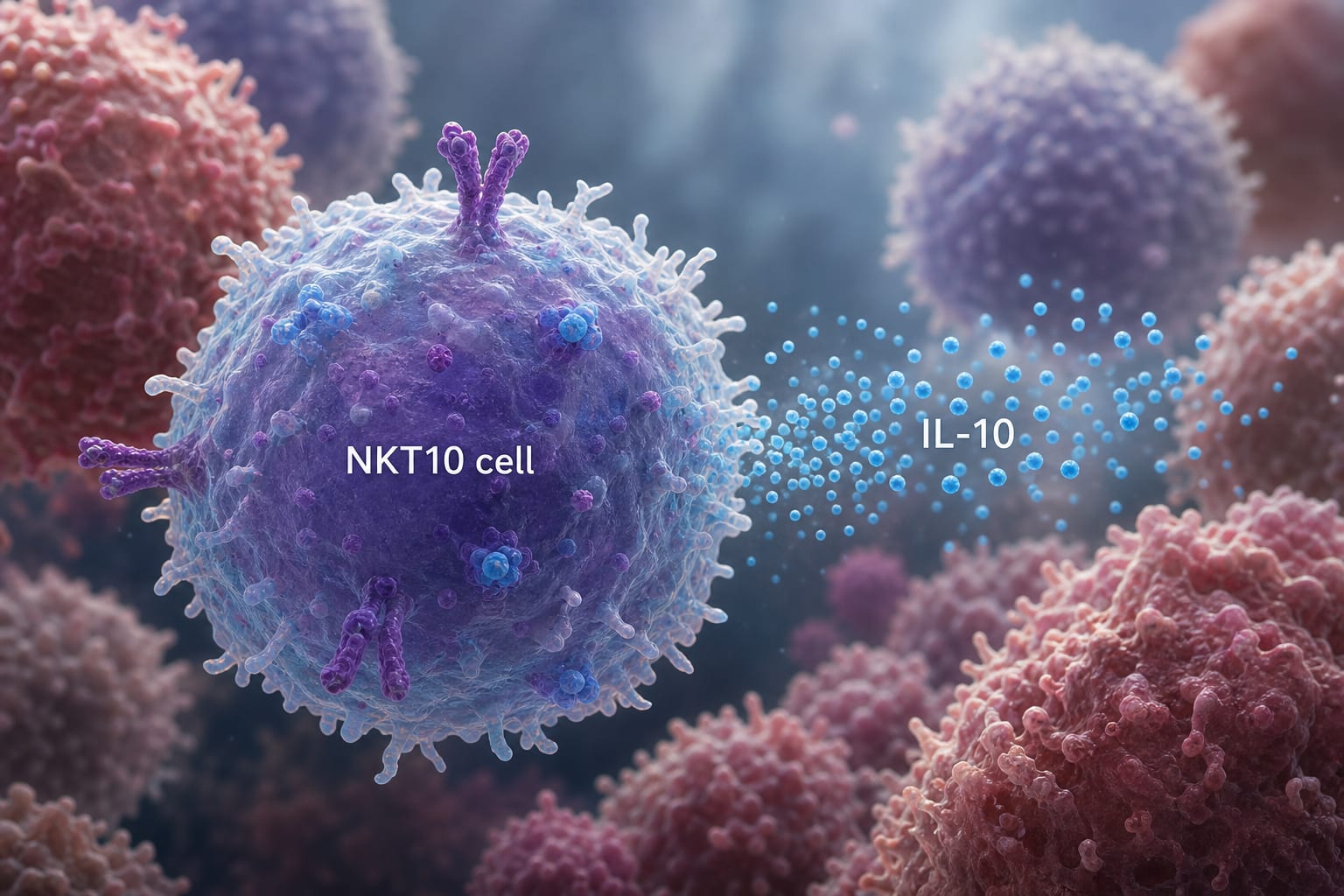
Human NKT10 cells are enriched in cord-derived invariant natural killer T cells and mediate immune-regulation in a xenogeneic graft-versus-host disease model - Summary - MDSpire

Human NKT10 cells are enriched in cord-derived invariant natural killer T cells and mediate immune-regulation in a xenogeneic graft-versus-host disease model

  • By

  • Abel Trujillo-Ocampo

  • Pamella Borges

  • Maison Grefe

  • Martiela Vaz de Freitas

  • Sung-Eun Lee

  • Yuan Qi

  • Jelita Clinton

  • Dan Li

  • Hong He

  • Ling Yu

  • Arnau Peris-Cuesta

  • Erik A. Ehli

  • Qing Ma

  • Xiaoping Su

  • Dinler Amaral Antunes

  • Gheath Al-Atrash

  • Jeffrey J. Molldrem

  • Elizabeth J. Shpall

  • Jin S. Im

  • June 10, 2026

  • 0 min

Share

Objective:

To characterize human NKT10 cells from cord-derived iNKT cells and investigate their role in immune regulation in allogeneic stem cell transplantation.

Approach:
    Key Findings:
    • Cord-derived iNKT cells contained a high frequency of CD4+CD25+CD161lowFoxP3+ iNKT cells.
    • These cells showed Th2/Th10-biased cytokine production upon antigenic stimulation.
    • Single-cell RNA sequencing confirmed the presence of an NKT10-like subset enriched with immunoregulatory pathways.
    • Cord-derived iNKT cells suppressed alloreactive T cell proliferation in vitro.
    • In vivo, these cells ameliorated xenogeneic graft-versus-host disease in NSG mice.
    Interpretation:

    Limitations:
    • The study primarily focuses on cord-derived iNKT cells, limiting generalizability to other sources.
    • Further clinical studies are needed to validate the findings regarding NKT10 cells.
    Conclusion:

    NKT10 cells from cord-derived iNKT cells exhibit significant immunoregulatory properties.

Original Source(s)

Related Content