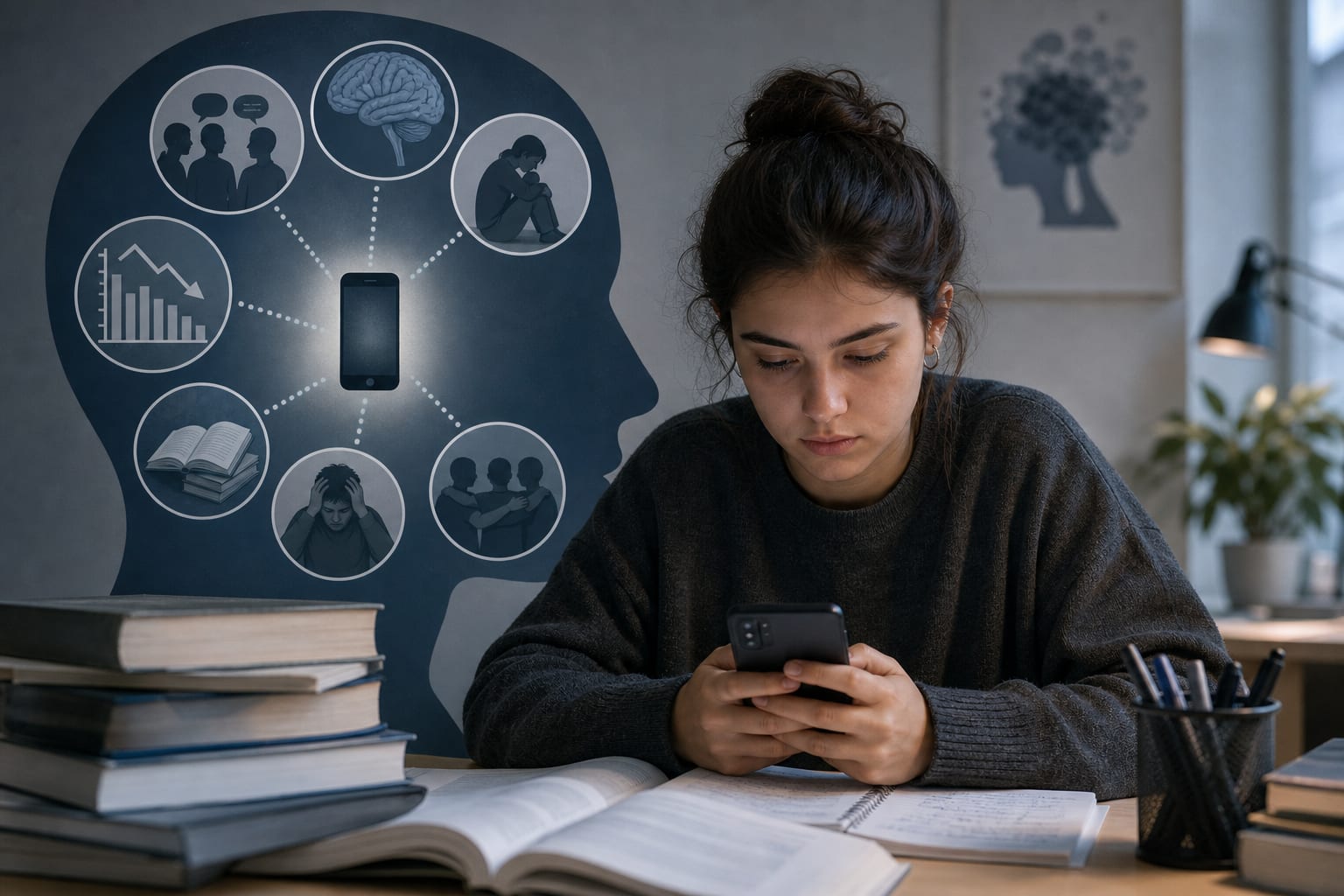
Demographic, social, psychological, mental health, and academic correlates of problematic smartphone use among French psychology students - Summary - MDSpire
Advertisement
Demographic, social, psychological, mental health, and academic correlates of problematic smartphone use among French psychology students
To estimate the prevalence and severity of problematic smartphone use (PSU) among French psychology students and examine various correlates and predictors of PSU severity.
Approach:
Study Design: A cross-sectional online survey was conducted among 973 psychology undergraduate and master's students from two French universities.
Data Collection: Participants completed measures of PSU, smartphone use behaviors, social resources, cognitive functioning, impulsivity, personality traits, future-self connection, mental health, and academic functioning.
Data Analysis: Correlation analyses, multivariate linear regression, and moderation/mediation analyses with bootstrapping were performed.
Key Findings:
Mean PSU score was slightly below the midpoint of the 1–7 scale.
Prevalence of PSU ranged from 1.64% to 5.14% using conservative estimation; 25% exceeded the cut-off score of 4.14 according to an alternative estimation method.
Higher PSU scores were observed among younger students, women, bisexual participants, and undergraduates.
Impulsivity was the strongest predictor of PSU, followed by smartphone-related problems, smartphone use frequency (SUF), and working memory difficulties.
Lower social support, lower conscientiousness, higher neuroticism, poorer mental health, and greater academic-smartphone use interferences were associated with higher PSU.
Interpretation:
Sleep difficulties, depressive mood, and self-esteem partially mediated the relationship between SUF and PSU severity. Community engagement and future-self connection unexpectedly strengthened the SUF–PSU association.
Limitations:
The study is limited to psychology students, which may not represent the broader student population.
Self-reported measures may introduce bias.
Conclusion:
PSU is a relevant issue among French psychology students, highlighting the need for interventions focusing on self-regulation, emotional coping, and context-specific academic smartphone use.