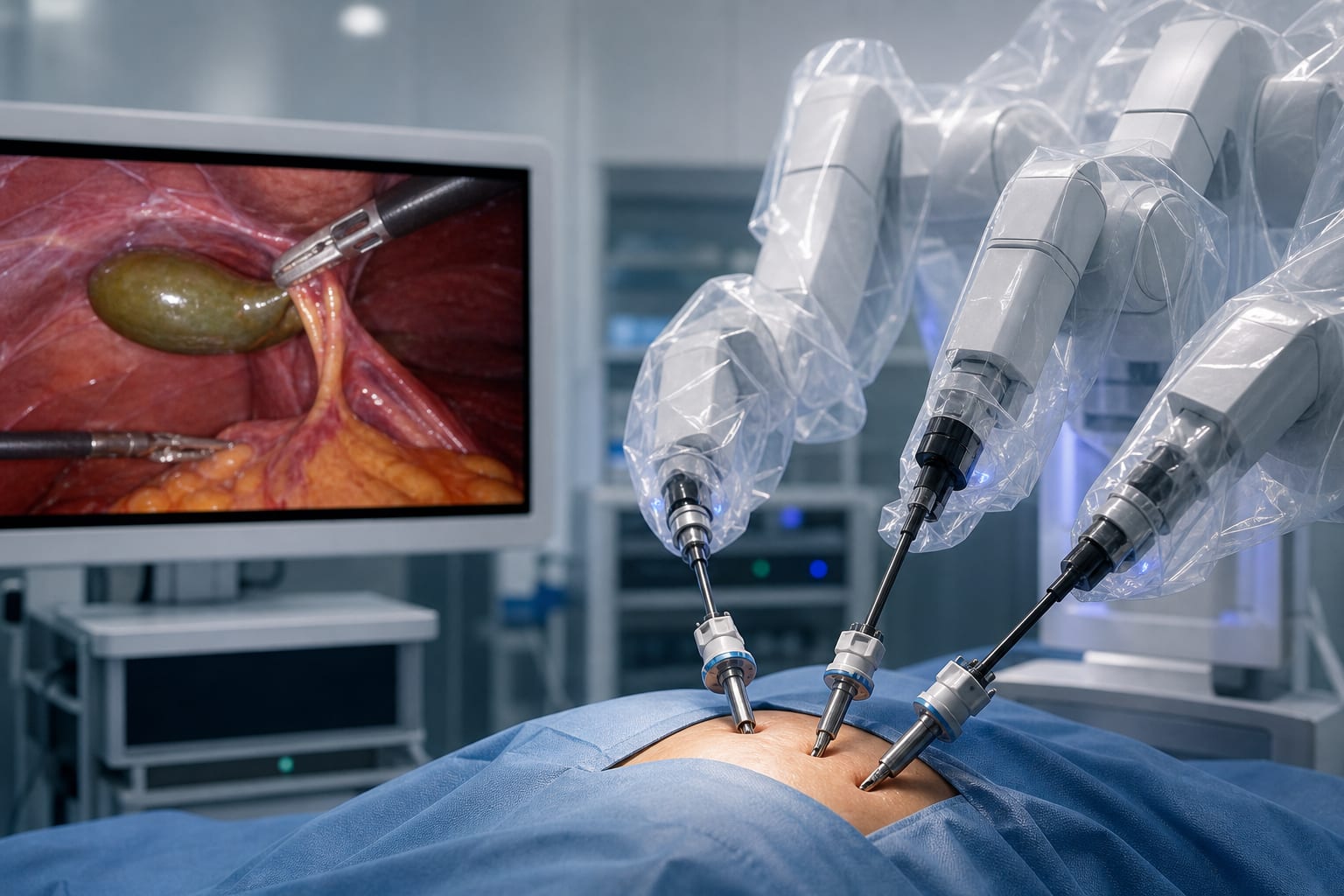
To compare perioperative outcomes and early recovery between robotic-assisted and conventional laparoscopic cholecystectomy in children.
Approach:
Study Design: A single-centre retrospective comparative cohort study was conducted at a tertiary paediatric referral centre.
Patient Selection: Consecutive patients (≤18 years) undergoing cholecystectomy for benign gallbladder disease were included and divided into two groups based on surgical approach: pre-robotic and robotic.
Data Analysis: Demographic, intraoperative, and postoperative outcomes were analysed using the Mann–Whitney U test for continuous variables and Fisher’s exact test for categorical variables.
Key Findings:
A total of 28 patients were included (13 pre-robotic, 15 robotic).
Median operative time was significantly longer in the robotic group (2:22 h vs. 1:33 h; p < 0.001).
Length of hospital stay was significantly shorter in the robotic group (2 vs. 4 days; p = 0.003).
No conversions to open surgery or surgical site infections were observed.
Postoperative complications were rare and comparable between groups (7.7% vs. 0%; p = 0.46).
Early oral feeding within 24 h occurred in 100% of robotic cases versus 69.2% in the pre-robotic group (p = 0.041).
Passage of flatus within 24 h was observed in 93.3% versus 30.8% in the pre-robotic group (p = 0.002).
Interpretation:
Robotic-assisted cholecystectomy is a safe and feasible approach in paediatric patients, with perioperative outcomes comparable to conventional laparoscopy. Despite longer operative times, the robotic approach was associated with shorter hospital stay and faster recovery of bowel function.
Limitations:
The study is retrospective and conducted at a single centre.
The sample size is relatively small (28 patients).
Further larger prospective studies are needed to confirm these results.
Conclusion:
Robotic-assisted cholecystectomy may promote early postoperative recovery in pediatric patients.