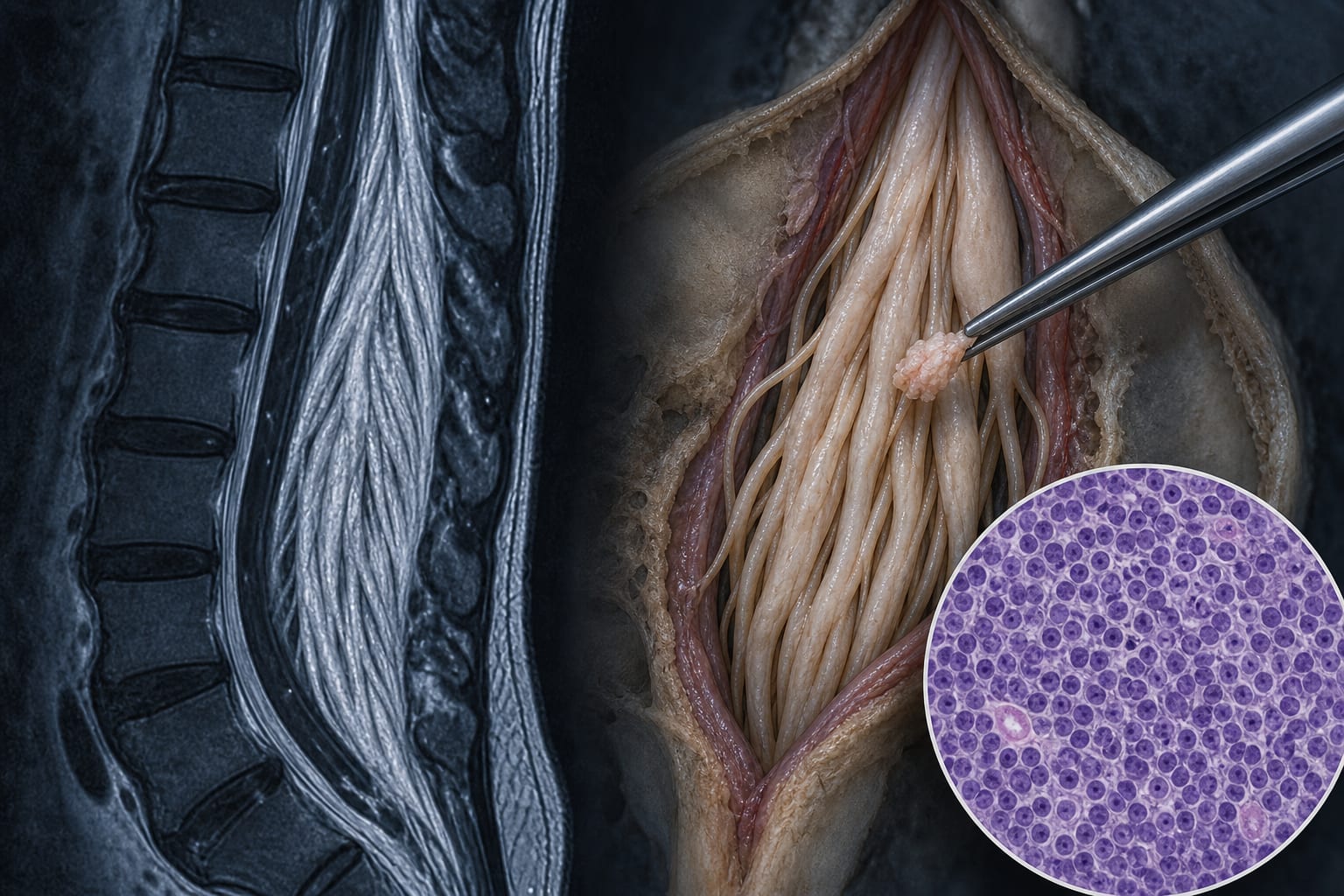
Diffuse cauda equina nerve root enlargement: diagnostic challenges, clinicopathological spectrum, and the role of surgical biopsy - Summary - MDSpire
Advertisement
Challenges in Diagnosing Diffuse Enlargement of Cauda Equina Nerve Roots: A Review of Clinical and Pathological Aspects and the Importance of Surgical Biopsy
To characterize the clinicoradiological features of patients presenting with diffuse cauda equina root enlargement and to evaluate the diagnostic role of surgical biopsy in cases with uncertain etiology.
Approach:
Study Design: Retrospective review of 12 patients with symptoms of cauda equina and diffuse nerve root enlargement on MRI from 2019 to 2024.
Diagnostic Evaluation: Standardized diagnostic workup including MRI, CSF analysis, NCS/EMG, and serological testing; surgical biopsy performed in selected cases.
Treatment and Follow-up: Treatment strategies based on diagnosis, including chemotherapy and immunotherapy; clinical follow-up conducted at 1, 3, and 6 months.
Key Findings:
All patients exhibited diffuse enlargement of cauda equina nerve roots on MRI, with underlying etiologies including malignant lymphoma and immune-mediated neuropathies.
Surgical biopsy provided important pathological information in cases with diagnostic uncertainty.
Patients with lymphoma generally demonstrated favorable responses to systemic chemotherapy, while those with immune-mediated disorders improved following immunotherapy.
Interpretation:
Diffuse cauda equina nerve root enlargement is associated with heterogeneous etiologies, necessitating careful diagnostic evaluation.
Limitations:
Small sample size limits generalizability.
Retrospective nature may affect the consistency of data collection and outcomes.
Conclusion:
Surgical biopsy may be beneficial in selected cases when noninvasive investigations are inconclusive.