Multicentre validation of the PRECISE scoring system for prostate MRI during active surveillance - Summary - MDSpire

Multicentre validation of the PRECISE scoring system for prostate MRI during active surveillance

  • By

  • Francesco Giganti

  • Riccardo Leni

  • Vinayak Wagaskar

  • Giorgio Gandaglia

  • Tristan Barrett

  • Valeria Panebianco

  • Francesco Sanguedolce

  • Erik JRJ van der Hoeven

  • Sangeet Ghai

  • Jeremy Grummet

  • Jasmin Gmeiner

  • Jan Philipp Radtke

  • Ryan D. Ward

  • Ronaldo Hueb Baroni

  • Francesco Porpiglia

  • Juan Gomez Rivas

  • Fabio Zattoni

  • Raphaële Renard-Penna

  • Claudia Kesch

  • Marco Gatti

  • Nicola Schieda

  • Guillaume Ploussard

  • Sara Lewis

  • Giorgio Brembilla

  • Christof Kastner

  • Emanuele Messina

  • Ash Tewari

  • Caroline M. Moore

  • Massimo Valerio

  • Armando Stabile

  • Veeru Kasivisvanathan

  • May 4, 2026

  • 0 min

Share

Objective:

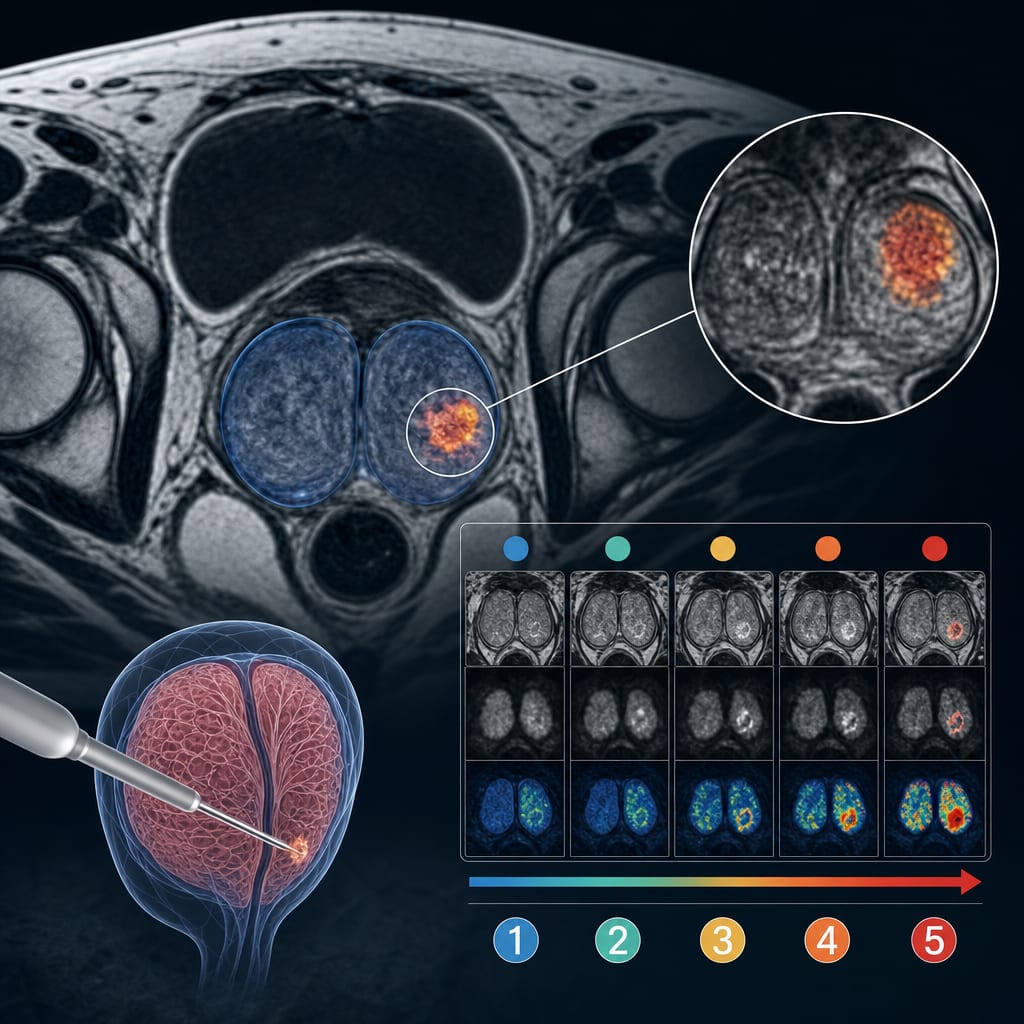
To evaluate the utility of the PRECISE scoring system for assessing radiological changes in prostate MRI during active surveillance in an international multicenter setting, highlighting its potential impact on patient management.

Key Findings:
  • The PRECISE scoring system effectively predicted biopsy progression in patients on active surveillance, with a statistically significant correlation.
  • Higher PRECISE scores (4-5) were associated with increased likelihood of Gleason score upgrade, with specific odds ratios provided.
  • The study demonstrated the utility of MRI in improving patient selection for active surveillance, potentially reducing unnecessary interventions.
Interpretation:

The PRECISE scoring system is a valuable tool for monitoring prostate cancer progression during active surveillance, aiding in clinical decision-making.

Limitations:
  • Retrospective design may introduce bias, particularly in patient selection and data interpretation.
  • Variability in MRI protocols across centers could affect results, necessitating careful consideration in multicenter studies.
  • Exclusion of certain patient groups limits generalizability, particularly among those with higher Gleason scores.
Conclusion:

The PRECISE scoring system is validated as a reliable method for assessing radiological changes in prostate MRI, enhancing the management of patients on active surveillance and potentially improving clinical outcomes.

Original Source(s)

Related Content