Conexiant’s news site is now MDSpire News. Learn more
Advertisement
AI may estimate chest fluid with similar efficacy to radiologists
A general-purpose AI model performed comparably to experienced readers, but substantial errors highlighted the limits of chest radiography for quantifying pleural fluid.
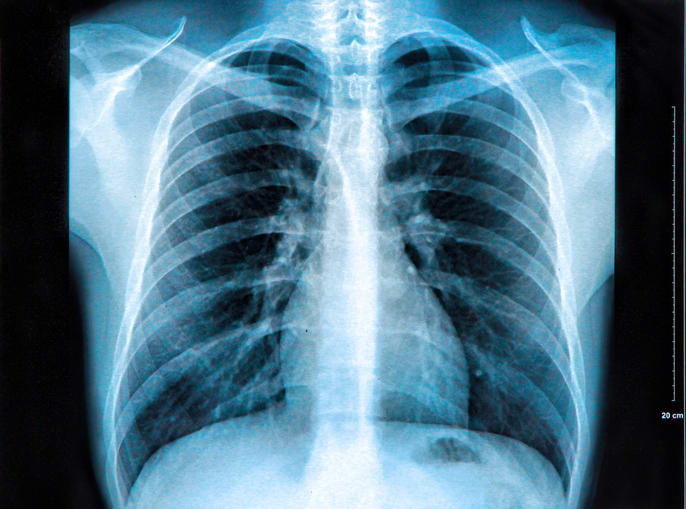
To compare the accuracy of an AI model and experienced radiologists in estimating pleural effusion volume on chest radiography.
Approach:
Study Design: Retrospective observational study of 88 adult patients who underwent chest radiography and computed tomography (CT) on the same day.
Participants: Patients with CT-confirmed pleural effusion of at least 20 mL in 1 hemithorax.
Methods: Two radiologists estimated pleural fluid volume on radiographs while blinded to CT measurements. An AI model analyzed the same radiographs.
Evaluation: Agreement between CT-derived volumes and estimates from radiologists and AI was assessed, along with estimation error and identification of clinically significant effusions.
Key Findings:
Moderate agreement with CT across all three approaches (radiologists and AI).
Mean estimation errors were 300 mL for radiologist 1, 250 mL for radiologist 2, and 264 mL for AI.
Positive bias in estimates: 103 mL for radiologist 1, 146 mL for radiologist 2, and 57 mL for AI.
Area under the curve (AUC) for identifying pleural effusions of at least 300 mL was 0.84 for radiologist 1, 0.90 for radiologist 2, and 0.85 for AI.
AI showed high within-session consistency but lower between-session consistency.
Interpretation:
The wide limits of agreement observed across all evaluators in this retrospective cohort confirm that chest radiography provides only a coarse approximation of pleural fluid volume, irrespective of the interpreter.
Limitations:
Retrospective design and single institution study limit generalizability.
Cohort selection enriched for positive cases, introducing spectrum bias.
CT volumetry used as reference standard rather than actual drained fluid volume.
Only one AI model evaluated, which may change with software updates.
Conclusion:
The findings indicate that both AI and radiologists have similar estimation capabilities for pleural effusion volume, but substantial variability exists.