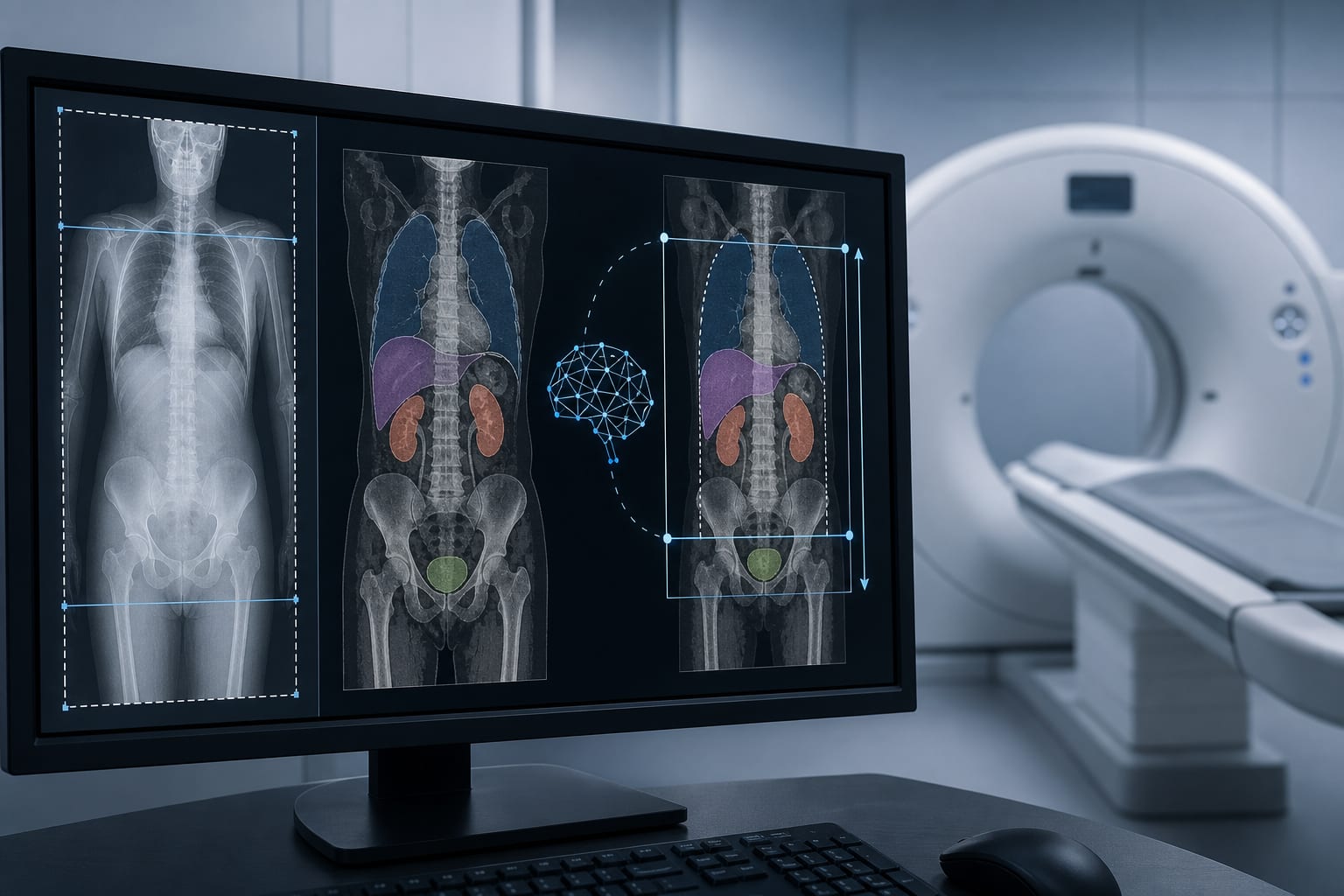
To develop and validate an AI model for accurately segmenting anatomical structures in scout views to optimize scan ranges in CT imaging, thereby reducing unnecessary radiation exposure.
Key Findings:
Overscanning occurs in 30–60% of cases, leading to increased radiation exposure, highlighting the need for improved scan range determination.
AI can effectively segment multiple anatomical structures critical for determining scan ranges, suggesting its utility in clinical practice.
The study demonstrated the feasibility of automated scan-range optimization using AI, paving the way for future applications.
Interpretation:
The AI model shows promise in reducing unnecessary radiation exposure by optimizing scan lengths based on accurate anatomical segmentation, potentially transforming CT imaging practices.
Limitations:
The study is retrospective and conducted at a single center, which may limit generalizability to broader populations.
The model's performance in diverse clinical settings and with different patient populations remains to be validated, necessitating further research.
Conclusion:
The implementation of AI for scan-range optimization in CT imaging could significantly enhance patient safety by minimizing radiation exposure, but further validation in diverse clinical settings is essential.
by Sebastian Ziegelmayer, Tristan Lemke, Markus Graf, Su Hwan Kim, Lukas Lemke, Christian J. Mertens, Felix Busch, Dominik Weller, Marcus R. Makowski, Lisa C. Adams, Keno K. Bressem