Spontaneous Coronary Artery Dissection in an Underrepresented Region: Insights from the Serbian (RS) SCAD Registry - Summary - MDSpire

Spontaneous Coronary Artery Dissection in an Underrepresented Region: Insights from the Serbian (RS) SCAD Registry

  • By

  • Apostolović, Svetlana Radomir

  • Stanojevic, Dragana

  • Mehmedbegovic, Zlatko

  • Krljanac, Gordana

  • Ilić, Ivan

  • Petrovic, Milovan

  • Djokovic, Aleksandra

  • Mitov, Vladimir

  • Zdravkovic, Vladimir

  • Kovacevic, Mila

  • Maricic, Bojan

  • Andjelkovic Apostolovic, Marija

  • Nikolic, Miroslav

  • Cankovic, Milenko

  • Dabovic, Dragana

  • Zivanovic, Zeljko

  • Stanetic, Bojan

  • Iveljic, Ivana

  • Nikolic, Dusan

  • Aleksandric, Srdjan

  • Beleslin, Branko Dusan

  • April 24, 2026

  • 0 min

Share

Objective:

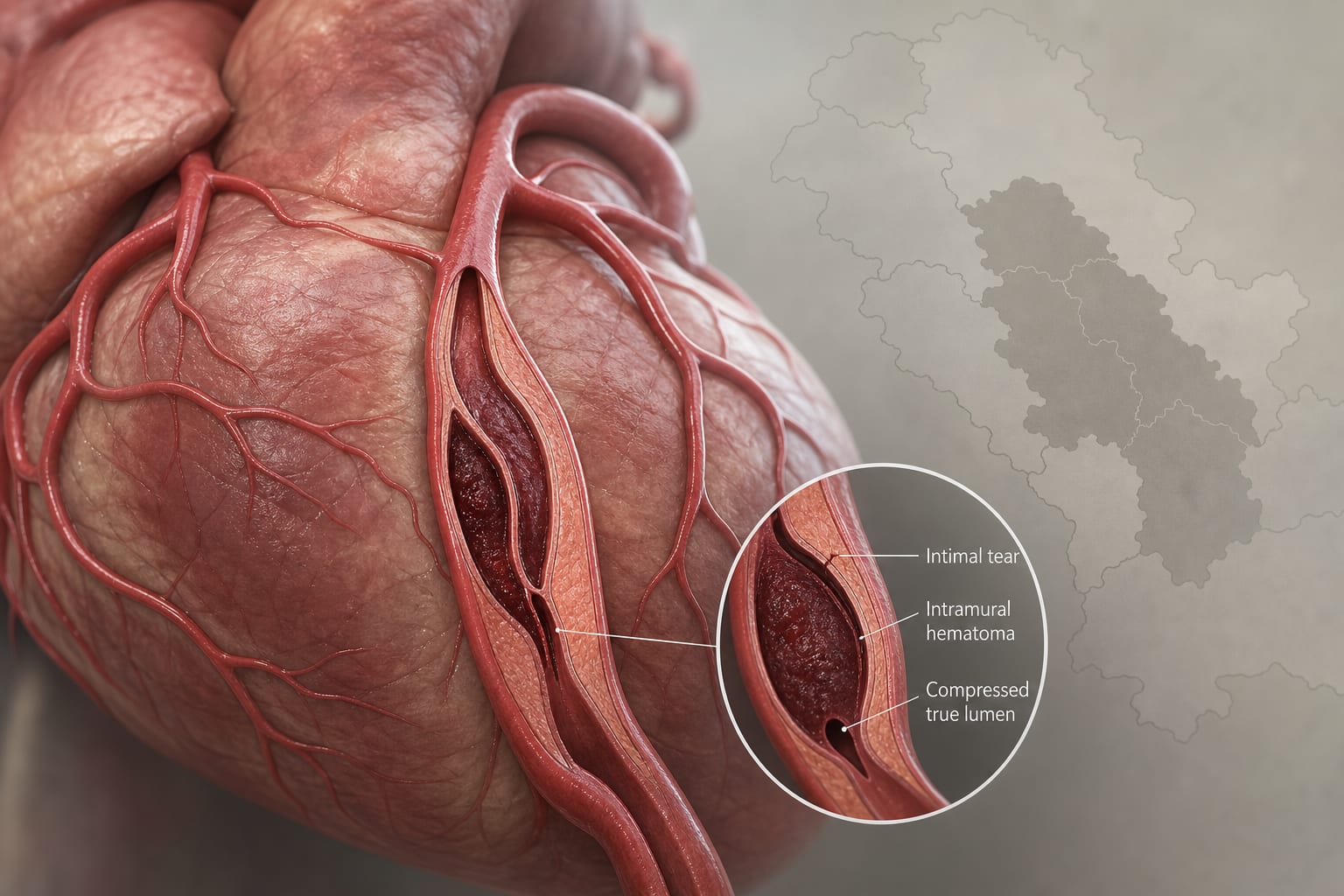
To provide comprehensive multicenter data on spontaneous coronary artery dissection (SCAD) from the Serbian SCAD Registry, highlighting significant differences from Western cohorts that may impact clinical management.

Key Findings:
  • Among 123 patients, the mean age was 47.8 years, with 85.4% being female.
  • High prevalence of traditional cardiovascular risk factors: hypertension (49.6%), dyslipidemia (46.3%), smoking (41.5%).
  • Emotional stress was the most common precipitating factor (38.5%).
  • Left anterior descending artery involvement occurred in 56.1%, with Type 2a SCAD being the most frequent (42.1%).
  • PCI was performed in 51.3%, and dual antiplatelet therapy was prescribed in 87%.
  • In-hospital MACE occurred in 23.6%, with mortality at 8.1%.
  • One-year MACE was 8.2%.
Interpretation:

The Serbian SCAD cohort exhibits a distinct profile with a higher burden of cardiovascular risk factors and adverse events compared to Western registries, suggesting a need for improved management strategies that could enhance patient outcomes.

Limitations:
  • Data primarily derived from a single region may limit generalizability to other populations.
  • Follow-up duration may not capture long-term outcomes comprehensively, potentially underestimating the true incidence of adverse events.
Conclusion:

The findings indicate that greater adherence to guideline-based conservative management may improve outcomes for SCAD patients in Eastern Europe, highlighting the need for tailored approaches in this demographic.

Original Source(s)

Related Content