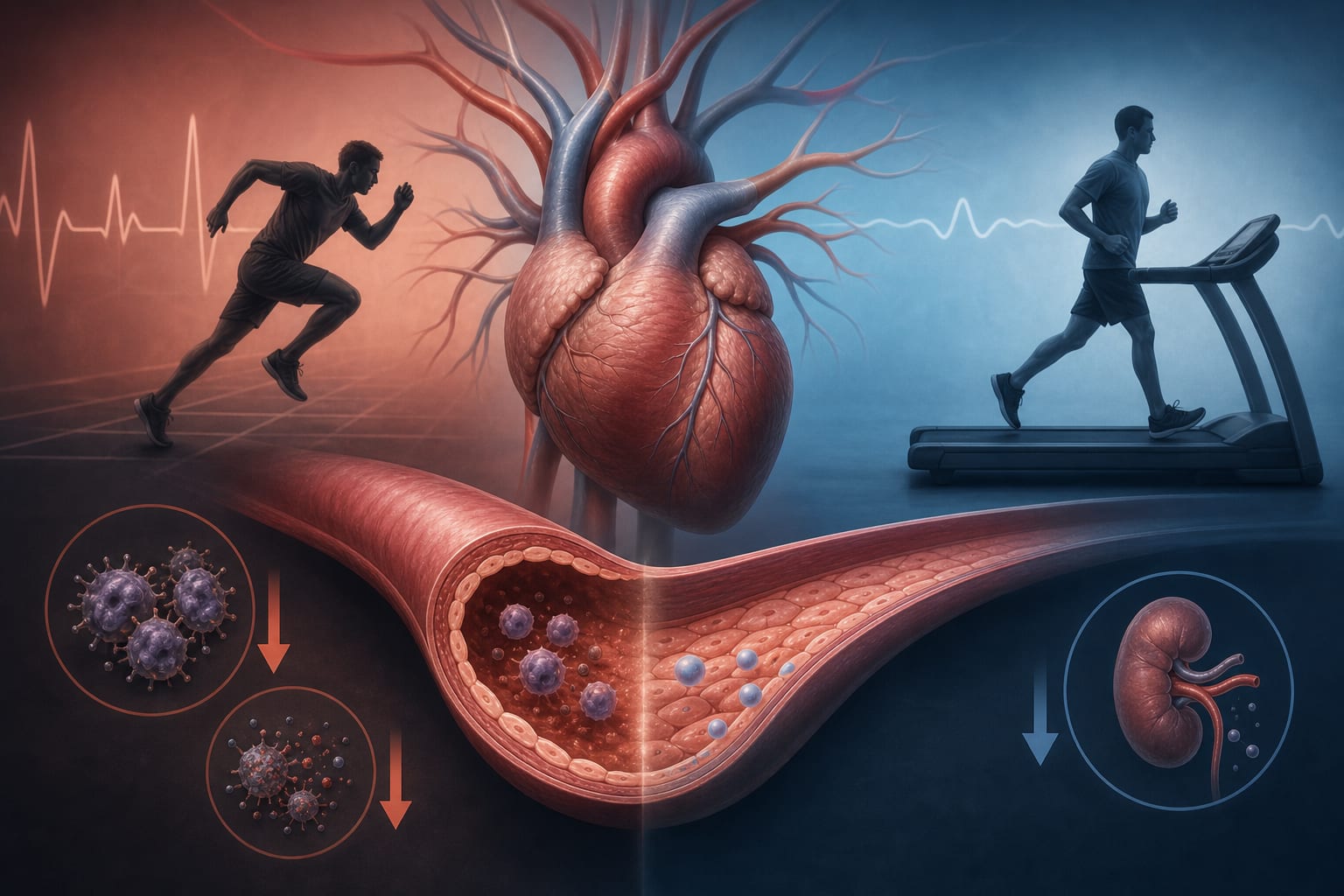
Effects of HIIT and MICT on cardiovascular function in essential hypertension: roles of inflammation, oxidative stress, and RAS axis - Summary - MDSpire
Advertisement
Impact of HIIT versus MICT on cardiovascular health in essential hypertension: examining inflammation, oxidative stress, and the RAS pathway
To compare the effects of High Intensity Interval Training (HIIT) and Moderate Intensity Continuous Training (MICT) on blood pressure homeostasis, cardiovascular structure, and function in patients with essential hypertension (EH).
Approach:
Study Design: A single-blind, two-arm, parallel randomized controlled trial involving 56 EH patients assigned to either HIIT or MICT for 8 weeks.
Intervention: HIIT consisted of 1 × 10 min with 2 min intervals, while MICT involved 35 min of continuous training, both performed three times per week.
Outcome Measures: Primary outcome was change in flow-mediated dilation (FMD); secondary measures included blood pressure, cardiovascular risk factors, and neuro-humoral regulation.
Key Findings:
HIIT group showed a significantly greater improvement in FMD compared to MICT (mean difference: 0.85% [95% CI, 0.50–1.21]).
HIIT resulted in favorable changes in nitric oxide, endothelin-1, arterial stiffness, and inflammatory biomarkers (all P < 0.05).
Both HIIT and MICT significantly improved systolic blood pressure, pulsatility index, resistive index, angiotensin II, and norepinephrine (all P 0.05).
Interpretation:
Both HIIT and MICT similarly lower systolic blood pressure in EH patients, with HIIT showing a greater improvement in endothelial function and certain cardiovascular parameters.
Limitations:
Small sample size of 56 participants may limit generalizability.
Short duration of 8 weeks may not capture long-term effects of exercise interventions.
Conclusion:
Both HIIT and MICT demonstrate efficacy in improving FMD and lowering systolic blood pressure, with HIIT showing superior effects on arterial stiffness and certain cardiovascular parameters.