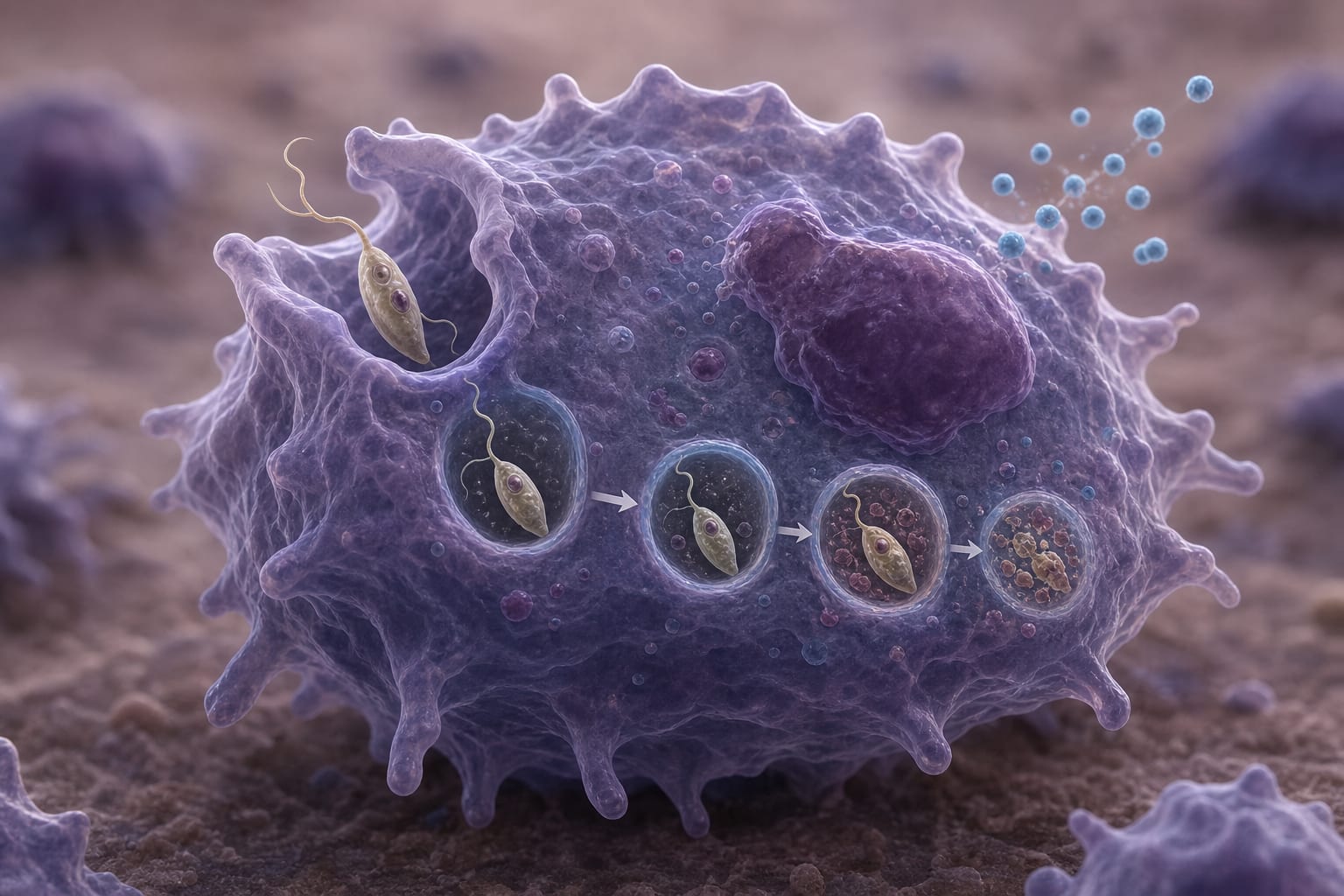
To elucidate the involvement of phagosome formation in the control of intracellular parasites in macrophages from subclinical (SC) individuals compared to those from cutaneous leishmaniasis (CL) patients, focusing on the differences in phagosome formation speed and effectiveness.
Key Findings:
SC macrophages exhibited higher expression of LAMP-1 during the initial stages of infection compared to CL macrophages.
SC macrophages maintained effective control over L. braziliensis, showing a lower number of viable parasites during the infection kinetics.
L. braziliensis killing was observed within the first 2 to 4 hours of infection, continuing effectively even after 48 hours.
Interpretation:
SC macrophages can form phagosomes more quickly and sustain their activity longer, leading to better control of L. braziliensis compared to CL macrophages, highlighting the importance of phagosome dynamics in parasite management.
Limitations:
The study was conducted in a specific endemic area, which may limit the generalizability of the findings to other regions.
The mechanisms underlying the differences in phagosome formation between SC and CL macrophages require further investigation to understand their implications.
Conclusion:
SC macrophages demonstrate enhanced phagosome formation and effective parasite control compared to CL macrophages.
by Caic Figueiredo, Alan Rocha dos Santos, Camila Pimentel, Maurício T. Nascimento, Fabio Peixoto, Vítor Oliveira, Olivia Bacellar, Lucas P. Carvalho, Edgar M. Carvalho, Thiago M. Cardoso