Diagnostic performance and clinical utility of shear-wave elastography in musculoskeletal soft-tissue tumors: a systematic review
By
Yayun Lin
Jianping Wang
Hao Sun
Jianmin Zhou
June 30, 2026
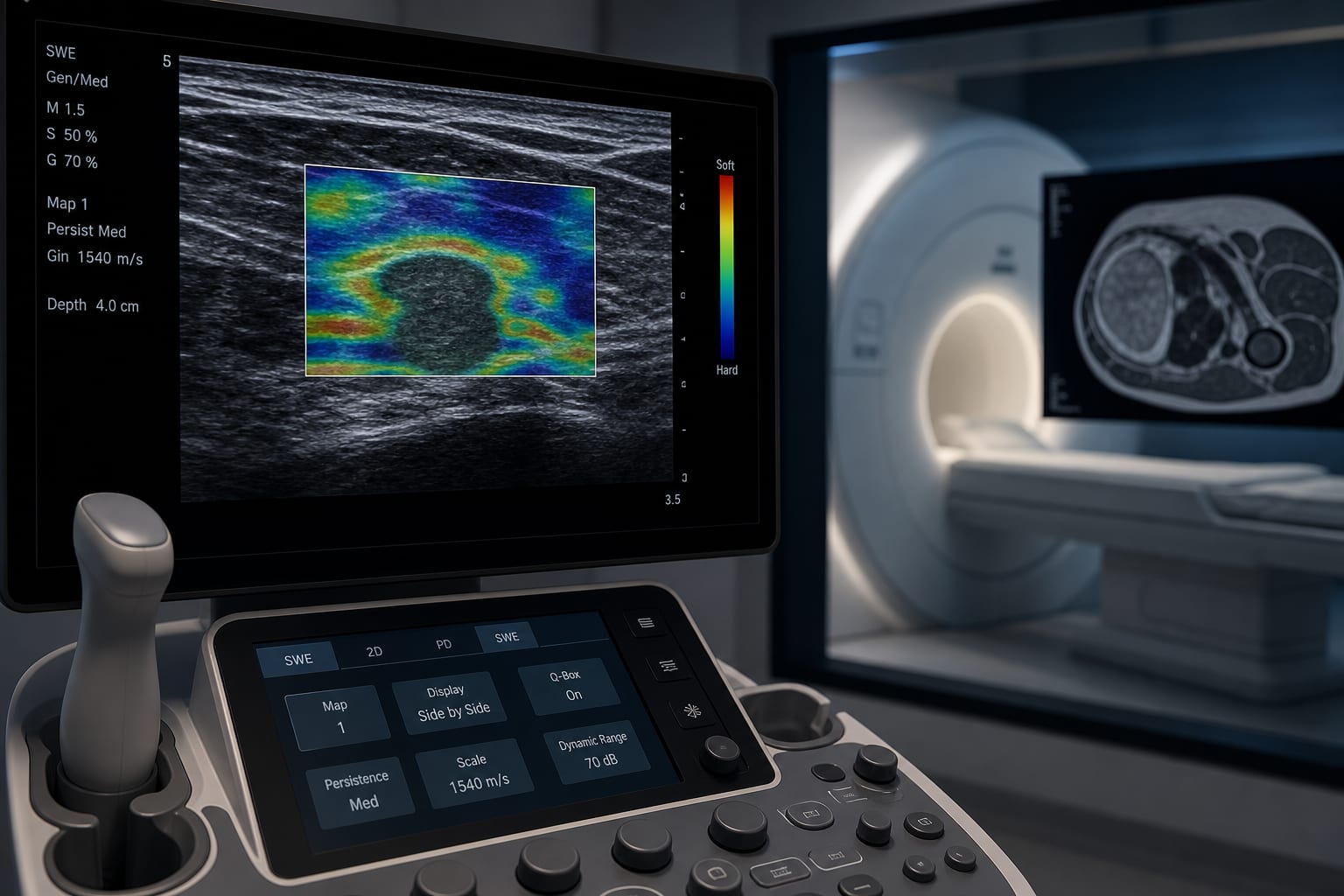
Objective: To evaluate the diagnostic accuracy, reproducibility, and clinical utility of SWE for differentiating benign and malignant soft-tissue tumors.
Approach: Study Selection: Eligible studies included patients with histologically verified extraosseous soft-tissue masses evaluated using quantitative SWE.Data Extraction: Sensitivity, specificity, and area under the ROC curve (AUC) were extracted or reconstructed.Synthesis Method: Due to methodological and threshold heterogeneity, a narrative synthesis was performed.Evidence Rating: Certainty of evidence was rated with GRADE-DTA.Key Findings: Ten studies (n = 1,335 lesions; 22-41% malignant) met inclusion criteria. SWE reproducibility was high (intraclass correlation coefficient > 0.85 in four studies). Diagnostic performance varied widely (AUC range 0.57-0.87). SWE showed higher specificity in benign-appearing or superficial lesions but struggled to distinguish lipomatous or deep lesions from malignancy. MRI was superior in most direct comparisons (AUC 0.85-0.90). Certainty of evidence was moderate for superficial lesions and low for deep or lipomatous tumors. Interpretation: SWE demonstrates excellent reproducibility but inconsistent diagnostic utility across lesion types.
Limitations: Marked methodological and threshold heterogeneity. Poor cross-vendor reproducibility. Limited generalizability due to varying lesion characteristics. Conclusion: Standardized acquisition protocols and vendor calibration are prerequisites for broader clinical adoption.
Sources: