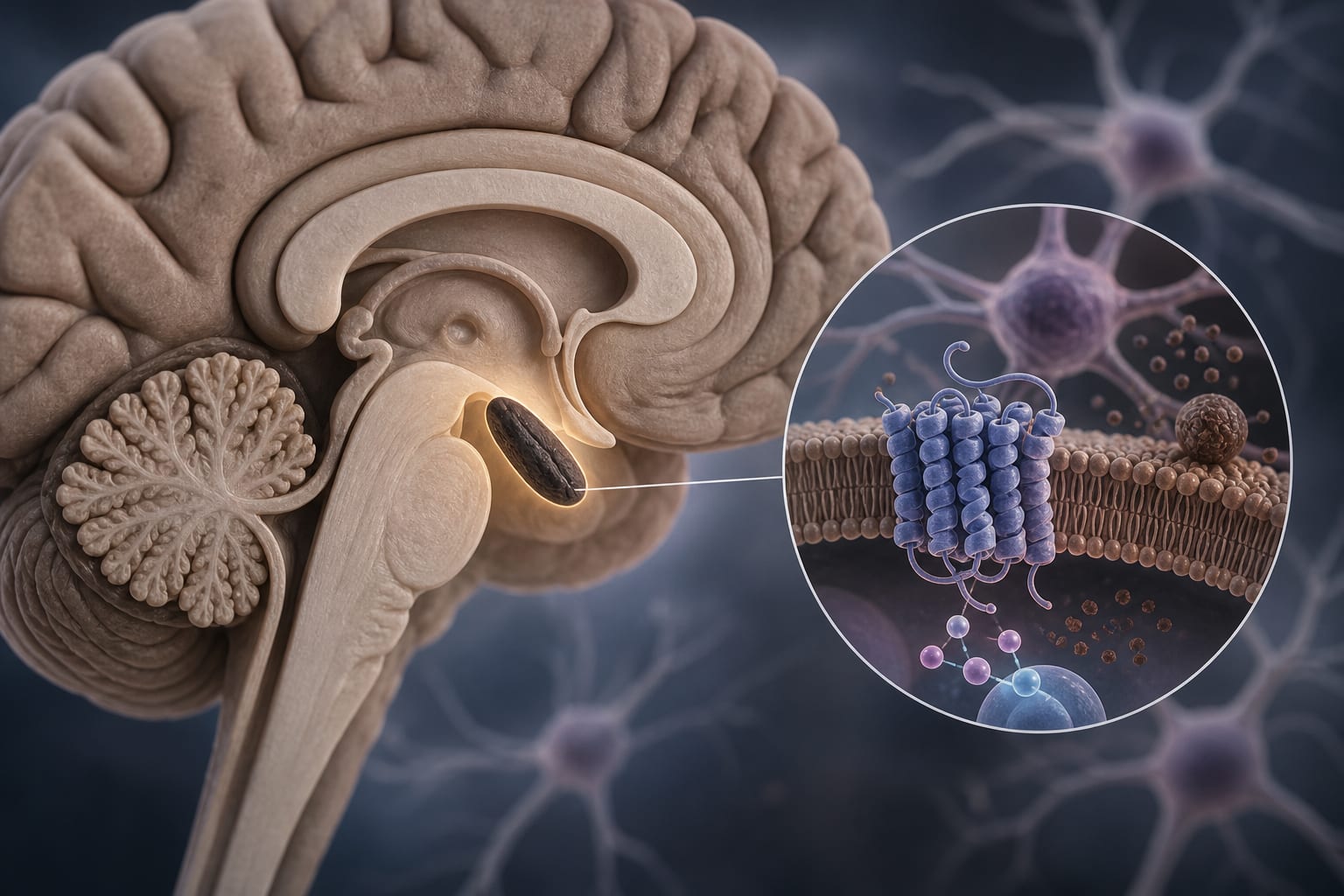
To assess whether MC1R loss-of-function variants are associated with differences in Parkinson disease (PD) progression after onset.
Approach:
Study design and cohorts: Longitudinal cohort study using PPMI data, with an independent replication cohort pooled from SURE-PD phase 2, SURE-PD3, and STEADY-PD III.
Participants and exposure: The primary analysis included 383 PPMI participants with sporadic PD; 231 carried an MC1R loss-of-function variant and 152 did not. Variants were also examined by zygosity, penetrance, and individual variant.
Outcomes and analysis: Mixed-effects models estimated annual changes in MDS-UPDRS Part III motor scores and secondary clinical, cognitive, autonomic, sleep, mood, and dopamine-transporter imaging measures. Mean follow-up in PPMI was 6.8 years.
Interpretation:
The supplied article context describes the study rationale and methods but does not report results; no findings about the association between MC1R variants and PD progression can be summarized.
Limitations:
The provided context ends during the statistical methods and contains no results or discussion.
Details of the independent replication cohort and its findings are not included in the supplied context.
Conclusion:
The study was designed to evaluate whether common MC1R loss-of-function variants modify PD progression, but the supplied material does not state the study’s conclusions.
by Jackson G. Schumacher, Xinyuan Zhang, Jian Wang, Johannes M. Dijkstra, Hirohisa Watanabe, Xiang Gao, Marianna Cortese, Eric A. Macklin, Michael A. Schwarzschild, Xiqun Chen