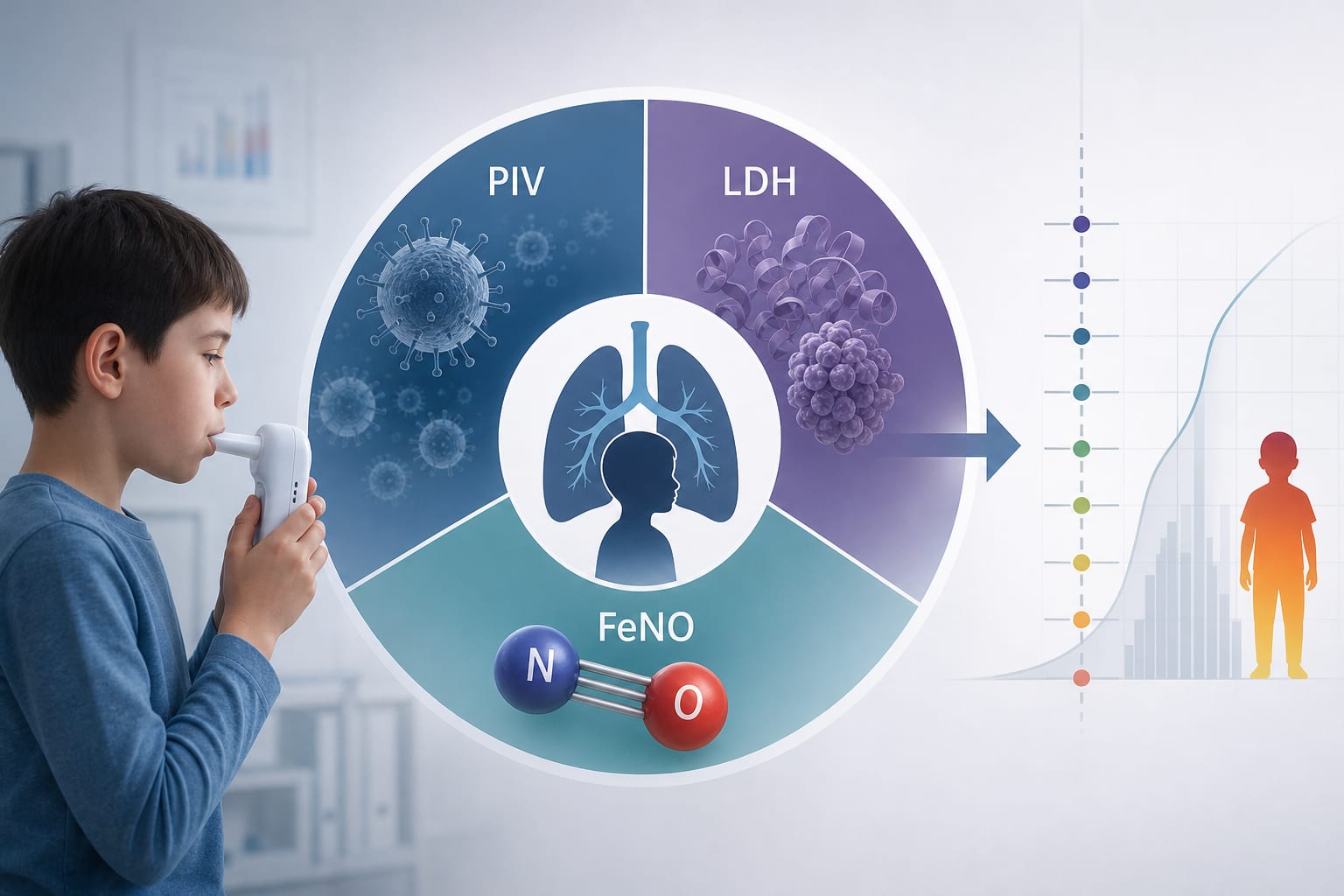
Development and internal validation of a multidimensional nomogram integrating PIV, LDH, and FeNO for predicting poor asthma control in school-aged children - Summary - MDSpire
Conexiant’s news site is now MDSpire News. Learn more
Advertisement
Creation and internal assessment of a comprehensive nomogram combining PIV, LDH, and FeNO to forecast inadequate asthma management in pediatric patients
To develop and internally validate a risk stratification model integrating systemic inflammatory, metabolic, and airway-specific indicators for identifying uncontrolled asthma in pediatric patients.
Approach:
Study Design: Retrospective study involving 232 children with bronchial asthma aged 6–14 years.
Data Collection: Clinical data, laboratory biomarkers, and pulmonary function parameters were collected, with asthma control assessed using the Childhood Asthma Control Test (C-ACT).
Statistical Analysis: LASSO regression was used for variable selection, followed by multivariate logistic regression to identify independent predictors.
Model Evaluation: Internal model performance was evaluated using ROC analysis, calibration curves, and decision curve analysis (DCA).
Key Findings:
Six independent predictors of poor asthma control were identified: PIV (OR=1.008), LDH (OR=1.043), FeNO (OR=1.056), Vitamin D (OR=0.891), asthma duration (OR=1.251), and FEV1% predicted (OR=0.953).
PIV, LDH, FeNO, and asthma duration were identified as risk factors, while Vitamin D and FEV1% predicted were identified as protective factors.
The combined model demonstrated superior predictive performance (AUC = 0.886) compared to individual biomarkers and the baseline model.
The nomogram showed good calibration and provided favorable clinical net benefit in decision curve analysis (DCA).
Interpretation:
A multidimensional model integrating various biomarkers provides accurate risk stratification for poor asthma control in school-aged children.
Conclusion:
This approach may facilitate localized risk assessment and support personalized management in pediatric asthma.