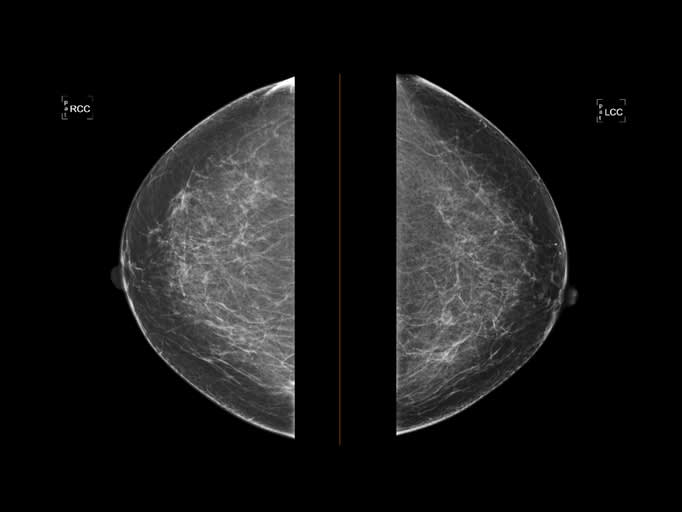
The article examines AI applications in breast imaging, including lesion detection, imaging-derived risk assessment, risk-based screening, and workflow support.
Approach:
Imaging analysis: AI can identify and characterize findings, quantify breast density, and assess imaging features such as tissue distribution, asymmetry and texture.
Risk assessment: After a normal mammogram, algorithms can compare imaging patterns with databases to estimate short-term breast cancer risk; these estimates may change across examinations.
Practice operations: Applications described include case triage, report generation, technical quality assessment and detection of breast arterial calcifications.
Key Findings:
The article describes mammographic risk phenotype as an imaging-derived estimate of future breast cancer risk, distinct from assessment of visible lesions.
Combining mammographic risk with clinical information may improve predictive performance; genetic information could potentially further refine stratification.
Dr. Schilling reports that her practice has observed improved cancer detection, including invasive and interval cancers, alongside fewer false-positive and false-negative examinations, recalls and biopsies, and greater efficiency and confidence.
The article states that AI-derived risk approaches remain under investigation.
Interpretation:
AI-derived imaging features may complement clinical risk information and, potentially, genetic information in individualized screening. The article states that clinical studies must demonstrate improved patient outcomes before screening frequency or modality is changed on the basis of AI-derived risk.
Limitations:
The article provides no study design, sample size, quantitative effect estimates or citations for the practice outcomes reported by Dr. Schilling.
The article notes that AI-derived risk approaches remain under investigation and that improved risk prediction must translate into better patient outcomes before screening changes are made.
Conclusion:
Potential applications include identifying patients who may warrant supplemental imaging or intensified surveillance, as well as informing less intensive screening for patients consistently classified as lower risk. These approaches remain under investigation.
Harold Burstein, MD, PhD, and Laura S. Dominici, MD, FACS, discuss highlights from the SENOMAC trial which sheds light on whether some patients with early breast cancer and limited lymph node involvement can safely avoid additional axillary surgery.
Patients with estrogen-receptor-positive (ER+) HER-2-negative advanced breast cancer experienced significantly improved progression-free survival (PFS) when treated with an oral combination regimen that included giredestrant, a novel, next-generation selective ER degrader and full antagonist (SERD), compared to a standard combination approach.