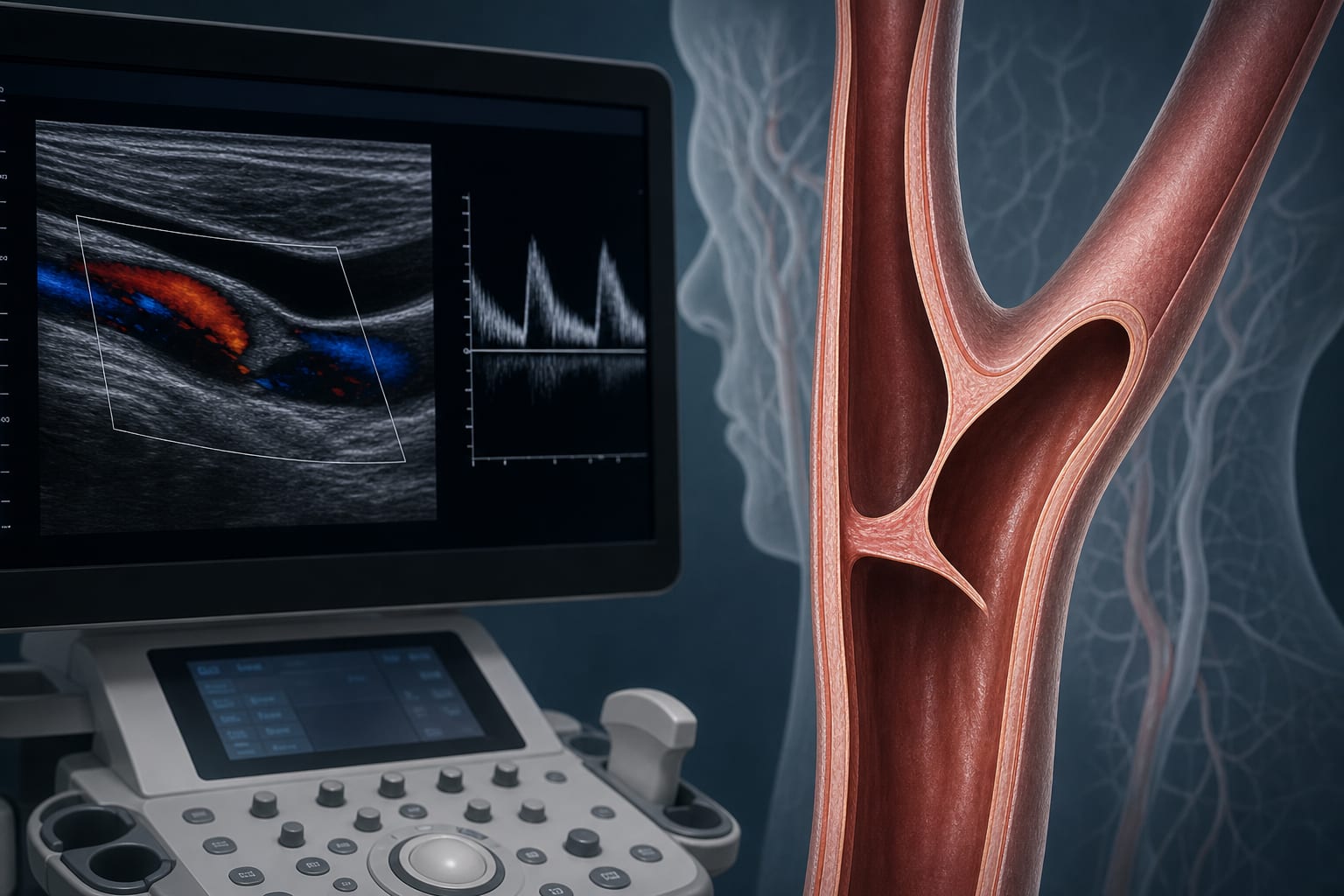
To investigate the differences between symptomatic and asymptomatic carotid webs (CWs) using clinical and ultrasound morphological features and identify potential risk factors for CW-associated ischemic stroke.
Approach:
Study Design: Retrospective recruitment of 45 patients diagnosed with CW using digital subtraction angiography or computed tomography angiography.
Data Collection: Patients categorized based on occurrence of CW-associated stroke; multimodal ultrasound used to identify morphological characteristics, carotid stenosis rate, and hemodynamic alterations.
Statistical Analysis: Binary-variable logistic regression assessed high-risk ultrasound morphologic features of CW-induced ischemic stroke.
Key Findings:
15 out of 45 patients had stroke-related symptomatic CWs.
Symptomatic patients had higher prevalence of hyperlipidemia and greater web dimensions (length: 5.80 ± 1.64 mm vs. 4.41 ± 1.67 mm, p = 0.011; thickness: 1.88 ± 0.43 mm vs. 1.38 ± 0.39 mm, p < 0.001).
Higher prevalence of curved CW shape in symptomatic patients (80.0% vs. 43.3%, p = 0.044).
Symptomatic group had more severe CW-induced stenosis (46.35 ± 9.89% vs. 40.13 ± 11.44%).
Lower resistance index in symptomatic cases (0.59 ± 0.10 vs. 0.65 ± 0.07, p = 0.02).
Multivariate analysis identified CW length, thickness, and lower RI as independently associated factors of symptomatic CWs.
Interpretation:
Limitations:
Retrospective design may introduce selection bias.
Small sample size limits generalizability of findings.
Lack of standardized criteria for distinguishing symptomatic from asymptomatic CWs.