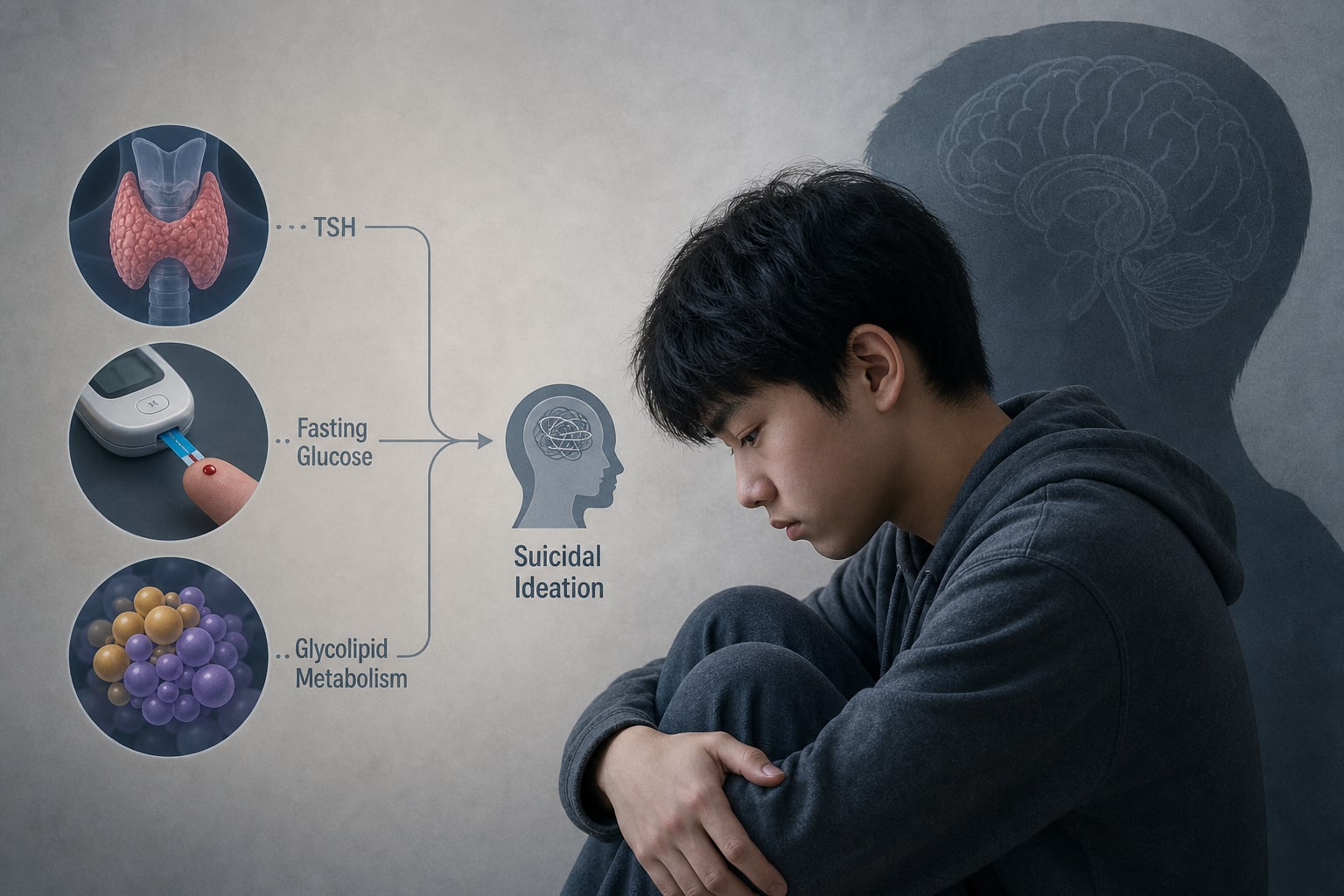
Thyroid-stimulating hormone, fasting blood glucose and suicidal ideation in Chinese adolescents with major depressive disorder: a cross-sectional study - Summary - MDSpire
Advertisement
Association of Thyroid-Stimulating Hormone, Fasting Glucose Levels, and Suicidal Thoughts in Chinese Adolescents Diagnosed with Major Depressive Disorder: A Cross-Sectional Analysis
To investigate the associations between TSH levels, glycolipid metabolism parameters, and suicidal ideation in adolescents with MDD.
Approach:
Study Design: Cross-sectional study conducted in Anhui Province, China.
Participants: 146 adolescents with MDD and 70 healthy controls were enrolled.
Assessment Tools: Depressive symptoms and SI severity were assessed using HAMD-24 and PANSI.
Data Collection: Socio-demographic data, laboratory parameters, TSH levels, and glycolipid metabolism parameters were collected.
Key Findings:
Adolescents with MDD had significantly lower fasting blood glucose levels compared to healthy controls (P < 0.001).
Worse family relationships, higher HAMD-24 scores, and elevated TSH and FBG levels were independently associated with suicidal ideation (all P < 0.05).
The combination of these factors demonstrated a good discriminatory ability for suicidal ideation, with an area under the curve (AUC) of 0.851.
Interpretation:
TSH and FBG levels are associated with SI in adolescents with MDD, but further validation in larger studies is needed to determine their clinical utility as biomarkers.
Limitations:
Cross-sectional design limits causal inferences.
Sample size may not be representative of the broader population.
Conclusion:
Further research is warranted to explore the associations between TSH and FBG levels and suicidal ideation in adolescents with MDD.