Alectinib combined with 5-aminolevulinic acid-based photodynamic therapy promotes apoptosis in endometrial cancer cells by targeting ferrochelatase - Summary - MDSpire
Conexiant’s news site is now MDSpire News. Learn more
Advertisement
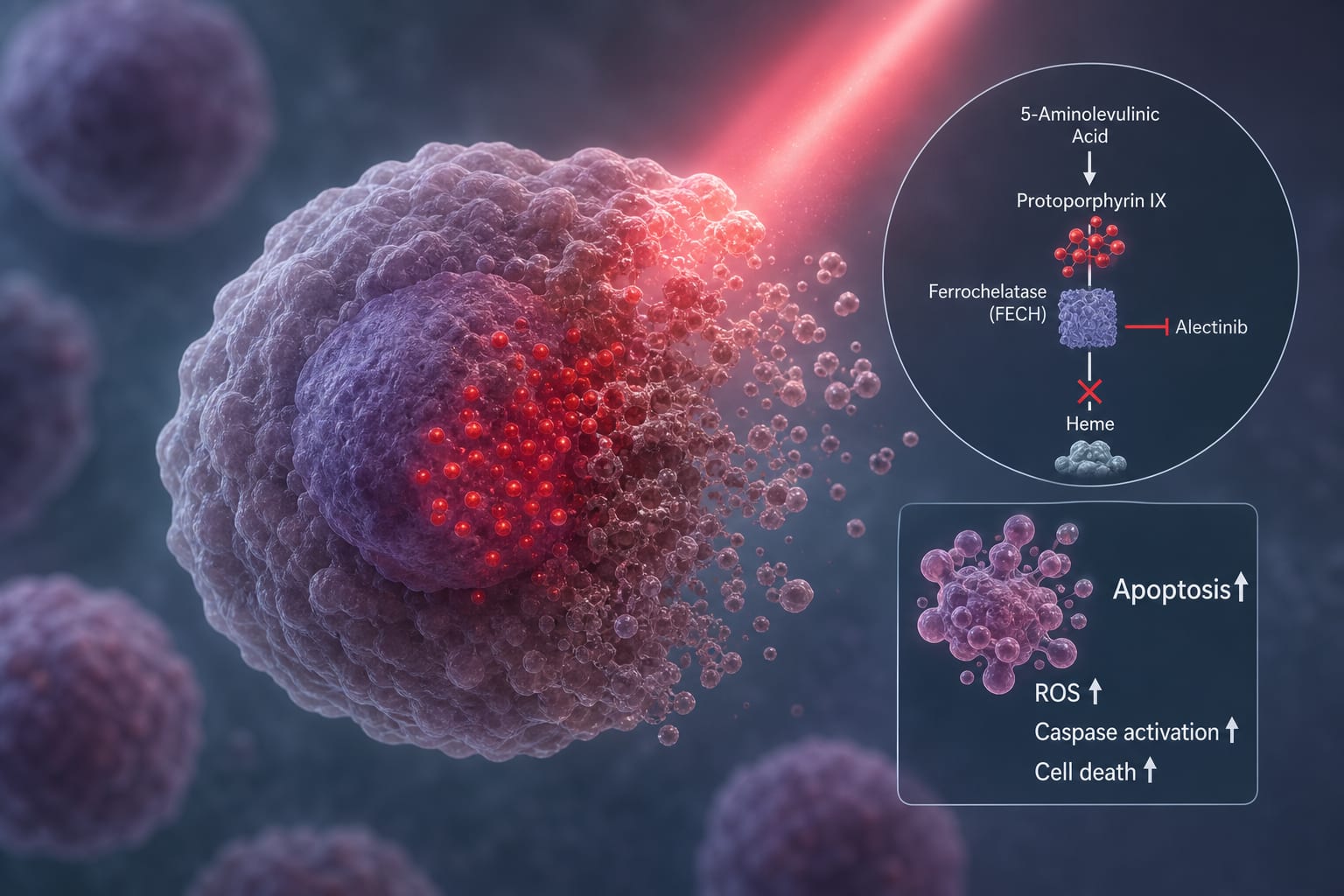
Combination of Alectinib and 5-Aminolevulinic Acid-Based Photodynamic Therapy Enhances Apoptosis in Endometrial Cancer Cells by Inhibiting Ferrochelatase Activity
To investigate the antitumor effect and underlying mechanism of alectinib combined with 5-aminolevulinic acid-based photodynamic therapy (ALA-PDT) on endometrial cancer cells via targeting FECH.
Approach:
Cell Lines: In vitro study on human endometrial cancer Ishikawa (ISK) and HEC-1-A cell lines.
Cytotoxicity Assay: Cytotoxicity of alectinib was assessed using CCK8 assay to determine optimal concentration.
Microscopy and Staining: Confocal laser microscopy was used to observe PpIX localization; ROS generation was detected by fluorescent probe staining.
Gene and Protein Expression: qPCR and Western blotting measured mRNA and protein levels of FECH after alectinib treatment.
Alectinib's IC50 values were 38.83 μM for ISK and 42.70 μM for HEC-1-A cells.
PpIX co-localized with mitochondria, showing higher fluorescence intensity in alectinib and ALA groups compared to control.
Combination treatment with alectinib and ALA-PDT promoted ROS accumulation and reduced heme levels.
Alectinib treatment increased FECH mRNA and protein expression significantly (P<0.05).
Combined treatment induced a higher apoptosis rate than ALA or alectinib alone.
Interpretation:
Alectinib may enhance the efficacy of ALA-PDT in endometrial cancer by targeting FECH, promoting PpIX accumulation and apoptosis.
Limitations:
Study conducted in vitro; results may not directly translate to clinical settings.
Further research needed to explore the in vivo efficacy and safety of the combination treatment.
Conclusion:
Alectinib targets FECH activity to enhance mitochondrial PpIX accumulation, leading to increased apoptosis in endometrial cancer cells when combined with ALA-PDT.
An updated clinical practice guideline from the American Society for Radiation Oncology substantially expands and modernizes recommendations for the use of radiation therapy in pancreatic cancer.