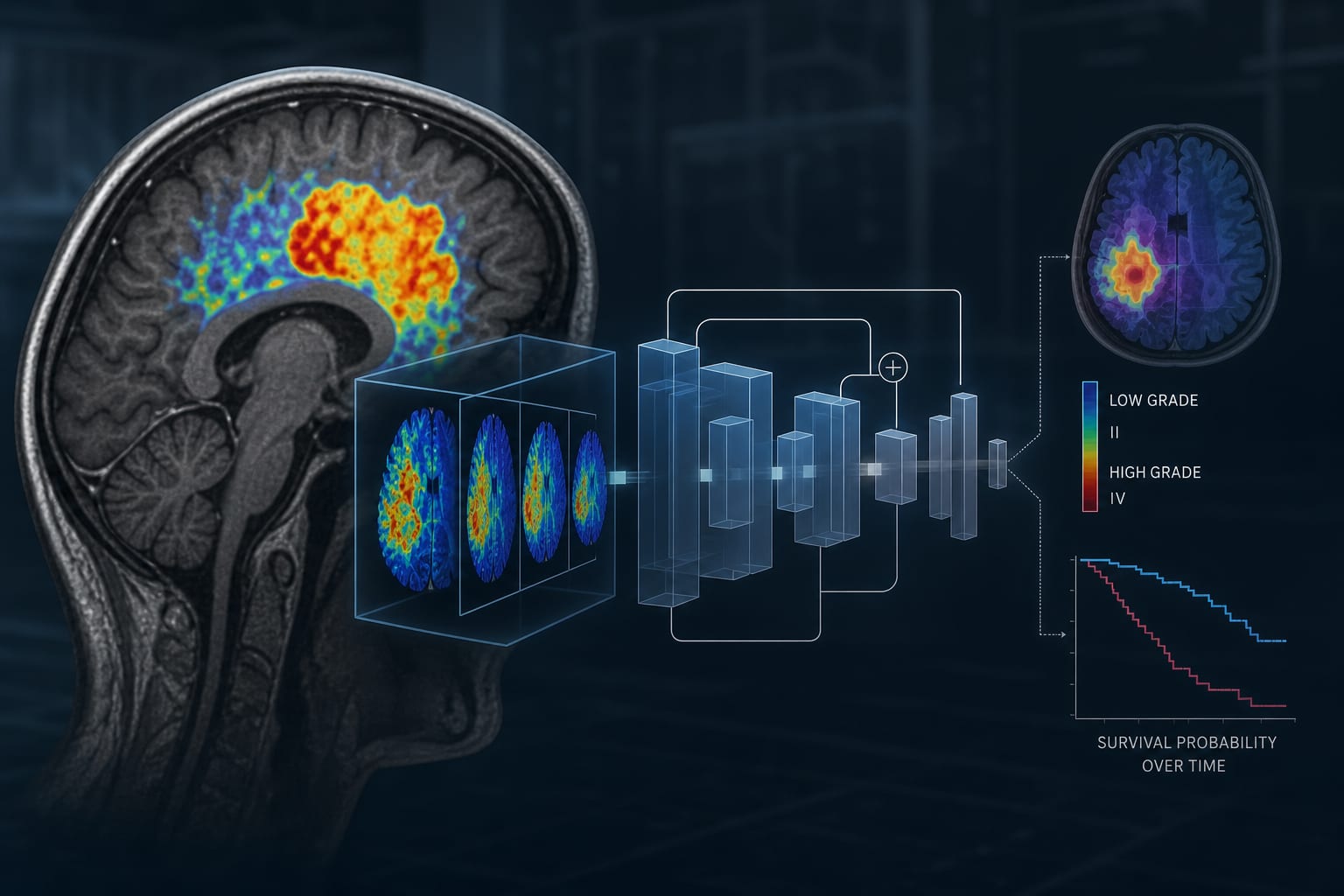
To develop and validate ASLNet, an interpretable deep learning model for predicting histopathologic grade and overall survival in patients with diffuse glioma using ASL MRI, highlighting its significance in clinical prognosis.
Key Findings:
The ASLNet grading model achieved an AUC of 0.79, macro-F1 score of 0.74, accuracy of 0.60, and recall of 0.73, indicating its potential utility in clinical settings.
The OS prediction model achieved an AUC of 0.70, macro-F1 score of 0.73, accuracy of 0.66, and recall of 0.94 for the long-survival class, suggesting its relevance for patient management.
Interpretation:
ASLNet demonstrates the potential of interpretable, perfusion-based deep learning for glioma grade and survival prediction, suggesting that ASL MRI contains clinically relevant prognostic information that could enhance patient outcomes.
Limitations:
Further external validation is warranted to confirm the findings, as the retrospective nature of the study may introduce biases that affect the generalizability of the results.
Conclusion:
ASL-based deep learning models like ASLNet could serve as valuable noninvasive tools for glioma risk stratification, enhancing clinical decision-making.
by Rafail C. Christodoulou, Georgios Vamvouras, Platon S. Papageorgiou, Evros Vassiliou, Sokratis G. Papageorgiou, Christina Kalogeropoulou, Peter Zampakis, Elena E. Solomou, Michalis F. Georgiou