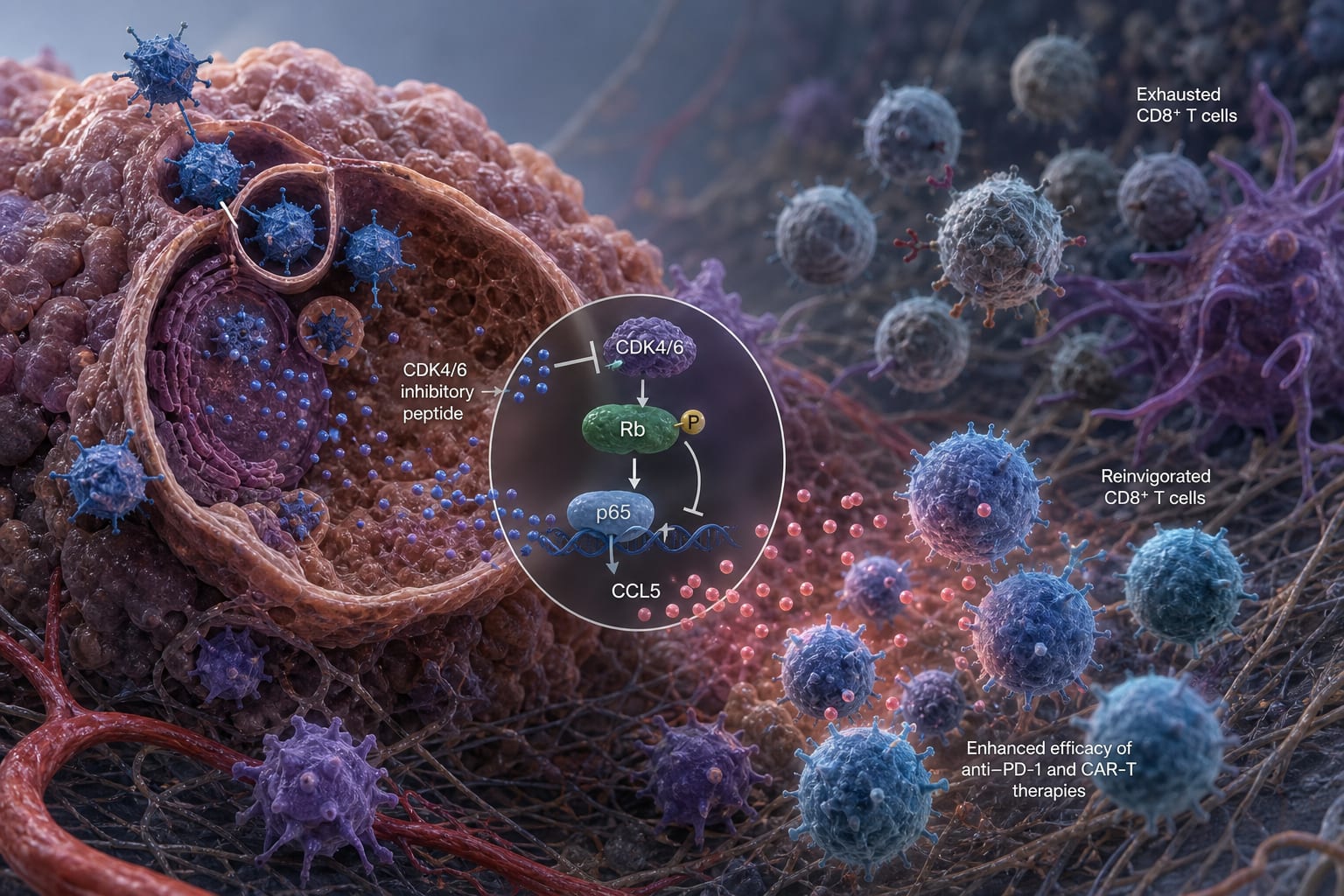
A CDK4/6 inhibitor-armed oncolytic adenovirus reverses T cell exhaustion through the Rb-p65-CCL5 pathway and potentiates the antitumor activity of anti-PD-1 or CAR-T therapy in colorectal cancer - Summary - MDSpire

A CDK4/6 inhibitor-armed oncolytic adenovirus reverses T cell exhaustion through the Rb-p65-CCL5 pathway and potentiates the antitumor activity of anti-PD-1 or CAR-T therapy in colorectal cancer

  • By

  • Dan Zhou

  • Beibei Ran

  • Lingkai Kong

  • Yan Liu

  • Lingjun Xiao

  • Xiangmei Chen

  • Wencui Liu

  • Xiao Li

  • Jing Zhang

  • Jiahui Zhang

  • Hao Wu

  • Guang Zhang

  • Xiaosong Gu

  • Wenjie Zhang

  • Junhua Wu

  • Chunping Jiang

  • June 15, 2026

  • 0 min

Share

Objective:

To engineer an oncolytic adenovirus that mitigates T cell exhaustion and enhances the efficacy of anti-PD-1 and CAR-T therapies in colorectal cancer.

Approach:
    Key Findings:
    • ADV-PTD4-D3 improved tumor control and induced robust antigen-specific immunological memory, suggesting a potential shift in treatment paradigms.
    • The treatment reversed functional exhaustion of CD8+ T cells and enhanced their infiltration into tumors, addressing critical barriers to effective therapy.
    • ADV-PTD4-D3 significantly potentiated the efficacy of PD-1 blockade and CAR-T cell therapy, indicating its role as a valuable adjunct in cancer treatment.
    Interpretation:

    Engineering oncolytic viruses to locally modulate T cell exhaustion pathways may enhance antitumor immunity in colorectal cancer, paving the way for innovative therapeutic strategies.

    Limitations:
    • The study primarily utilized murine models, which may not fully replicate human responses.
    • Long-term effects and potential off-target effects in humans remain to be evaluated, necessitating further clinical investigation.
    Conclusion:

    The findings support the potential of ADV-PTD4-D3 as a strategy to enhance T cell responses and improve outcomes in colorectal cancer treatment.

Original Source(s)

Related Content