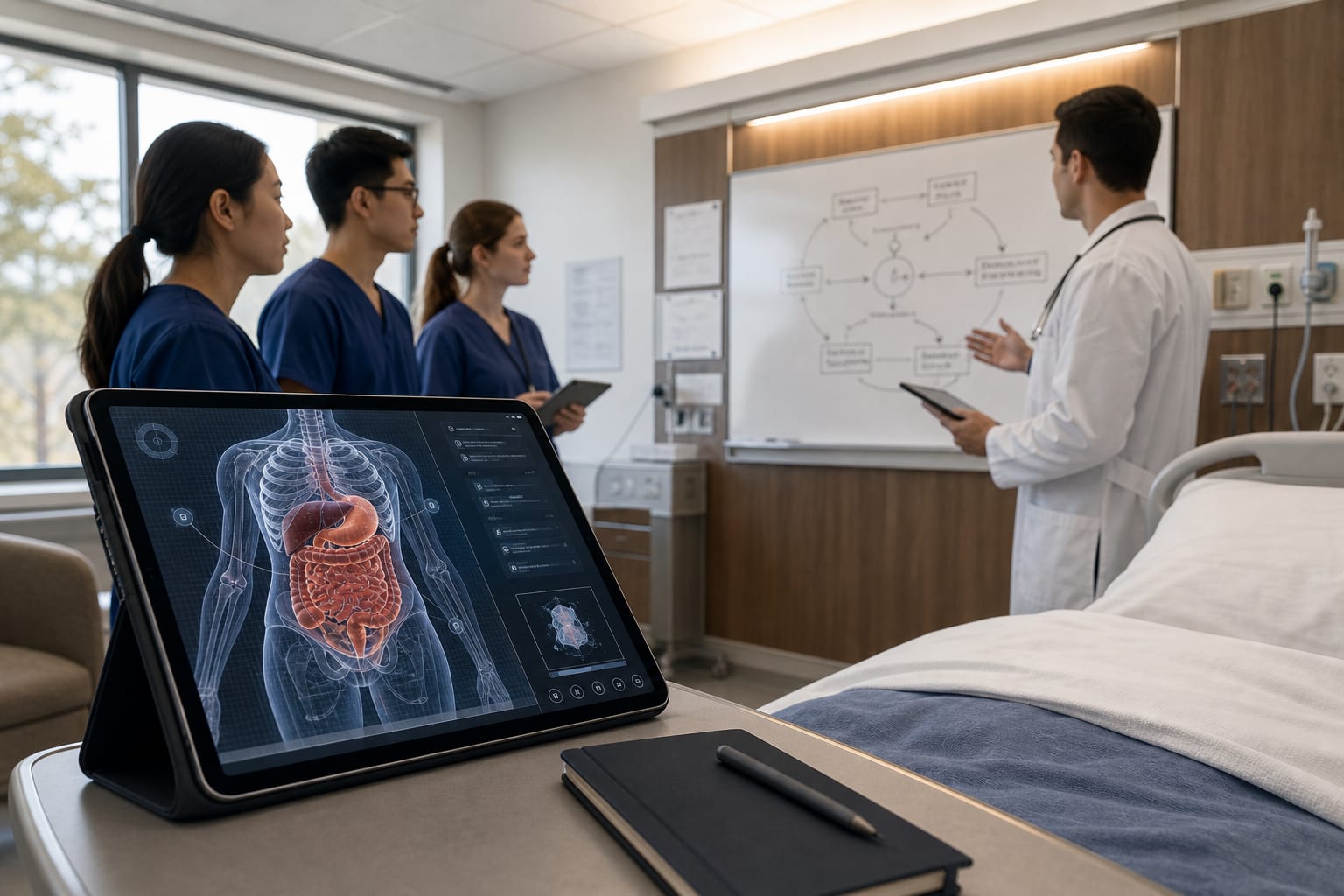
To examine how surgical ward rounds can be redesigned to enhance learner engagement through constructivist learning theories, structured teaching models, and intelligent technologies.
Approach:
Constructivist Learning Theories: Focus on active engagement and knowledge construction rather than passive observation.
Structured Teaching Models: Utilize frameworks like SNAPPS, OMP, and BID to provide systematic approaches to teaching.
Intelligent Technologies: Incorporate generative AI and immersive VR to enhance learning experiences and outcomes.
Key Findings:
SNAPPS may improve clinical reasoning and case presentation quality.
OMP achieves higher learner satisfaction in time-pressed settings.
Generative AI can simulate consultant-level questioning and support learning consolidation.
Immersive VR offers scalable skills training with potential for long-term knowledge retention.
Interpretation:
An integrated framework is proposed that positions educational theory as the foundation, structured models as the methodology, and technology as an empowering tool.
Limitations:
The review is narrative and does not employ systematic search strategies or formal risk-of-bias assessments.
Emerging technologies raise concerns about accuracy, over-reliance, and algorithmic bias.
Conclusion:
The field requires multi-center studies with standardized outcomes and systematic investigation of AI and VR integration with established teaching frameworks.