Development and validation of a 24-h predictive model for hypertriglyceridemic moderately severe acute pancreatitis: a single-center retrospective study - Summary - MDSpire
Advertisement
Development and validation of a 24-h predictive model for hypertriglyceridemic moderately severe acute pancreatitis: a single-center retrospective study
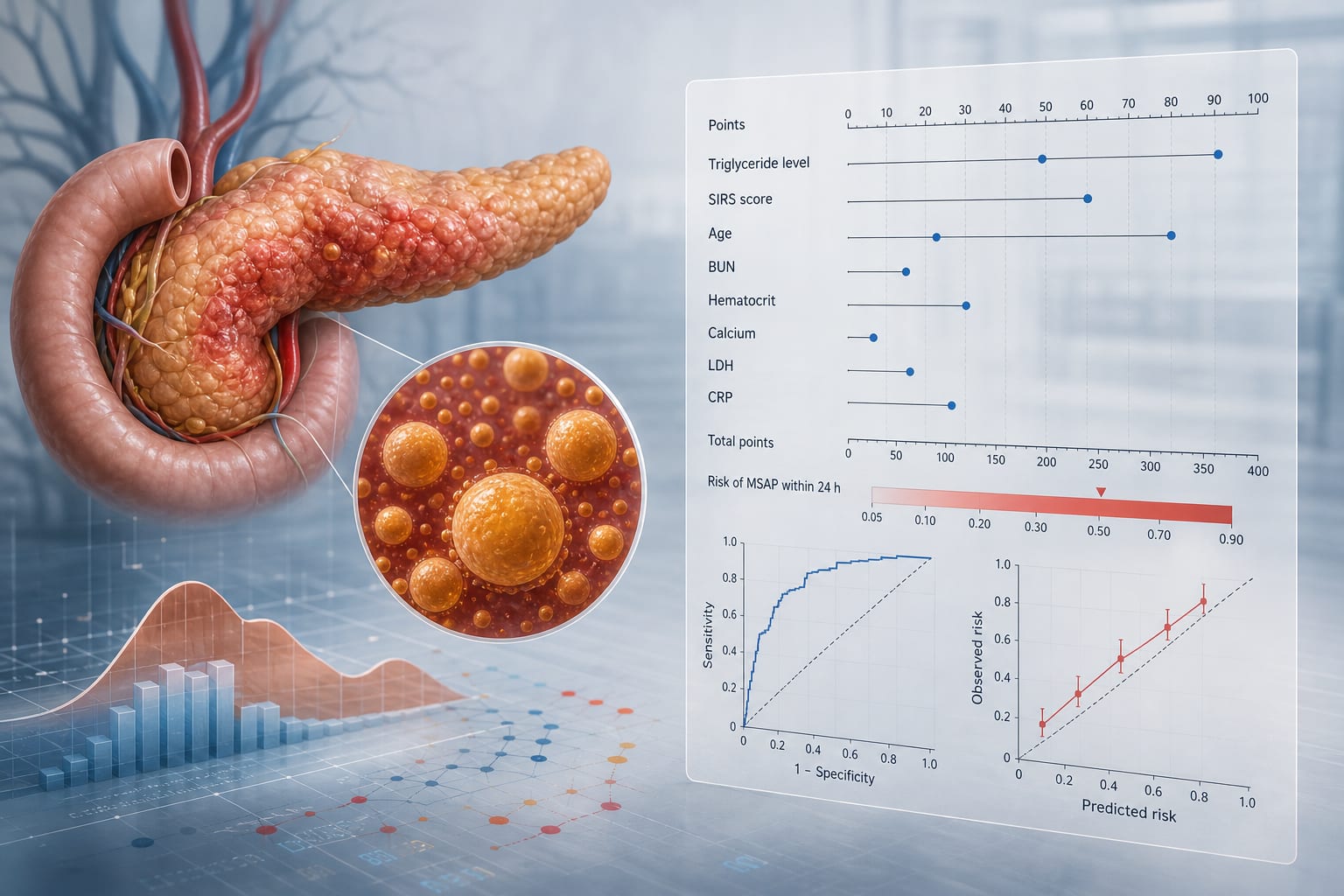
To develop and validate a risk prediction model for identifying patients with hypertriglyceridemia-induced acute pancreatitis who are at risk of progressing to moderately severe acute pancreatitis (MSAP) within 24 hours after admission, thereby providing decision support for early clinical intervention.
Approach:
Study Design: A single-center retrospective study was conducted with 146 patients with HTG-AP, randomly divided into training and validation sets at a ratio of 7:3.
Model Assessment: Model discrimination was assessed using ROC-AUC, and calibration performance was evaluated using the Hosmer–Lemeshow goodness-of-fit test, calibration plots, Brier score, and calibration slope.
Key Findings:
SIRS (OR = 202.469, p < 0.001) and elevated triglyceride levels (OR = 1.066, p = 0.013) were identified as independent risk factors for predicting moderately severe disease.
The prediction model achieved an AUC of 0.909 in the validation cohort, with sensitivity of 86.2% and specificity of 90.9%.
The AUC of the 24-h TG level alone was 0.690, indicating lower predictive performance compared to the combined model. Internal validation was performed using 1,000 bootstrap resamples to estimate and adjust for optimism bias.
Interpretation:
The prediction model based on SIRS and triglyceride levels demonstrates good predictive performance for identifying patients at risk of progressing to moderately severe acute pancreatitis.
Limitations:
The study was conducted at a single center, which may limit the generalizability of the findings.
Further studies are required to validate the effectiveness of the prediction model.
Conclusion:
SIRS and elevated triglyceride levels within 24 hours after admission are independent predictors of progression to moderately severe disease in patients with HTG-AP.