Case Report: Primary sporadic intramedullary malignant peripheral nerve sheath tumor with intracranial extension and a subpial nodule suggestive of early dissemination - Summary - MDSpire
Advertisement
Case Report: Primary sporadic intramedullary malignant peripheral nerve sheath tumor with intracranial extension and a subpial nodule suggestive of early dissemination
To present a rare case of sporadic intramedullary malignant peripheral nerve sheath tumor (MPNST) and its aggressive clinical course, highlighting its occurrence without neurofibromatosis type 1 (NF1) or prior radiotherapy.
Approach:
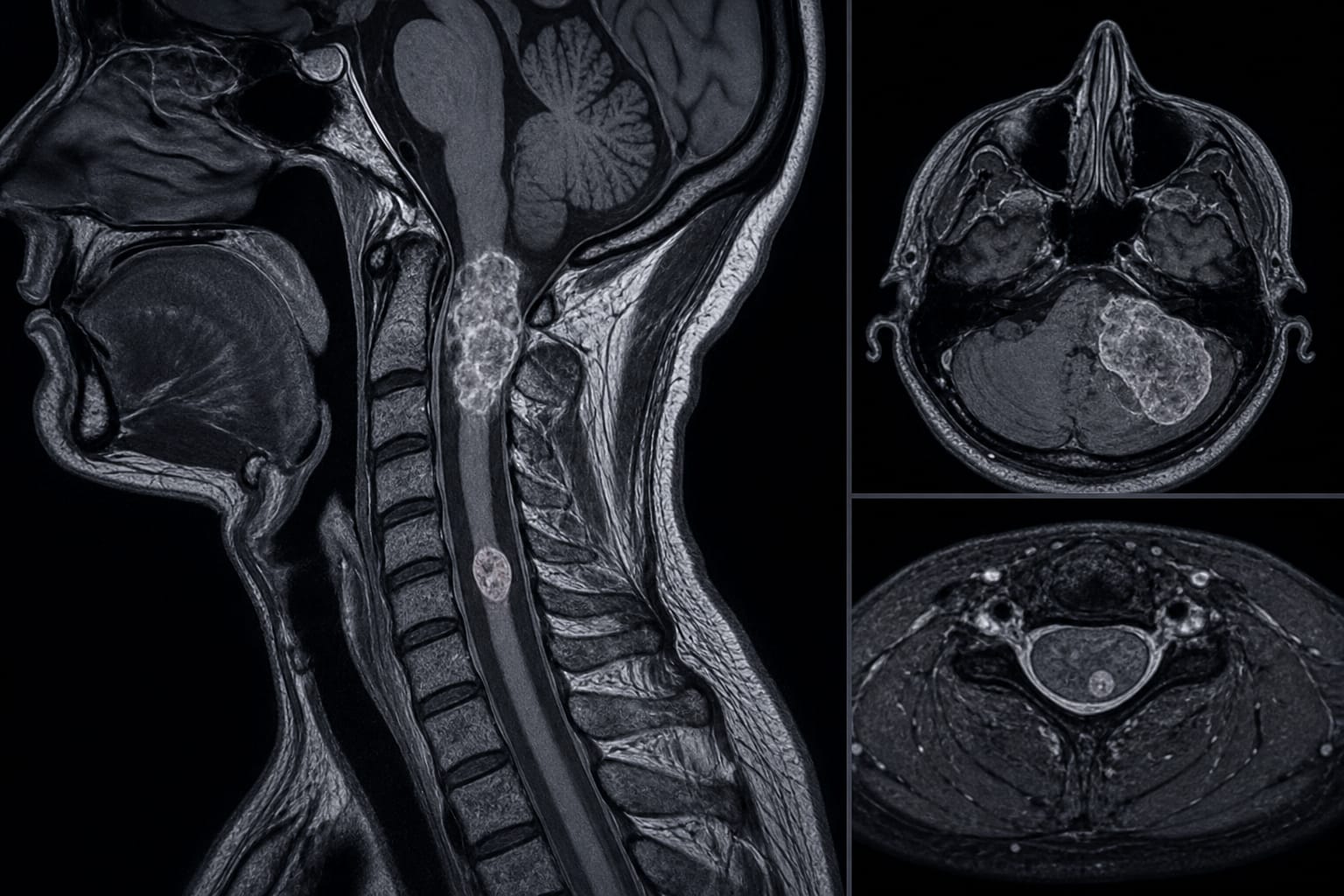
Case Presentation: A 22-year-old male presented with a four-month history of progressive left-sided weakness, gait imbalance, and sensory disturbance. MRI revealed an intramedullary tumor at C2 with intracranial extension and a small dorsal subpial enhancing nodule at C5, raising concern for early neuraxial dissemination. Gross total resection was achieved.
Recurrence: Eighteen months post-surgery, the patient experienced recurrence with left cerebellar extension and rapid clinical deterioration.
Key Findings:
Intramedullary MPNSTs are extremely rare, especially in sporadic cases without NF1 or prior radiotherapy.
The patient exhibited aggressive tumor behavior with rapid progression and recurrence despite gross total resection.
Imaging features suggested early dissemination, which is atypical for MPNST and may indicate a more aggressive clinical course.
Interpretation:
The case highlights the aggressive nature of sporadic intramedullary MPNST and the significance of atypical imaging features.
Limitations:
Limited number of reported cases makes it difficult to generalize findings.
The patient's decision to decline adjuvant radiotherapy may have influenced the clinical outcome.
Conclusion:
Sporadic intramedullary MPNSTs can exhibit rapid progression and recurrence.
Harold Burstein, MD, PhD, and Erica Mayer, MD, MPH discuss results from the TRAK-ER trial, which were presented at the 2026 ESMO Breast Cancer Congress.