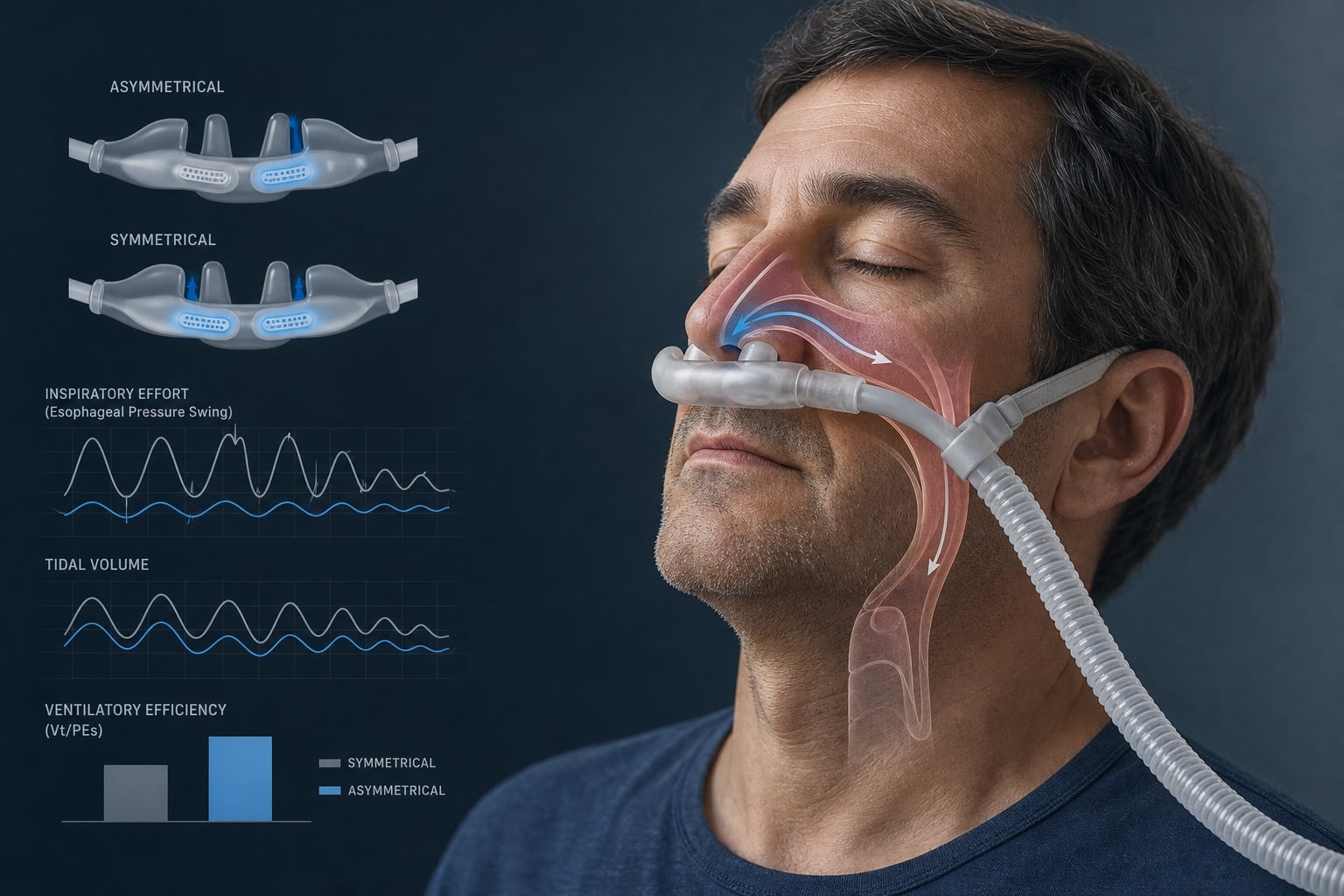
To compare the effects of asymmetrical and symmetrical nasal high-flow (NHF) interfaces on inspiratory workload in clinically stable adults.
Approach:
Study Design: Randomized crossover trial with two NHF interfaces applied to participants in a 1:1 ratio.
Participants: Adults aged ≥ 18 years with clinical stability and SpO₂ ≥95% on room air were included; those with certain respiratory conditions or contraindications were excluded.
Measurements: Esophageal pressure, tidal volume, dynamic transpulmonary pressures, and hemodynamic variables were measured during each NHF interface application.
Key Findings:
Asymmetrical NHF interface resulted in significantly lower pressure-time product (PTPes) per minute compared to symmetrical interface (mean difference of 30.66 cmH₂O·s/min, p = 0.006).
Lower inspiratory esophageal pressure swing (ΔPes) was observed with asymmetrical interface (mean difference of 1.36 cmH₂O, p = 0.038).
Tidal volume (VT) was significantly higher during asymmetrical interface (mean difference of 33.00 mL, p = 0.005).
Respiratory rate and minute ventilation (MV) did not differ significantly between interfaces.
Lower heart rate and mean arterial pressure were noted during asymmetrical NHF.
Interpretation:
Limitations:
Single-center study with a small and heterogeneous sample size.
Brief exposure periods and lack of carbon dioxide measurements.
Estimation of dynamic transpulmonary pressure (ΔPL) using a fixed Paw value.