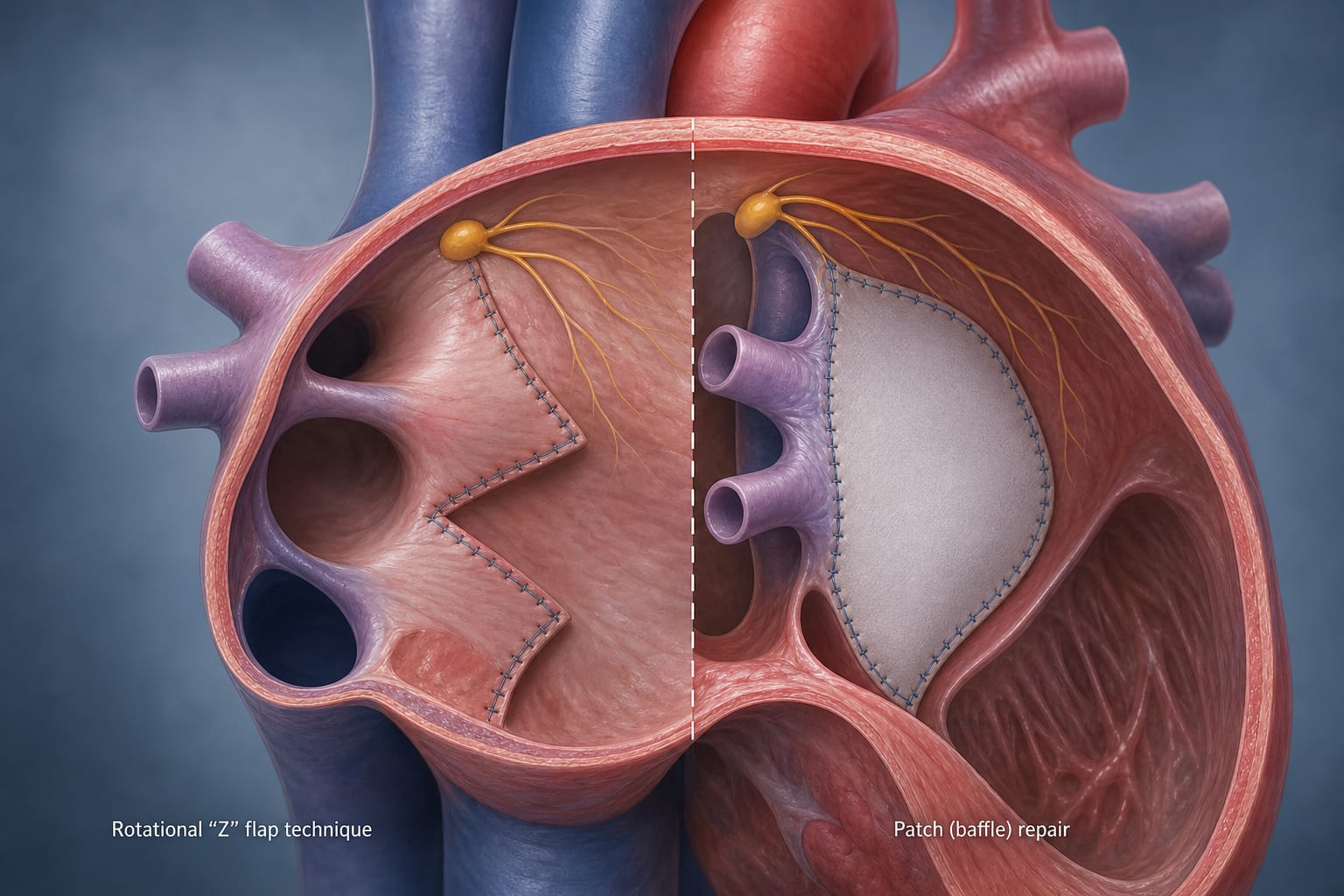
Same-same, but different? Postoperative rhythm disturbances and other analysis after rotational Z-flap vs. patch repair of sinus venosus atrial defects - Summary - MDSpire
To compare the clinical outcomes and incidence of postoperative arrhythmias between two surgical techniques: conventional patch repair and rotational 'Z' flap technique for sinus venosus atrial septal defects, highlighting their clinical significance.
Key Findings:
Operative times were significantly shorter in the 'Z' flap group (182.6 min) compared to the baffle group (209 min), suggesting a potential for reduced surgical risk.
Postoperative rhythm disturbances occurred in 54.5% of the total population, with right bundle branch block being the most frequent (40.1%), indicating a need for careful monitoring.
'Z' flap group had a significantly higher incidence of sinoatrial block with atrio-ventricular junctional rhythm (17.5% vs. 4.3%; p = 0.035), which may influence surgical choice.
No patients required permanent pacemaker implantation, and no significant differences were found regarding residual shunts or superior vena cava stenosis.
Interpretation:
Both surgical methods are effective for SVASD correction, with the 'Z' flap technique being more efficient but associated with a higher risk of postoperative junctional rhythms, which is crucial for surgical decision-making.
Limitations:
The study is retrospective and conducted at a single center, which may limit generalizability and introduce biases.
Exclusion of patients with preoperative arrhythmias may affect the overall findings and applicability of results.
Conclusion:
The 'Z' flap technique is surgically more efficient but carries a higher risk of postoperative junctional rhythms compared to the conventional baffle repair, emphasizing the need for careful patient selection.