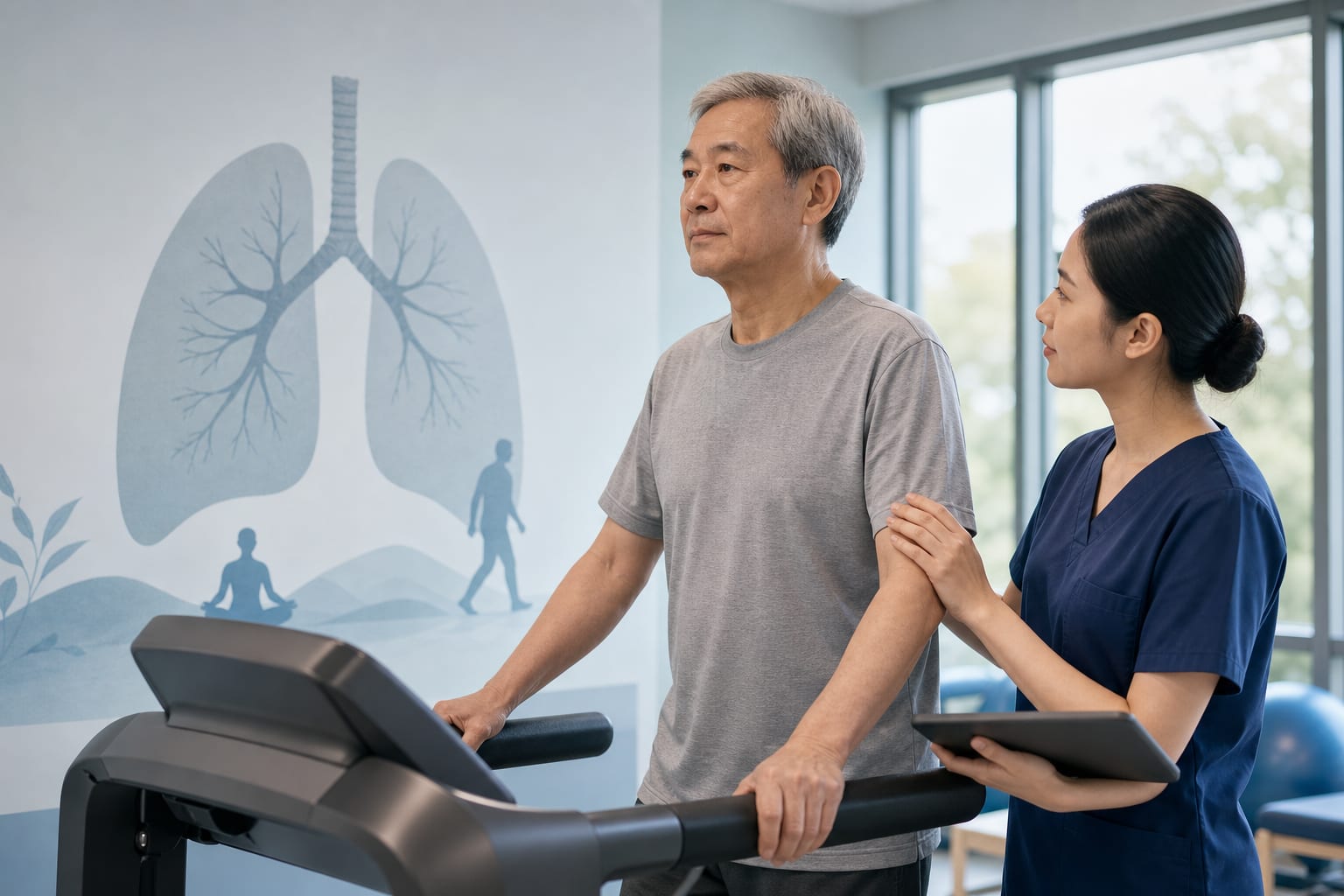
Impact of exercise rehabilitation and behavioral interaction nursing on postoperative quality of life and psychological outcomes in lung cancer patients - Summary - MDSpire
Advertisement
Impact of exercise rehabilitation and behavioral interaction nursing on postoperative quality of life and psychological outcomes in lung cancer patients
To evaluate the association between combined exercise rehabilitation, behavioral interaction nursing, and postoperative outcomes in patients with lung cancer.
Key Findings:
Quality of life scores improved by 27.3% in the intervention group compared to minimal change in controls (P<0.001).
Significant improvements in arterial oxygenation (PaO2 and SaO2) were observed (P<0.001).
Muscle tone recovery showed improvements in upper (48.2%) and lower extremities (55.5%) compared to controls (P<0.001).
Systemic inflammation decreased with a 20.9% reduction in hs-CRP levels (P<0.001).
Depression prevalence decreased by 62.0% and anxiety by 53.3% in the intervention group (P<0.001).
Hope scores increased by 34.5% and self-efficacy improved by 28.5% (P<0.001).
Interpretation:
The combined approach of exercise rehabilitation and behavioral nursing was associated with enhanced multidimensional postoperative recovery in lung cancer patients.
Limitations:
Observational design may introduce unmeasured confounding.
Further prospective randomized controlled trials are essential to establish causality.
Conclusion:
The findings suggest that combined exercise rehabilitation and behavioral interaction nursing may represent a promising comprehensive rehabilitation strategy for lung cancer patients.
Akeso’s PD-1/VEGF bispecific beats PD-1 plus chemo in lung cancer, Amgen wins EC approval for its DLL3-targeted T-cell engager, and Aragen scales Renaissance’s Fast Track anti-GD2 antibody