Dynamic urinary proteomics integrates single-cell and spatial transcriptomics to reveal tumour microenvironment and predict immunotherapy response in biliary tract cancer - Summary - MDSpire

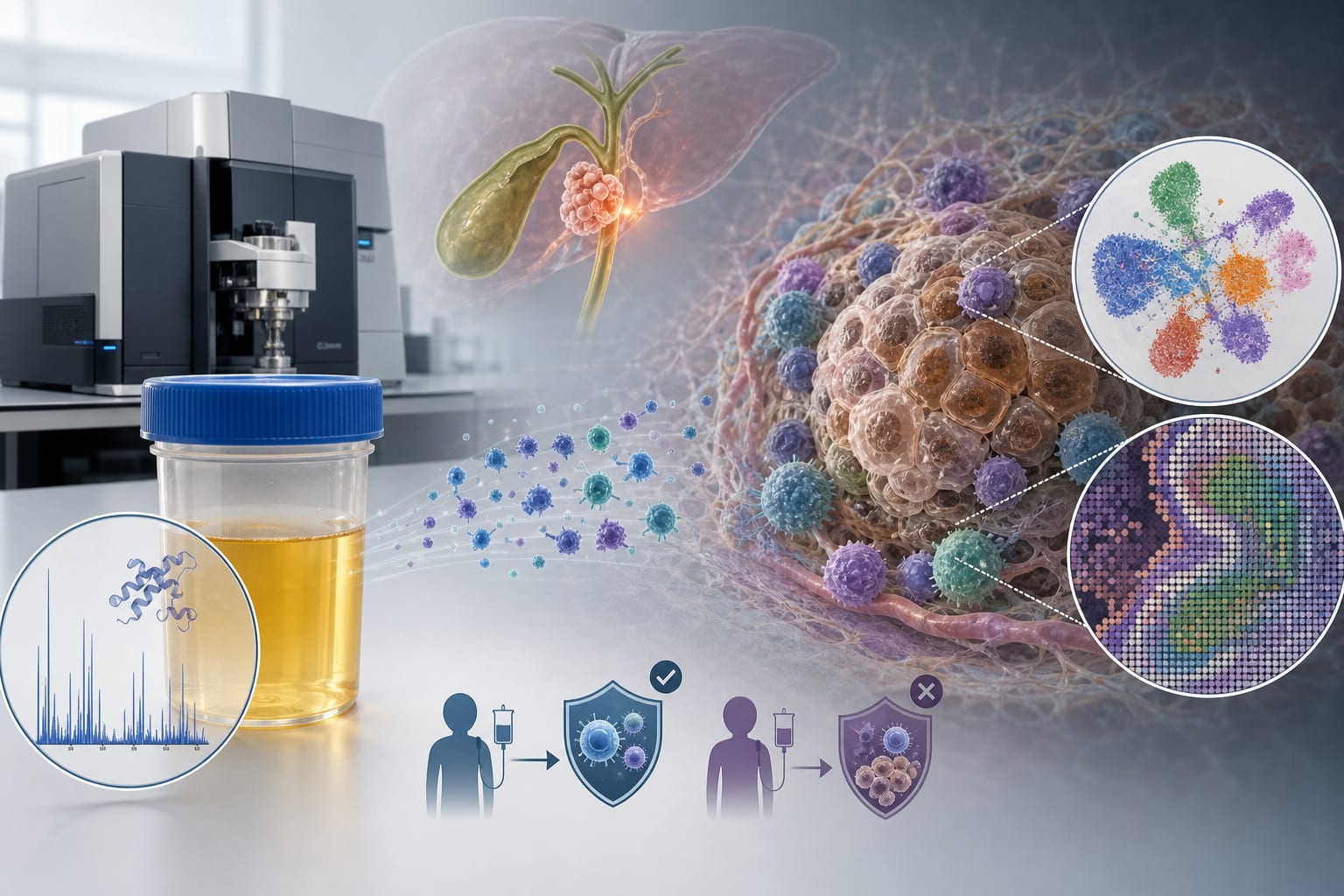
Dynamic urinary proteomics integrates single-cell and spatial transcriptomics to reveal tumour microenvironment and predict immunotherapy response in biliary tract cancer

  • By

  • Shanshan Wang

  • Zhengguang Guo

  • Boyu Sun

  • Kai Liu

  • Jiashuo Chao

  • Ziyu Xun

  • Yunchao Wang

  • Zibo Xu

  • Ziyue Huang

  • Hao Wang

  • Yang Tan

  • Nan Zhang

  • Mingjian Piao

  • Longhao Zhang

  • Chengjie Li

  • Shuofeng Li

  • Jiongyuan Li

  • Haidan Sun

  • Feng Qi

  • Aiwei Wang

  • XiaoBo Yang

  • Chengpei Zhu

  • Hanping Wang

  • Wei Sun

  • Haitao Zhao

  • July 1, 2026

  • 0 min

Share

Objective:

To investigate urinary proteomics as a non-invasive method for predicting immune checkpoint inhibitor (ICI) responsiveness and understanding tumor microenvironment dynamics in biliary tract cancer (BTC), addressing the critical need for reliable biomarkers.

Key Findings:
  • Urinary proteomics provides a non-invasive approach to predict ICI responsiveness and capture tumor dynamics, potentially transforming patient management.
  • Protein tyrosine phosphatase non-receptor 13 is identified as a promising biomarker and potential therapeutic target, highlighting its relevance in enhancing ICI outcomes.
  • The study positions urinary proteomics as a valuable tool for early prediction and monitoring of ICI responsiveness in BTC, paving the way for future research.
Interpretation:

The findings suggest that urinary proteomics can serve as a dynamic biomarker for monitoring immune responses and tumor microenvironment changes in BTC patients undergoing immunotherapy, potentially improving patient outcomes.

Limitations:
  • The study is preliminary and requires further validation in larger cohorts to confirm findings.
  • Potential biases in sample collection and analysis, such as selection bias and variability in urine sample handling, may affect the generalizability of the findings.
Conclusion:

Urinary proteomics may enhance the understanding of ICI responsiveness and tumor dynamics in biliary tract cancer, supporting its role as a non-invasive biomarker with significant clinical implications.

Original Source(s)

Related Content