VHA-guided resuscitation and post-24-hour survival in traumatic hemorrhage: a propensity- matched retrospective cohort study from China - Summary - MDSpire
Advertisement
VHA-guided resuscitation and post-24-hour survival in traumatic hemorrhage: a propensity- matched retrospective cohort study from China
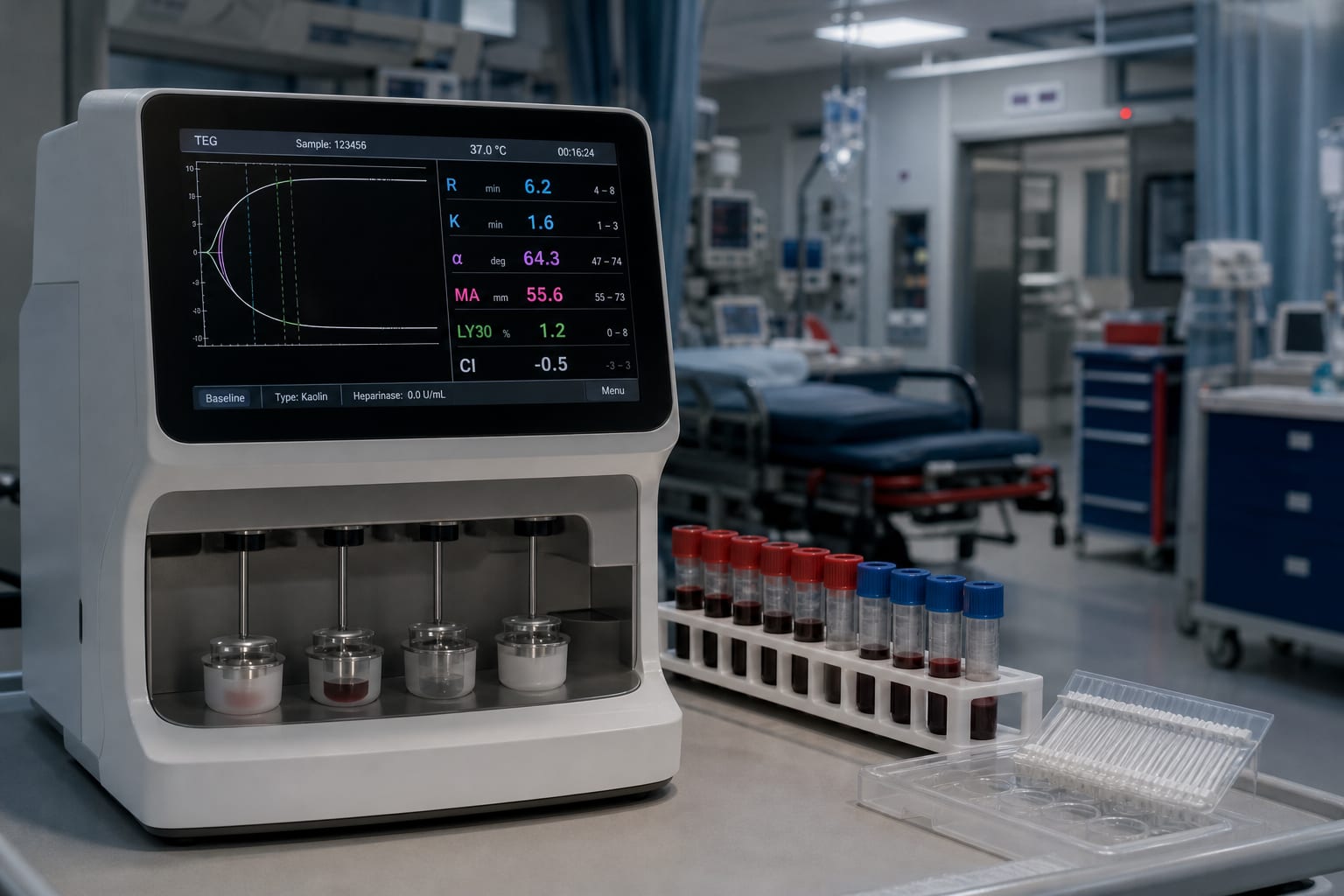
To evaluate the association between implementation of viscoelastic hemostatic assay (VHA)/TEG-guided hemostatic resuscitation and clinical outcomes among transfused traumatic hemorrhage patients who survived at least 24 h after emergency department arrival in China.
Approach:
Data Analysis: Propensity score matching was employed to reduce baseline imbalance among transfused traumatic hemorrhage patients who survived at least 24 h.
Key Findings:
A total of 154 patients who survived at least 24 h were included after propensity score matching, with 77 patients in each group. Post-24-h in-hospital death occurred in 21 of 77 patients in the CCA-guided group and 9 of 77 patients in the VHA-guided group.
Kaplan–Meier analysis indicated improved post-24-h in-hospital survival in the VHA-guided group (log-rank P = 0.015).
VHA-guided resuscitation was associated with a lower hazard of post-24-h in-hospital death (adjusted HR 0.37, 95% CI 0.16–0.84, P = 0.018).
The VHA-guided group exhibited reduced plasma utilization and greater fibrinogen-directed replacement compared to the CCA-guided group.
Interpretation:
VHA-guided hemostatic resuscitation was associated with improved post-24-h in-hospital survival and better coagulation management in transfused traumatic hemorrhage patients.
Limitations:
The study design was retrospective and before-after, which may introduce survivorship bias.
Residual confounding may affect the findings.
The study cannot determine the impact of VHA-guided resuscitation on survival during the initial 24 h.
Conclusion:
VHA-guided hemostatic resuscitation was associated with improved outcomes in patients who survived beyond 24 hours.